 ™
™A Stingray Got Your Foot. Here's the Hot Water, the Barb, and the Four-Day Clock
The lifeguard's bucket is the medicine, not the comfort — stingray venom comes apart in heat. The soak runs 30 to 90 minutes, the barb can stay behind where only an X-ray finds it, and how the wound looks on day four decides whether you also need a doctor.
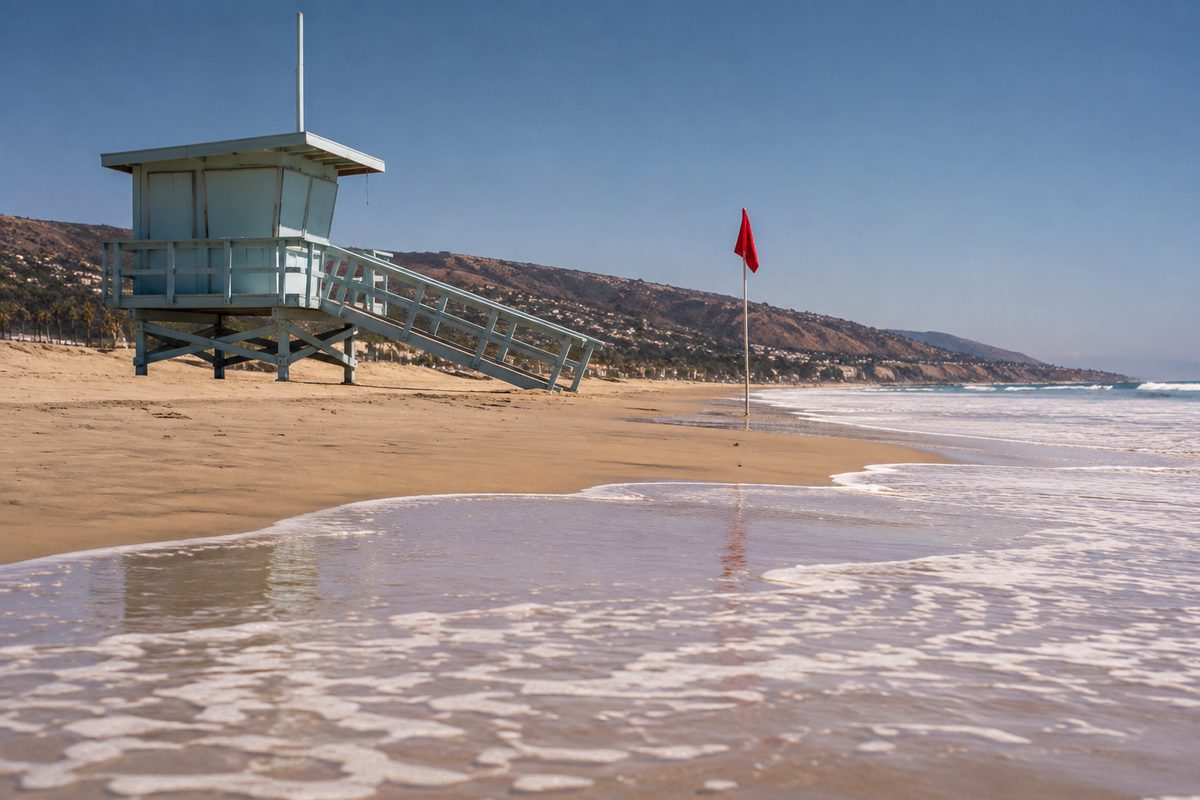
The bucket is not a kindness. It is the treatment. Stingray venom is heat-labile — heat takes it apart — which is why the first thing a lifeguard does is put your foot in water hot enough to be unpleasant and then leave it there for a long time. The National Institutes of Health's clinical review of stingray injury says the immersion should begin as soon as possible, "ideally in the field by lifeguards or paramedics," and in a hospital it runs 30 to 90 minutes without interruption. You are wondering whether you can cut that short because the pain is easing. The pain easing is the water working, and the answer is no.
You're reading this because warm water brings the rays in with it. The Associated Press's Amy Taxin reported in August, in a story LAist published Aug. 13, that Bolsa Chica and Huntington State Beaches had logged more than 3,100 stingray incidents in 2026 by then — twice what they recorded in all of 2025 — and that San Diego's beaches counted more than 900 in the first half of 2026, more than in the first six months of any of the previous five years. Chris Lowe, who directs the Shark Lab at Cal State Long Beach, told the AP that Southern California lifeguards can treat 10,000 stingray injuries in a year, and that the round stingray is "really a subtropical species that is thriving at the end of its range because of climate change." Bryan R. Etnyre, the state park superintendent for northern Orange County, put it to the AP more plainly: the water has been "consistently staying in the 60s," and he does not think there was a week all winter that dropped below 60.
Two caveats before the steps, because you deserve both. First, those counts are Orange County's and San Diego's. Los Angeles County publishes no comparable running tally, so nobody — including us — can tell you how many people get stung at Zuma or Dockweiler in a summer. Second, this page reports published guidance from the county and the medical literature, each item linked. It is a map of what the agencies and the studies say, and it does not replace the person at the tower who is looking at your actual foot.
What we could measure ourselves, we did. We pulled the two nearest public water-temperature gauges on the morning of Friday, Aug. 14: NOAA's tide station at the Santa Monica pier read 68.0°F at 9:18 a.m., and the Scripps waverider buoy moored offshore in Santa Monica Bay read 22.6°C — 72.7°F — at 8:56, taken half a meter below the surface. The two disagree by nearly five degrees, which is what you would expect from a pier gauge and an open-water buoy. Both are warm, and warm shallow sand is exactly where a round stingray spends a summer afternoon.
Step 1. Walk to the tower. Do not drive home.
L.A. County Fire's Lifeguard Division answers this one in a single sentence on its own FAQ page: "Go straight to a lifeguard for treatment." The division covers 72 miles of sandy beach and open water across eleven cities plus Catalina, and it keeps a stingray information handout it gives to people it has already treated. The reason to walk rather than drive is the clock in the injury itself: the NIH review notes that the pain climbs to its maximum within 30 to 90 minutes and can last up to 48 hours. Thirty minutes from now you will be less able to make decisions than you are right now, and the hot water is at the tower, not at your house.
The county's standing beach-safety advice is to swim near an open lifeguard station and to ask the lifeguard about conditions before you get in. That advice reads like boilerplate right up until the afternoon it decides how far you have to limp.
Step 2. The soak, and the temperature rule nobody tells you
Hot, not scalding — and the test is not your injured foot. The NIH review is specific: the water "should be heated to a temperature that will not result in burns, and the temperature should be tested on a non-affected extremity, as the patient may have impaired sensation on the injured extremity." A stung foot is a bad thermometer. Use the other one, or a hand.
How long is a real question with a real answer. A prospective study of 22 stingray patients treated on-site, published in the Journal of Emergency Medicine in 2018 by a University of California, San Diego team including Dr. Christanne Coffey, found the average immersion ran 73.6 minutes, with a range of 35 to 145. Mean pain scores fell from 7.36 before the soak to 2.18 after — an average drop of 5.18 points on a 10-point scale. That is the whole case for sitting there: the treatment is boring, it takes over an hour, and it works.
Step 3. What the hot water does not do
It does not remove anything. Stingray barbs are serrated, they break, and pieces stay behind — and the NIH review notes that barbs are radiopaque, meaning a plain X-ray will show one. There is no agreed standard for when to image; in one retrospective review of 119 California emergency-department cases, 57% of patients got radiographs and a foreign body turned up in only two of them. So the honest version is: most stings leave nothing behind, and the only way to know yours is one of them is a film.
The rest of the wound care is unglamorous and easy to skip. Irrigate it. Ask about your tetanus status and update the shot if it is due — the review says so in as many words. Small wounds are generally left open to close on their own rather than stitched shut, because closing a puncture over marine bacteria is how you get an infection. On antibiotics there is no clear consensus; some clinicians reserve prophylaxis for deep penetrating wounds, and when antibiotics are used, coverage is aimed at Vibrio along with Staphylococcus and Streptococcus. That is a conversation for a clinician, not a beach.
Step 4. The four-day clock
Here is the number to write on your hand, because it starts after everyone has gone home. Dr. Coffey, who researches these injuries at UC San Diego Health, told the AP that most stings need no further medical attention — but that if redness and swelling are still going four or five days later, something else is happening: an infection, or a barb fragment that an X-ray would find. In her team's own 22-patient study, six people still had symptoms or complications at the three-day follow-up, one was diagnosed with cellulitis on day eight, and no wound smaller than a centimeter developed any complication at all. Wound size did the predicting. If yours is small and quiet four days on, that matches the data. If it is red and angry four days on, that also matches the data, and it is the half that needs a doctor.
When it is 911 instead
Almost every stingray injury in Los Angeles is a foot or an ankle, and almost every one of them ends at a bucket. The exceptions are the reason the exceptions exist. The NIH review directs clinicians to an EKG, cardiac monitoring, labs and a chest X-ray for a patient with an injury to the chest or abdomen or with severe systemic symptoms — nausea, vomiting, fainting, shortness of breath, seizures — and to transfer to a facility with intensive-care capability if there is concern for severe systemic illness. Ongoing bleeding, a deep puncture, or pain that will not settle are also on its referral list. You do not need to memorize that. You need to know that a sting to the torso is a different event from a sting to the foot, and that it is a call, not a walk.
The prevention is one word, and it is not "careful"
Shuffle. Do not lift your feet as you wade; slide them, so a buried ray feels you coming and leaves. L.A. County Fire's lifeguards were pushing the stingray shuffle publicly as early as April, when the division warned that stings were rising with the water temperature and that the animals bury themselves in shallow sand where swimmers step on them, per the Santa Monica Mirror's April 11 report. The NIH review describes the same technique and adds two more: probe the sand ahead of you with a stick or pole, and if you are a diver, stay off the seafloor. It also says something anglers should read twice — do not try to untangle a stingray from a net or a line yourself.
You're wondering about jellyfish. It is the opposite drill.
This is the mistake worth heading off, because the two hazards showed up in the same county advisory this year and the treatments point in different directions. For a jellyfish sting, L.A. County Fire's lifeguard FAQ says to avoid touching the site and to let a lifeguard treat it, usually with a mixture of vinegar and saline. The City of Malibu, in the advisory the Mirror quoted, was blunter about the thing people get wrong: "DO NOT wash with fresh water." Fresh water can set off the stinging cells that have not fired yet. Hot fresh water is the correct answer to a stingray and the wrong answer to a jellyfish, and the two animals are in the same three feet of surf.
One last number, because it explains why this feels bigger than the record says
The NIH review puts the United States at roughly 750 to 2,000 stingray injuries reported annually. Lowe told the AP that Southern California lifeguards alone can treat 10,000 in a year. Both figures can be true, and the gap between them is the point: the review itself notes that many people with minor stingray injuries never present to a health-care facility and are handled in the field by first responders. The national number counts hospitals. The regional number counts buckets. If you have ever spent an hour at a tower with your foot in one, you are in the second number and not the first — which is another way of saying the system worked exactly as designed, and nobody wrote it down.
Comments 0