 ™
™Your Landlord Won't Make the Repair. Here's the L.A. Complaint That Starts the Clock.
Filing costs nothing and takes one call. What decides everything is whether the inspector sees the problem.
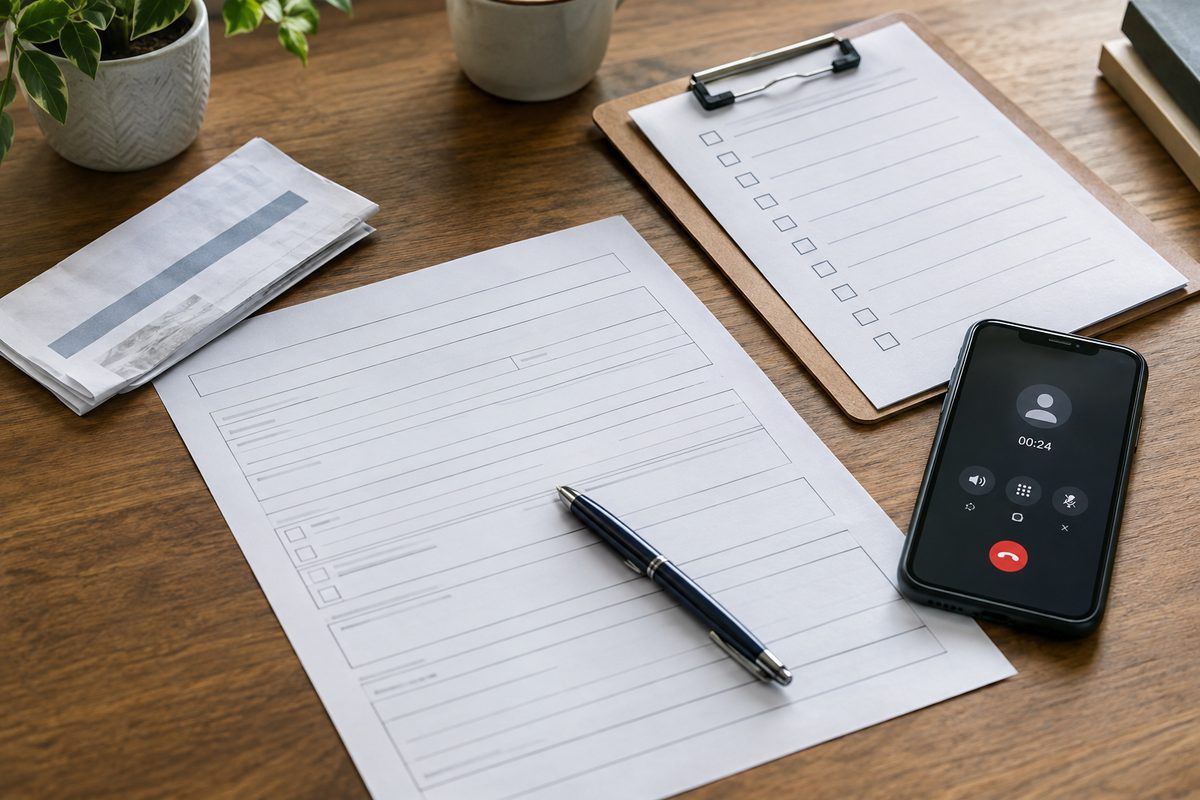
You told the landlord. Nothing happened. You're wondering whether calling the city does anything at all, or whether it only makes things worse at home — and the honest answer is that it does one specific thing, which is worth understanding before you dial. A city inspector who sees the problem writes an order to your landlord. That written order is the hinge. It starts a repair clock, it is what puts a building into the program that cuts its rents, and under state law it is the document that can stop a landlord from lawfully collecting rent at all. Without it, you have a complaint. With it, you have a record.
Reporting a violation in the city of Los Angeles is free, and the Los Angeles Housing Department — LAHD, the agency that inspects rental housing here — says on its own tenant page that anyone can report one — you don't have to be the tenant, and there is no charge. Three routes: the hotline at (866) 557-RENT (7368), the department's online complaint form, or a walk-in at one of its four regional public counters.
Here is the whole path, step by step, read this week off the city's and the county's own pages.
Step 1: Find out which agency is actually yours
This is the step people skip, and skipping it costs weeks. Three different agencies handle habitability in Los Angeles County, and which one is yours depends on the shape of your building and the line your street sits on.
The Los Angeles Housing Department takes your complaint if you rent in the city of Los Angeles and the property has two or more residential units on the lot, with at least one of them rented. LAHD's inspections and fees page lists what that covers: apartment buildings, duplexes, two single-family homes on one lot, residential hotels, and any property carrying an accessory dwelling unit or a junior accessory dwelling unit — an ADU or JADU, in the city's shorthand. What it doesn't cover is also listed: owner-occupied units, vacant properties, and hotels, motels, inns and tourist homes.
If you rent a single house in the city — one dwelling on the lot, no second unit, no ADU — you are outside the Los Angeles Housing Code, and LAHD is the wrong number. Its complaint form says so on the page before you fill anything in: for a property with only one dwelling, a residential condominium, a commercial building or a vacant lot, call the Department of Building and Safety at (888) LA4-BUILD, which is (888) 524-2845, or use 311. That single sentence redirects a large share of renters in this city, and it is printed where almost nobody reads it.
If your address is in an unincorporated area — a neighborhood with a Los Angeles mailing address and no city government of its own — neither city agency has jurisdiction. LAHD's page points those callers to (877) 966-CODE (2633). The county's own habitability program publishes a different number for conditions inside a rental unit: the Department of Public Health's Environmental Health call center at (888) 700-9995. For a leak, a rodent problem or no heat, that second number is the one that reaches the program that inspects for it. If you aren't sure which side of a line you live on, the county program's own question-and-answer page sends readers to the Public Works Service Locator to check, and it's worth checking before you spend an afternoon on hold.
And if you rent in one of the county's other cities, LAHD's instruction is the same one it gives everyone outside its jurisdiction: contact that city's own code enforcement agency directly. Nothing on this page is that city's rule.
Step 2: Tell the landlord first, in writing
LAHD's tenant page puts this before the complaint: tell your landlord about the problem, and if the repair doesn't come in a reasonable time, then contact the department. That ordering isn't just politeness. Two separate state remedies are measured from the date you gave notice, and an email or a text with a date on it is the cheapest evidence you will ever create.
Under California Civil Code section 1942, a tenant who gave notice of a condition that makes the place untenantable, and whose landlord neglected to fix it, may repair it and deduct the cost from the rent — but only where the repair costs no more than one month's rent, and not more than twice in any twelve-month period. The statute adds a useful presumption: a tenant who acts after the thirtieth day following notice is presumed to have waited a reasonable time. That presumption is rebuttable, and it runs from your notice, which is why the notice needs a date.
Step 3: The hotline is anonymous. The web form is not.
This is a real choice and the two routes are not equivalent.
What the form requires: the online complaint form states that you must provide your name, a contact phone number, and the address of the property. It also states what happens to that information — your name and phone number are kept confidential and not released to the public, and LAHD uses them to call you and schedule the inspection.
What the form warns: one line on that page decides more cases than any other. "If you do not return or answer our calls after 3 attempts, your complaint will be closed as nonresponsive." Three missed calls from an unfamiliar number and your case is gone. If you file online, answer the phone.
If you don't want to give a name, the form itself tells you what to do instead: call the hotline at 1-866-557-RENT (7368). The trade-off is that a complaint about a condition inside your own unit needs someone to let the inspector in, so anonymity and an interior inspection don't easily coexist.
One thing LAHD states plainly on its complaint page, and it is the reason a lot of Angelenos never file: the department says it is not affiliated with federal immigration authorities, that it will never ask about your immigration status, and that assistance is available to all Angelenos regardless of status.
On how fast you hear back, the city's own pages disagree with each other, and we'd rather print the disagreement than pick a winner. LAHD's tenant page and its inspections page both say that if you give a contact number, you'll be contacted by phone within 72 hours. The complaint form says every effort will be made to respond to your request within 24 hours. Plan on the 72.
Step 4: One word decides which queue you land in
LAHD sorts complaints into exactly two buckets, and its inspections page gives the definitions and the examples. This is the part where how you describe the problem genuinely changes what happens next.
An urgent complaint is any condition posing a serious risk to health or safety, or a present, imminent, extreme and immediate hazard to life or limb. The department's own examples: no hot water in the unit, no heat during winter season, illegal construction in progress.
A non-urgent complaint is everything else. Its examples: inoperable windows, leaky faucets, peeling paint.
You're wondering whether that means you should call everything urgent. It doesn't — the inspector classifies what they find, not what you said. What it means is that if your problem genuinely belongs in the first list, say the words that put it there. "There's been no hot water since Tuesday" is an urgent complaint by the city's own definition. "The water heater isn't great" is not.
A narrower and faster category sits above both. Under the Urgent Repair Program, a violation that the agency determines breaches Civil Code 1941.1 or Los Angeles Municipal Code 57.107.6 and amounts to a present, imminent, extreme and immediate hazard gets a Two-Day Order to Repair: the owner has two days to commence the work. LAHD lists the conditions that trigger one — leaking gas pipes, sewage overflows, unprotected swimming pools, loose or missing guardrails, blocked emergency openings, exposed live electrical wiring, and no hot water.
Step 5: The inspection is the entire case
Everything else on this page depends on one afternoon, and the rule that governs it is blunt. LAHD's tenant page: on the day of the initial complaint inspection, if the alleged violations are not observed by the inspector, the case is closed. Not paused. Closed.
So the practical instructions are these. Be there, or arrange for another responsible adult to be there — the department requires it for any complaint about a condition inside a unit, and the person reporting has to provide access. Make the condition visible before the inspector arrives: an intermittent leak that isn't leaking at 10 a.m. is a closed case at 10:05. Walk the inspector through everything, not only the thing you called about, because the order can only cite what gets seen.
Don't expect a report you paid for to do the work for you. The city's rule is the one above — what the inspector doesn't observe isn't on the order — and the county writes the same principle down in so many words: third-party inspection reports, a private mold assessment being the common example, are not accepted as evidence of a violation or of compliance. The inspector's own observation is the only currency here.
Step 6: The order, and the thirty days after it
If the inspector observes violations, a written order goes to the owner, and a copy is posted at the property. The compliance period is generally 30 days.
After the compliance date, an inspector re-inspects. Corrected, and the case closes. Not corrected, and the owner may be referred onward — to a General Manager's hearing, into the Rent Escrow Account Program, and/or to the City Attorney's office for prosecution. LAHD's 2023 bulletin on the Systematic Code Enforcement Program — the routine inspection round every covered building gets — adds a detail owners feel: after a General Manager's hearing, a substandard order may be recorded against the property, and the owner is required to pay for all subsequent inspections.
On extensions, the current page is stricter than the reputation. LAHD says inspection staff can grant an extension of time only after the first re-inspection has been conducted on schedule and staff determine that significant progress is being made. An owner who does nothing for 30 days is not supposed to get more time for doing nothing.
If the two-day order is the one that was issued and it expires without compliance, the city can do the repair itself. LAHD sends a city-approved contractor to bid and then directs the work. The costs become a personal obligation of the owner, and they arrive with a surcharge: an amount equal to 40 percent of the cost of the actual work, to cover the city's cost of administering the contract and supervising it. LAHD may file a lien with the County Recorder to collect.
What REAP actually does to the rent — and it's arithmetic, not mood
The Rent Escrow Account Program is where a building goes when the orders don't get answered. Every summary of it, including the city's, describes a rent reduction of "10% to 50% depending on the nature and severity of the violations cited," which reads like a judgment call. It isn't one. We read all nineteen pages of the governing regulation, Rent Adjustment Commission Regulations section 1200.00, last amended March 7, 2024, and the number comes out of a table.
Section 1200.07 lists fifteen violation categories — nuisance conditions, structural hazards, fire warning devices, exiting, fire protection equipment, hazardous storage, failure to test or certify, failure to manage or secure, sanitation and infestation, weather protection, maintenance, electrical, plumbing and gas, heating and ventilation, and illegal construction. Each one scores 10 percent at low severity, 15 at medium, 20 at high. The regulation then says the total reduction for a unit is the sum of the category percentages.
That is why the range tops out where it does. Three high-severity categories reach 60 percent on their own, and the regulation caps a unit's reduction at 50 percent — while requiring that the calculation still show what the total would have been without the cap. Two other numbers bound it: rent can never be reduced below $50 a month, and where the violations are of a nature likely to affect all the units, the reduction applies to all of them, not only the unit that complained. A repeat-offender clause can push the reduction up by as much as half again, where the same owner had another property in REAP within the prior 36 months, owns more than four residential units in the city, and that other property sat in REAP for more than twelve months.
Once a property is in, the program brochure sets out what follows. The reduced rent may be paid either to the landlord or into an escrow account LAHD opens, and paying it on time to either one satisfies the rent obligation in full. A notice goes on the property's title with the County Recorder. The owner is billed a $50 administrative fee per unit per month for as long as the building stays in, and must attend a REAP workshop within six months. A tenant outreach provider is assigned at no cost — the four the brochure names are the Coalition for Economic Survival, Inner City Law Center, Inquilinos Unidos and Strategic Actions for Just Economy.
The escrow money is not a rebate that shows up in your mailbox. Owners, tenants and third parties apply for it, and the renters' page names what it can be released for: making repairs, paying utilities, or relocating to a new apartment. Getting out takes a City Council vote — every cited violation signed off, no open orders left with Building and Safety, the Fire Department, county Public Health or the Department of Water and Power, and the water and power bills paid. Rents are restored and the escrow account closes 30 days after the Council acts.
The county runs a different program with the same name
If your address is unincorporated, almost none of the numbers above are yours. We compared the two systems page by page, and the county's is younger, stricter in places, and priced differently.
The Board of Supervisors enacted Chapter 8.53 of the county code on April 23, 2024, creating the Rental Housing Habitability Program, run by Public Health's Environmental Health division. It inspects every rental unit in the unincorporated areas once every four years. The scope is wider than the city's in the way that matters most to a lot of readers: it covers properties with two or more rental units and tenant-occupied single-family homes. The single house that falls outside the city's Housing Code is inside the county's program.
The complaint timetable is written down rather than implied: an inspector contacts the tenant within three days of the complaint and schedules the inspection within seven. Violations go on an Official Inspection Report, the landlord gets 21 days from the compliance date, and the re-inspection happens within five business days after that date. An extension of up to 30 calendar days is available for significant progress. Fail, and the case goes to the County Housing Program Chief, who can request an administrative hearing to put the property into the county's own REAP.
That county REAP lives in Chapter 8.55 and is run by the Department of Consumer and Business Affairs, not Public Health. Placement is decided by a hearing officer at the Office of County Hearing Officer, recorded with the Registrar-Recorder, and billed at $137 a month per property or unit — against the city's $50 — with the owner required at a workshop within 30 days rather than six months. The annual inspection fee differs too: the county charges $86 per unit on the property tax statement, half of it passable to the tenant at $3.58 a month, where the city's Systematic Code Enforcement Program fee — the charge that funds those routine inspections — is $67.94 a unit with a $2.83 monthly pass-through. One more line from the county FAQ is worth carrying: retaliation against tenants for exercising their rights under Chapter 8.53 is prohibited.
What a complaint does not do
Three things, stated plainly, because the gap between them and what people expect is where the disappointment lives.
It does not cut your rent by itself. Only placement in REAP does that, it comes after an order was ignored and a hearing was held, and the reduction takes effect on the date of the hearing officer's decision — not the date you complained.
It does not pay you anything. No part of the city process writes a tenant a check. The escrow account is not yours; it is a fund you can apply against for specific purposes.
It is not permission to stop paying rent. This is the one to be careful with. Civil Code section 1942.4 bars a landlord from demanding rent, collecting rent, issuing a rent increase or serving a three-day pay-or-quit notice when four conditions all hold: the dwelling substantially lacks the habitability standards of section 1941.1 or has been declared substandard; a public officer responsible for enforcing housing law has inspected and notified the landlord in writing; the conditions have gone 35 days past service of that notice without being abated, and without good cause; and the tenant didn't cause them. A landlord who violates it owes actual damages plus special damages of not less than $100 and not more than $5,000, and the prevailing party gets attorney's fees — a claim the statute says may be brought in small claims court where it fits inside that court's dollar limit, and one you need not try any other remedy before using.
Read what that statute constrains. It tells the landlord what they may not do, and it gives the tenant a claim for damages in front of a judge. It does not hand a tenant a self-help right to withhold. Whether a delay was "without good cause" is decided by a court on the facts, not by you at the kitchen table, and a tenant who stops paying on the strength of it is making a bet, not exercising a clear right. That gray zone is real and this page isn't going to smooth it over. What is not in doubt is condition number two: it requires an inspection and a written notice from a public officer. That is the thing a code complaint produces, and it is the whole reason to file one before you need it.
Do it in this order
Today: look your building up. LAHD's Property Activity Report takes an address, an assessor's parcel number or a case number and returns what the department's own system holds on the property. If there are already open orders, you are joining a case rather than starting one, and you should say so when you call.
Then: text or email the landlord, describe the condition in one sentence, and keep the timestamp. That date is what the thirty-day presumption in section 1942 runs from.
If nothing moves: file. Two or more units in the city of Los Angeles, call (866) 557-RENT or use the online form. One house in the city, call (888) 524-2845 or 311. Unincorporated county, call (888) 700-9995. Another city, call that city.
Use the right word. No hot water, no heat in winter, or construction going on without permits is an urgent complaint by the city's own definition. Gas, sewage, exposed wiring or a missing guardrail can be a two-day order. Say the condition, not your opinion of it.
Then answer your phone. Three missed calls closes the file. Be home for the inspection, have the problem visible when the inspector walks in, and show them everything — because what the inspector doesn't see that day doesn't exist on the order, and the order is the only part of this that has teeth.
Comments 0