 ™
™L.A. County's Election Mailer Names Three Dates. Four More Decide Whether Your Ballot Counts.
The registration cutoff, the postmark rule, and the signature deadline that runs three weeks past Election Day — with the statute behind each one.
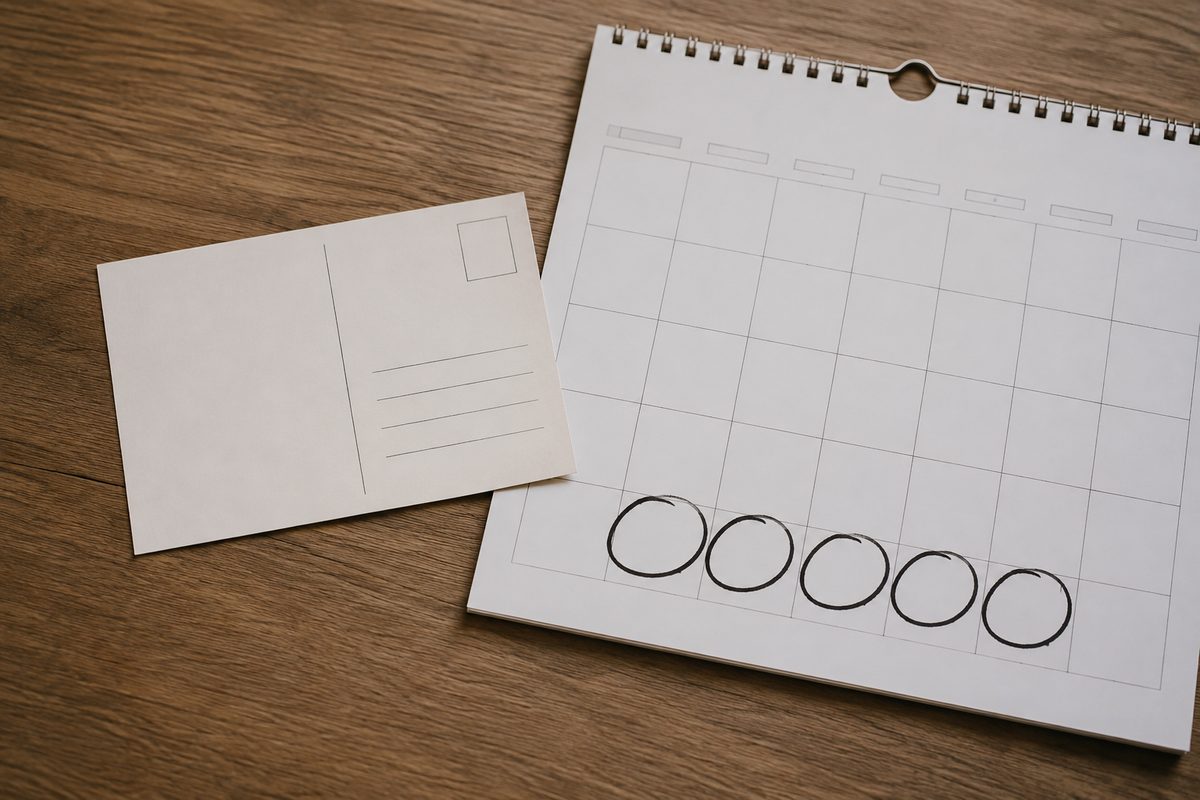
The postcard showing up in Los Angeles mailboxes right now is real, it is not a solicitation, and everything printed on it is true. It is also, by design, a card about how the election opens rather than how it closes. The Registrar-Recorder/County Clerk announced on August 21 that roughly 4.8 million registered voters would get one, translated into 18 languages, with a second, expanded mailer going to about 1 million newer registrants who currently receive their election materials in English. Three dates are on it. You're wondering whether the card is enough to go on. It is enough to start with, and four more deadlines — none of them on the card — are the ones that decide whether your ballot is counted after you fill it out.
So here is the whole calendar for the November 3 general election, in the order it happens, with the rule that sets each step. We read the county's own news release, the Secretary of State's official key-dates calendar for this election, its two-page voter Quick Facts, and the two sections of the California Elections Code that govern when a mailed ballot arrives too late and when a signature can sink it. Every hard edge below is written down somewhere, which is the good news: a deadline in a statute is a deadline you can quote back.
What the mailer says
The county's release lists exactly what the postcard highlights, and it is four bullet points carrying three dates. Vote-by-mail ballots begin going out to every registered voter no later than October 5. Official ballot drop boxes open the same day. Vote centers open October 24 and stay open through Election Day, November 3. And you may return a ballot by drop box, by mail, or in person at any vote center in the county — which is worth knowing on its own, because Los Angeles does not assign you a polling place you have to find.
"Providing voters with clear and accessible information early is an important part of preparing for the General Election," Registrar-Recorder/County Clerk Dean C. Logan said in the release. The card also points to PLAN.LAVOTE.GOV, and to a text line — send PLAN to LAVOTE, which is 528683 — for a personalized voting plan. The expanded version going to newer registrants adds a Language Request Form, which is how you change the language your ballot and materials arrive in.
One note on what this page can and cannot tell you: we are describing the mailer from the county's published description of it, not from a card in hand. If the postcard in your mail carries a date this piece says is missing, the card wins.
Step 1: October 19, the date the card doesn't carry
The county's calendar starts on October 5 because that is when it starts mailing things. Yours starts earlier. The Secretary of State's key dates and deadlines for this election put the "last day to register to vote for the general election" on October 19, fifteen days before Election Day. Registration and updates go through registertovote.ca.gov, and the state's Quick Facts sheet notes that paper forms sit in post offices, county elections offices and libraries.
Missing October 19 is not the end of it, and this is the single most useful thing on this page. From October 20 through November 3, the state calendar provides same-day registration — "Conditional Voter Registration" in the statute, which the Secretary of State describes as "a safety net for Californians who miss the deadline." You go to any vote center, polling place or the county elections office, register there, and vote a provisional ballot on the spot. The state says those ballots "will be processed and counted once the county elections office has completed the voter registration verification process." What it costs you is the convenience of a ballot arriving at your house, and a slower count.
The date that decides whether you get mail at all, then, is October 19. The date that decides whether you can vote is November 3. They are not the same date, and only one of the two is on the card.
The three that matter
October 19. Register or fix your registration by then and the ballot comes to you. After that you can still vote — you have to go get the ballot instead.
The postmark, not the arrival. A mailed ballot is timely if it is postmarked by November 3. The county has a week after that to receive it.
Your signature. It is checked against your registration record, and if it doesn't match, you have until 5 p.m. on November 25 to fix it. Nothing on the card says so.
Step 2: The postmark is the deadline. The arrival is a different date.
This is where the state's own two documents will appear to disagree with each other, so it is worth taking slowly. The Quick Facts sheet lists "All ballots must be returned" on November 3, with an asterisk explaining that ballots returned by mail must be postmarked on or before November 3. The key-dates calendar lists November 10 as the day by which mailed ballots "must be postmarked on or before Election Day and received by your county elections office." Both are right. One is the deadline for you; the other is the window for the mail.
Elections Code section 3020 is the sentence underneath both. Subdivision (a) says ballots must be received by the close of polls on Election Day. Subdivision (b) then carves out the exception that covers almost every mailed ballot in California: it is timely if the elections official receives it "no later than seven days after election day" and it was postmarked on or before Election Day. Seven days after November 3 is November 10. The county says the same thing in plainer words on its own vote-by-mail page, citing the same subdivision.
The statute also handles the case that ruins ballots: no postmark, or an illegible one. Under 3020(b)(2), a ballot with no usable postmark still counts if the county date-stamps it on receipt and the identification envelope was signed and dated by you on or before Election Day. That is why the date line next to your signature is not decoration. Fill it in.
Two practical consequences follow, and the state says both out loud. Quick Facts recommends mailing the ballot at least seven days before Election Day, and — if you are mailing it closer than that — taking it into a post office and asking a clerk for a manual postmark. And if you are done deciding, skip the mail: you may hand your ballot to any drop box or polling location in California by 8 p.m. on November 3. Los Angeles County ran more than 400 drop boxes for the June primary, mapped at locator.lavote.gov.
Step 3: Your signature is the second ballot
The envelope is checked before the ballot inside it is ever opened, and that check is a real screen, not a formality. LAist reported in the run-up to the June primary that Los Angeles County runs envelopes past scanning devices that compare the signature to the one on file, pulling mismatches and blanks out for human review, and that most California counties reject something on the order of 1 to 2 percent of ballots. In the 2024 general election, LAist reported, roughly 21,300 ballots in Los Angeles County and 13,600 in Orange County were rejected — for signature problems and other reasons both.
The law is friendlier than that number sounds, and it is worth knowing which way it leans before you worry. Elections Code section 3019 starts from a presumption that the signature is yours and the vote will be counted. It states that an exact match is not required, and that shared characteristics are enough to call a signature valid. It bars officials from looking at your party preference, race, ethnicity or gender while comparing. It requires them to weigh explanations for a discrepancy, including that handwriting changes over a life and that people sign in a hurry. Substituting initials for a first or middle name is specifically not grounds for a mismatch, and a mark such as an X is presumed valid. Orange County Registrar of Voters Bob Page put the standard plainly to LAist: the signature "doesn't have to be an exact match."
And a rejection is not one clerk's call. Under 3019(c), a flagged signature is rejected only if two additional elections officials each find, beyond a reasonable doubt, that it differs in multiple, significant and obvious respects from every signature in your registration record.
What the notice says, and what it means
What it says: "the signature you provided on your vote by mail ballot does not compare with the signature(s) on file." What it means: a machine and then at least three people looked, and the ballot is being held, not thrown away. It is fixable by returning one form.
What it says: return the signature verification statement "as soon as possible." What it means: there is a hard date printed further down the same notice, and the county is required to fill it in. Read past the urgency to the date.
What it says: "I understand that my failure to sign this statement means that my vote by mail ballot will be invalidated." What it means: the fix is a signature, so an unsigned fix form fixes nothing. This is the one line on the form that can undo the whole errand.
Step 4: November 25, 5 p.m. — three weeks after the election is over
Section 3019 tells the county to mail you a notice, with a postage-paid return envelope, by the next business day after it decides your signature doesn't compare — and to also call, text or email you if it has any of those on file, leaving a voicemail if you don't pick up. The notice and instructions must be translated into every language the county is required to provide under Section 203 of the federal Voting Rights Act.
Then subdivision (j) sets the clock, and it is the deadline nobody publicizes. For a regularly scheduled statewide election, the county's notification deadline is 14 calendar days after the election and the receipt deadline for your statement is 22 calendar days after the election. Counting from November 3, that is a notice you should have by November 17 and a signed statement the county must have in hand by 5 p.m. on November 25. Run the same arithmetic on the June 2 primary and it lands on June 24, which is a useful sanity check against the date the county prints on the notice itself.
You do not have to mail it back. The statute lets you deliver the statement in person, by mail, by fax, by email, or by any other electronic means the county offers — and it lets you drop a completed statement into a drop box or hand it in at a polling place any time before the polls close on Election Day, if you are quick enough to have gotten one by then. There is no waiting period built in: once your statement arrives, the law tells the county to compare the signature immediately rather than hold it for the end of the canvass.
One boundary is worth stating plainly, because it is the reason the deadline is absolute. Under 3019(h), a ballot cannot be rejected for cause once its envelope has been opened — and the envelope isn't opened until the signature clears. Miss November 25 and there is no later step; the county writes the cause of rejection on the face of the envelope and the ballot stays sealed. The last day for county officials to certify the results is December 3.
Voting in person, and what the county hasn't announced yet
Vote centers open October 24 and run through November 3, and any of them will take you: Los Angeles is a Voter's Choice Act county, so there is no assigned precinct. The state's calendar has all counties opening ballot drop-off locations by October 6 — a day later than the county's own October 5 promise, which is the state's floor rather than a contradiction.
How many vote centers, and where, has not been published for the general election. For scale, and only for scale: for the June 2 primary the county opened 524 additional vote centers on the Saturday before, for a total of 646, running 10 a.m. to 7 p.m. on early days and 7 a.m. to 8 p.m. on Election Day itself. Those are June's numbers and June's hours. The general election's site list will post at locator.lavote.gov; check it rather than assuming last time's location is open again.
Bring these, and do these
A signature you can repeat. The one on your registration is the one you are being compared to. If yours has drifted, updating your registration before October 19 updates the comparison.
The date next to the signature. Section 3020(b)(2) makes it the backstop for a ballot the Postal Service failed to postmark legibly.
A tracking sign-up. The state runs "Where's My Ballot?" at wheresmyballot.sos.ca.gov, which sends text, email or voice updates as your ballot moves. The county's own status tool updates nightly, and voterstatus.sos.ca.gov answers the plain question of whether your vote was counted. This is also the cheapest way to learn you have a cure notice coming.
A working address on file. Every notice in Step 4 is mailed first-class to the address in your registration record. A stale address is how a fixable ballot becomes a rejected one.
The part worth remembering
Three dates are printed on the card. Four are not, and the four are the ones that decide whether a ballot you have already filled out ends up in the count. October 19 decides whether a ballot comes to you at all. November 10 is the last day one postmarked on time can still arrive. November 17 is the last day the county can mail you word that your signature didn't compare. November 25, at 5 p.m., is the last minute you can answer that letter — and the letter that starts the clock is a piece of first-class mail that looks like nothing much. None of it chases you. All of it is written down.
Dates, deadlines and code sections above were checked on September 2, 2026 against the Los Angeles County Registrar-Recorder/County Clerk's August 21 news release, the California Secretary of State's key dates and Quick Facts for the November 3, 2026 general election, and Elections Code sections 3019 and 3020. The vote center and drop box figures are the county's published figures for the June 2, 2026 primary and are not the general election's; the county has not published that count. The linked sources win over this page, which is re-verified and updated in place at this address.
Comments 0