 ™
™Santa Monica Wants Red-Light Cameras at Two Intersections. No Intersection Topped Three Severe Crashes.
Santa Monica logged 214 serious crashes in five years, spread so widely its own report says hot spots aren't the fix.
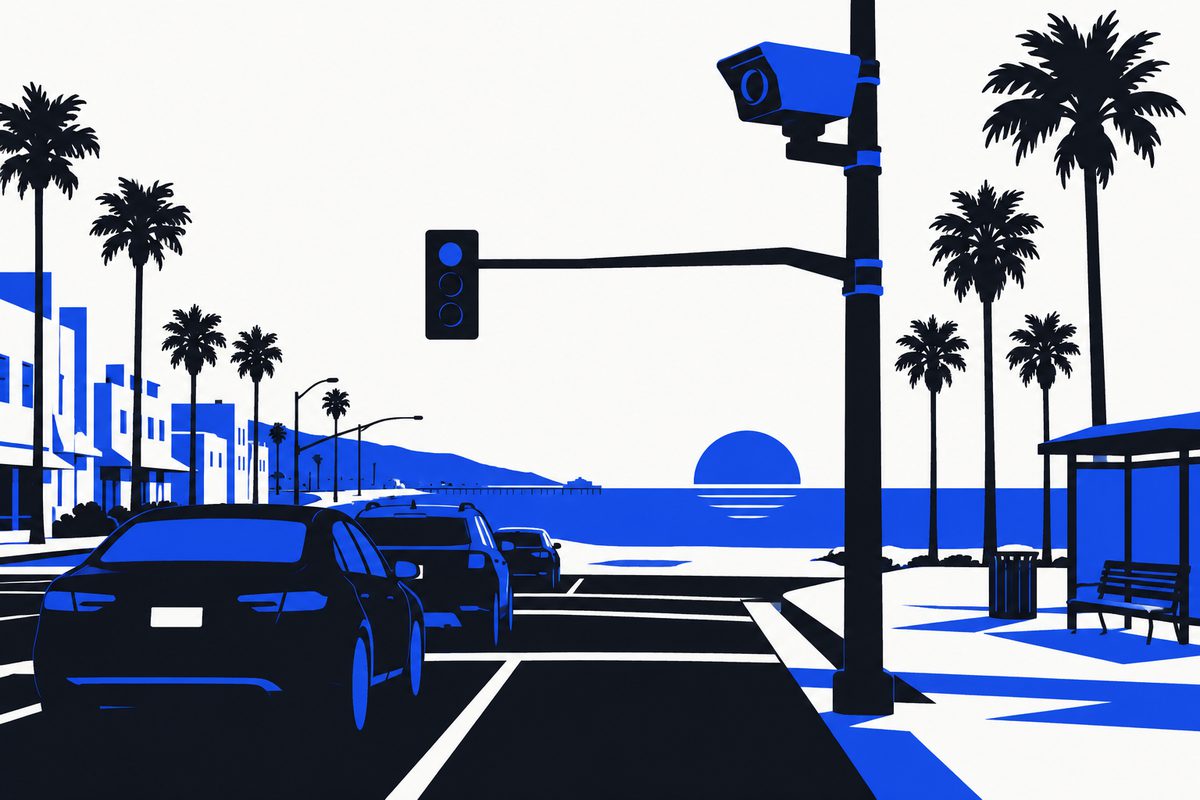
Item 10.A on the Santa Monica council agenda for September 8 is three subsections of municipal code that would let a camera write you a ticket. The ordinance adds Section 3.12.540 to the city's code and authorizes an automated traffic enforcement system to catch drivers running red lights. The first ticket is $100. It goes to whoever the car is registered to rather than whoever was driving, and it doesn't put a point on anybody's license.
What's in front of the council is smaller and larger than two cameras at once. It's smaller because the item is a first reading, and the two intersections still don't have names: the staff report says site selection is still underway and a vendor still has to be procured. It's larger because the ordinance isn't written for two locations. Staff says plainly that it “is intended to enable a citywide ATES Program rather than implement enforcement at a fixed number of locations,” with authority to “evaluate, select, add, remove, or relocate” sites later.
The whole thing runs on a statute that's eight months old.
What the state changed
California has allowed red-light cameras since the 1990s under Vehicle Code Section 21455.5, and that version is a criminal-side instrument: a moving violation, issued to an identified driver, carrying DMV points. Senate Bill 720, by Sen. Angelique Ashby and chaptered in October 2025, left that section alone and built a parallel one next to it. Section 21455.9 is civil. The vehicle is liable, not the driver, and the statute says a violation recorded this way “shall not result in the department suspending or revoking the privilege of a violator to drive a motor vehicle or in a violation point being assessed against the violator.” Ashby's office calls it the Safer Streets Program, an opt-in any city or county can take.
The money is capped in the code rather than set by the city. Santa Monica's staff report reproduces the ladder: $100 for a first violation with nothing in the previous three years, $200 for a second, $350 for a third, $500 for a fourth or beyond, and $50 for a first late fee. The council would adopt those numbers separately, through an amendment to the city's fines resolution, at some later meeting.
Then there's the apparatus the statute bolts on around the ticket, and it's the part that makes SB 720 a different animal from the cameras Los Angeles took down. A jurisdiction “shall reduce the applicable fines and penalties by 80 percent for indigent persons, and by 50 percent for individuals up to 250 percent above the federal poverty level.” It has to offer indigent recipients a payment plan with installments “of no more than twenty-five dollars ($25)” a month. Cameras have to sit in locations “that are geographically and socioeconomically diverse.” Before a single citation goes out, the program runs “only warning notices for 60 days,” after a public announcement made “at least 30 days prior.” The program is operated by a local department of transportation, which is why this item arrived from Public Works and not from the Police Department.
Revenue has a leash on it too. It goes first to program costs, and the city has to keep spending at least what it averaged on traffic calming across the 2020-21, 2021-22 and 2022-23 fiscal years. Anything above that is restricted to approved safety purposes. Staff's summary of all this is one sentence: “the program should be viewed primarily as a safety initiative rather than a revenue source.”
Los Angeles ran this experiment and quit
Fifteen years ago the city next door decided automated red-light enforcement wasn't worth keeping. Los Angeles had cameras at 32 intersections and the ticket was $480. The problem was never the photographs. The Los Angeles County Superior Court declined to enforce the citations, which meant it wouldn't hold up a vehicle registration or send an unpaid ticket to a credit bureau, and the program cost the city more to run than it brought in. “They'll send you a note that you owe the money,” Councilman Paul Koretz said of the court, as CBS Los Angeles reported in July 2011. “But they'll never actually make you pay, and they won't put it on your credit.” The council phased the program out that summer.
SB 720 answers the 2011 objection at the front end by making the penalty civil, and the paperwork cheaper, and the ticket about a fifth of the size. It says much less about the back end. We read Section 21455.9 for the collection language and found one clause: where a penalty is unpaid and an appeal has gone against the driver, the processing agency “may, promptly after the decision becomes final, proceed to collect the civil penalty.” No registration hold, no tax offset, no named mechanism. What happens to a $100 civil fine that somebody simply ignores is a question the statute leaves to the city, and Santa Monica's staff report doesn't answer it either.
The city's own crash data doesn't point at two intersections
The camera ordinance isn't traveling alone. Item 11.B is a Vision Zero study session, and it contains the five-year crash accounting the cameras are meant to answer. Between 2021 and 2025, Santa Monica recorded 214 fatal or severe-injury crashes: 21 fatal, 193 severe. Seventy-seven involved a pedestrian and 31 involved a bicyclist. Of the 21 people killed, 20 were walking or riding.
Here is where the report gets awkward for a two-camera program. Those 214 crashes were, in its own words, “widely dispersed throughout the City, with no single intersection seeing more than 3 FSI crashes.” Six intersections hit three. Another 29 had two. No corridor carried more than 12 percent of the total, and the three worst are long ones: 26 crashes along Ocean Avenue, 26 along Santa Monica Boulevard, 22 along Pico. The conclusion staff draws from that spread is a sentence that sits on the same agenda as a vote on cameras at two intersections: “This dispersion indicates that the City's remaining safety challenge cannot be resolved through a small number of hot-spot projects, and instead requires a systematic approach across the entire network.”
The report also breaks out what actually caused the crashes it can attribute, and running a red light isn't on the list. For pedestrian crashes where a driver was at fault, the leading factors were pedestrian right-of-way violations by the driver (23), other hazardous movement (8) and unsafe speed (7). For bike crashes where a driver was at fault, improper turning (5) and driving under the influence (3). Signal violations don't appear in either breakdown. The camera item makes its case on the general point instead, that red-light running “is a significant contributing factor in severe right-angle and turning collisions at signalized intersections,” and cites no Santa Monica count behind it.
None of which means the cameras won't work. It means the city's own analysis and the city's own enforcement proposal are pulling in different directions on the same agenda, and nothing in an enabling ordinance requires anybody on the dais to reconcile them.
A deadline the city already missed
Santa Monica adopted its Vision Zero commitment on February 23, 2016, inside the Pedestrian Action Plan, and set itself a target: zero fatal and severe-injury crashes by 2026. It's 2026. “The City did not achieve the adopted goal,” the report says, in those words.
The trend line under that sentence is doing two things at once. Total serious crashes fell from 62 in 2024 to 52 in 2025. Pedestrian crashes went the other way, in every single year of the period, from 9 in 2021 to 22 in 2025. The council's February 10, 2026 direction to staff, the one that produced both items, told them to prioritize human life over vehicle throughput.
Culver City never turned its cameras off
The nearest working comparison is one city over. Culver City has run red-light cameras under the old statute since 1998, at 12 intersections, and its council unanimously approved a five-year agreement with the vendor Verra Mobility for up to $4,554,000 in September 2024. That program issued 41,573 citations in 2023 alone. It also reports that violations fell 12.6 percent between 2017 and 2023 against a potential volume increase of 33.7 percent, and the item went to Culver City's council under the Police Department's name, because under Section 21455.5 that's whose program it is.
Santa Monica's staff report cites that same 12.6 percent as its evidence, and dates the Culver City program to 1999. Culver City's own announcement says 1998.
Forty-one thousand tickets in one year, out of twelve intersections, is the number worth sitting with. Under the statute Culver City uses, each one is a moving violation with a point attached. Under the statute Santa Monica is reaching for, the same photograph produces a $100 civil bill and a clean driving record.
What has to happen before anyone gets a bill
A first reading is the first of several votes, and staff lists the rest of the sequence. Candidate intersections have to be selected against objective safety criteria. The council has to adopt findings that automated enforcement is needed at each one. An ATES impact report has to be completed and approved, covering, per the statute, civil liberties impact, fiscal cost and location justification. The city has to write procedures for citation review, hearings, payment plans, privacy protections and records retention. Signs have to go up. Then 60 days of warnings. A contract award comes back to the council separately, and the ordinance itself takes effect 30 days after adoption, which is still a second reading away.
Staff is also asking the council for something it can't use yet. The third recommended action is to direct staff to monitor state legislation on automated speed enforcement and to move if Santa Monica ever becomes eligible. It isn't now. Assembly Bill 645 named a short list of jurisdictions for speed cameras and Santa Monica wasn't on it, while Los Angeles was: LADOT says it will install 125 speed safety systems and launch the pilot in late summer or fall of 2026, with a 60-day warning period and citations starting at $50. We laid out all four of the county's speed camera programs and their calendars last month. Santa Monica's route to a camera runs through the one law that didn't pick favorites.
The council was scheduled to take the first reading up at its 5:30 p.m. meeting on September 8. The result wasn't in the city's public record when this published, and the sequence doesn't change either way: a second reading, the site findings, the impact report and the contract award are each their own vote on their own night, and the warning notices don't start until all of them are done. The two intersections still don't have names.
Sources: Santa Monica City Council agenda for September 8, 2026, items 10.A and 11.B, and the text of SB 720, all retrieved September 8, 2026. The agenda was also covered by the Santa Monica Daily Press and the Lookout.
Comments 0