 ™
™LADWP's October Rates Charge Light Users More and Heavy Users Less
Tier 1 and Tier 2 now cost more than at any point this year, and the Tier 3 summer premium is gone.
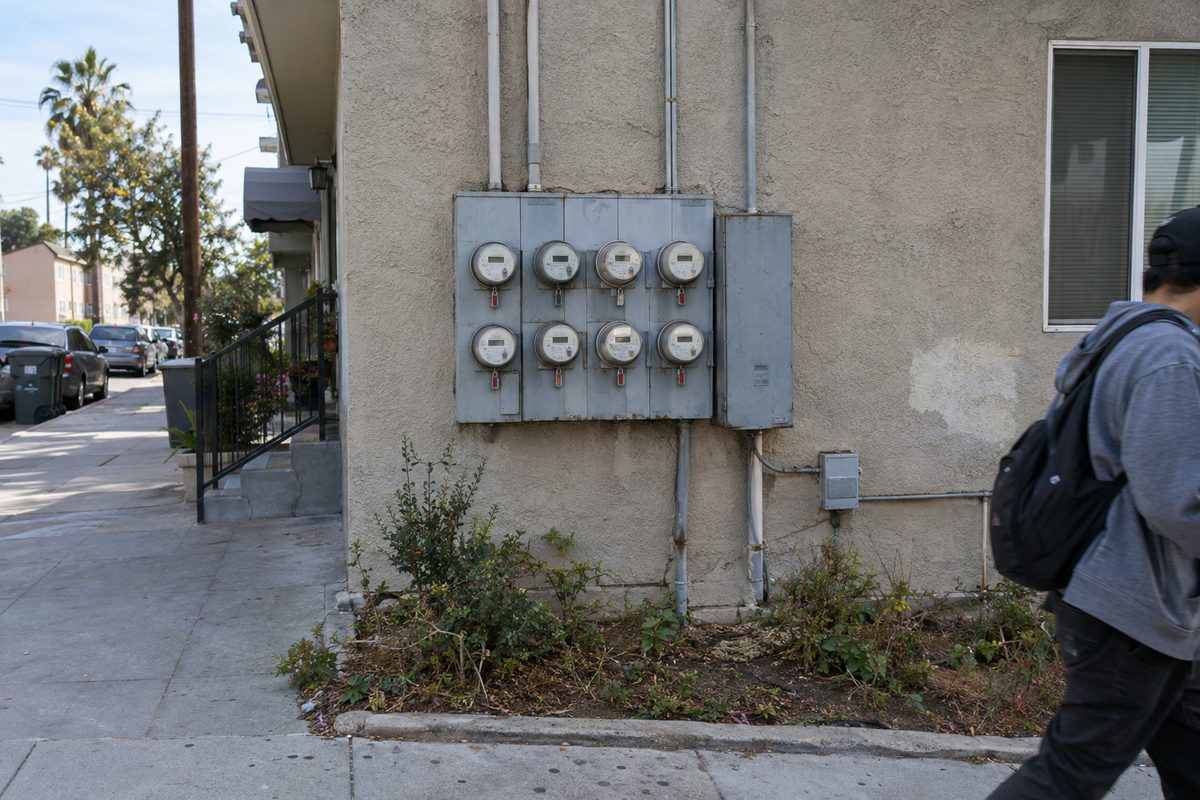
The first several hundred kilowatt-hours on a Los Angeles power bill got pricier on Oct. 1, and the heaviest use got nearly eight cents cheaper. That puts the Department of Water and Power's charge on ordinary usage at its highest all year. It also means part of what four days of record heat do to a bill has nothing to do with the heat.
Run against identical usage, the new rates split households by size. A 600-kilowatt-hour month in a cooler part of the city costs $5.30 more in October than it did in September, while an 1,800-kilowatt-hour month in a hotter part costs $10.19 less.
Every price behind those bills sits in one place, LADWP's posted residential rate summary, which prints the total consumption charge — the base rate plus the adjustment billing factors — for every tier and every stretch of the calendar. July through September ran 26.408 cents a kilowatt-hour in Tier 1, 32.267 cents in Tier 2 and 40.968 cents in Tier 3. October through December reads 27.292, 33.151 and 33.151.
Two changes landed on the same day
The first is the quarterly reset. LADWP footnotes its own table with the schedule — the adjustment billing factors are "adjusted in January, April, July and October" — and October's reset added 0.884 cents to every tier. That's what makes Tier 1 and Tier 2 the most expensive they've been in 2026, dearer now than they were in the summer high season.
The second is the end of that high season. LADWP splits the year into a high season of June through September and a low season of October through May, and the season moves only the third tier.
June shows it cleanly, because the season turned there with no quarterly reset attached: Tier 1 and Tier 2 held at 24.362 and 30.221 cents, and Tier 3 alone jumped to 38.922. Run that in reverse on Oct. 1 and Tier 3 drops to whatever Tier 2 is, which is why both now read 33.151.
Net of the reset and the season together, Tier 1 and Tier 2 rose 0.884 cents and Tier 3 fell 7.817. Against a year ago, every tier points the same way: October through December 2025 ran 24.604 cents in Tier 1 and 30.463 in Tiers 2 and 3, which makes this October 10.9 percent dearer in Tier 1 and 8.8 percent dearer in Tier 2.
Which tier you reach depends on your ZIP code
The rate summary prints a single set of tier prices for the whole city. What an address changes is how many kilowatt-hours it takes to leave each tier, and that's set by which of two temperature zones its ZIP code sits in — a split LADWP says it drew on the California Energy Commission's recommendation.
On monthly billing, a Zone 1 account gets its first 350 kilowatt-hours at the Tier 1 price, the next 700 at Tier 2 and everything above 1,050 at Tier 3. A Zone 2 account gets 500, then 1,000, then everything above 1,500. On bi-monthly billing all six numbers double, to 700 and 2,100 in Zone 1 and 1,000 and 3,000 in Zone 2.
LADWP is blunt about which zone is which and why: "People who live in the hotter parts of the city, Zone 2, are allowed a little more energy in Tier 1 than people who live in the cooler areas of Zone 1."
The assignment itself is a plain list of ZIP codes, published as the Residential Electric Zone Tables, and it doesn't track the map most Angelenos carry around. Every 91000-series ZIP code on the table is Zone 2, which puts the whole San Fernando Valley on the larger allowance.
South and East L.A. get it too — 90001, 90002, 90003, 90011, 90023, 90033, 90044, 90059, 90061, 90062 and 90063 among them — and so does downtown, where 90012, 90013, 90014, 90015, 90017 and 90021 all draw it. Zone 1 is the Westside, the coast and the Harbor: 90024, 90025, 90034, 90045, 90046, 90049, 90066, 90068, 90272, 90291, 90292, 90293, 90731 and 90744.
The line cuts through Koreatown, where 90005 and 90006 are Zone 2 while 90004, immediately north, is Zone 1. Zone 2 also carries a parenthetical that no other entry on the table needs: it includes the Owens Valley.
Crossing into Tier 3 still costs $14.80
Every residential bill also carries a Power Access Charge, a fixed monthly amount set by the highest tier the account reaches. LADWP posts it at $2.30 for Tier 1, $7.90 for Tier 2 and $22.70 for Tier 3. The same table sets a floor of $10 a month plus the adjustment factors.
This quarter that charge does more of the work. October's Tier 2 and Tier 3 energy rates are the same number, so crossing 1,050 kilowatt-hours in Zone 1 or 1,500 in Zone 2 doesn't change what the next kilowatt-hour costs at all. It moves the access charge from $7.90 to $22.70, a single $14.80 step that a reader watching only the per-kilowatt-hour columns wouldn't see coming.
What it looks like on a bill
We ran the posted rates against identical usage in both months, counting energy charges at the tier prices plus the Power Access Charge and nothing else. A real bill carries taxes and other line items on top of that, so these figures show only the difference the rates make.
A Zone 1 household at 600 kilowatt-hours a month. In September that's 350 kilowatt-hours at 26.408 cents and 250 at 32.267, or $173.10, plus the $7.90 Tier 2 access charge: $181.00. In October the same 600 run $178.40 plus the same $7.90, or $186.30. Identical usage, $5.30 more.
A Zone 2 household at 1,800 kilowatt-hours a month. In September that's 500 at 26.408 cents, 1,000 at 32.267 and 300 at 40.968, or $577.61, plus the $22.70 Tier 3 access charge: $600.31. In October the same usage energy-charges at $567.42, plus the same $22.70: $590.12. Identical usage, $10.19 less.
The line where October stops costing more
Stretch that comparison across every level of usage and the two directions meet at one point per zone. In Zone 1 it lands at about 1,170 kilowatt-hours a month: below that, October's rates cost more than September's for the same consumption, and above it they cost less. In Zone 2 the crossover is about 1,670.
Both sit well past the Tier 3 threshold, because October's increase on the first 1,050 or 1,500 kilowatt-hours has to be worked off by the discount on everything beyond it before the month comes out ahead.
The edge case: a bill that straddles Oct. 1
LADWP bills residential accounts monthly or bi-monthly, and a bi-monthly cycle covering September and October covers the rate change too. The rate pages lay out the two seasons and the two rate rows, but they don't say how a cycle split across them gets divided.
Read the service dates printed on your own bill and ask LADWP how it apportioned them, instead of assuming either rate ran the whole cycle.
Why October usage is going to be high anyway
The heat driving it is on the record. The National Weather Service's Los Angeles/Oxnard office logged a preliminary record high of 101 degrees at Bob Hope Airport in Burbank on Oct. 6, against a mark of 100 set in 1964.
The office's Extreme Heat Warning for downtown Los Angeles, the Santa Clarita Valley, the county beaches and the Santa Monica Mountains runs until 8 p.m. on Thursday, Oct. 8. Every mark the office has logged this month sits in our running tally.
Running an air conditioner through it is a choice most Angelenos make for themselves, because their landlord isn't yet required to: L.A. County capped apartment heat at 82 degrees but won't enforce the cap until January 2027, and the city hasn't set a ceiling at all.
When the bill that follows is the problem rather than the rate, the six programs that lower an LADWP bill have their own page, and two of them stop a shutoff outright.
The Extreme Heat Warning lifts at 8 p.m. Thursday. The October rates outlast it, holding through December until LADWP adjusts them again in January.
Comments 0