 ™
™
A Pothole Wrecked Your Wheel. Three Agencies Take the Claim, and You Have Six Months.
The City of Los Angeles, Los Angeles County and Caltrans each accept claims for road damage, none of them forwards yours to the others, and state law gives you six months for a wrecked wheel. Here is the form each one takes, the only address that can legally receive it, and the test that decides whether anybody pays.
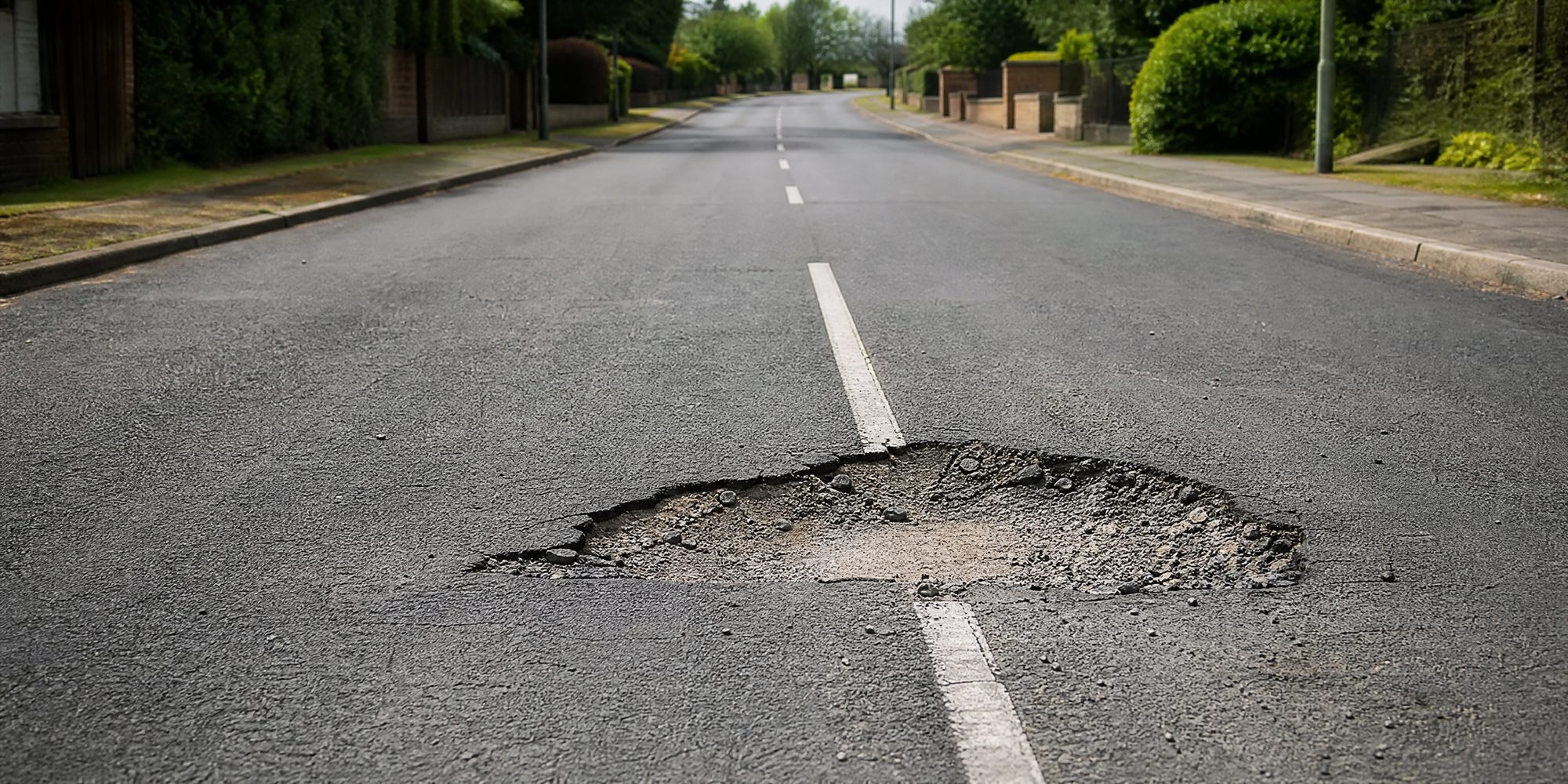
You are wondering whether this is worth an afternoon. That turns almost entirely on one question you can answer before you leave the tire shop: who owns the road you were driving on. Los Angeles is stitched together from city streets, county roads and state highways, and each of the three runs its own claims window, with its own form, its own address and its own clerk. None of them forwards anything to the others. A claim filed with the wrong one is not redirected. It is simply not a claim.
The clock is the reason to settle that today rather than after the repair bill clears. Under Government Code section 911.2, a claim for injury to personal property — which is what a wheel, a tire and a control arm are — has to be presented within six months. The Los Angeles City Attorney's office prints the rule on its own claims page next to the exception that keeps getting mistaken for it: six months for death, injury to a person, or injury to personal property; one year for other claims, damage to real property among them. The one-year figure circulates widely and is real. It is not yours. Your car is personal property, and six months is your number.
Step 1: Find out which agency owns the pavement
Three answers, and they are mutually exclusive.
A freeway or a state route is Caltrans. The department is blunt about the edge of its own responsibility. Its published statement on pothole and damage claims says it "does not pay claims for damage related to conditions on city or county roads," and that a driver has to show the damage happened on the state highway system. Freeways and signed state routes are that system. The city street you turned onto afterward is not.
A city street inside Los Angeles is the city's. Pavement repair there is the Bureau of Street Services' work, and the bureau's frequently asked questions page says pothole requests "must be filed through the 311 system" — by phone at 311, at the MyLA311 website, or through the app.
An unincorporated area or a county road is the county's. Claims against Los Angeles County go to the Clerk of the Board of Supervisors — not to Public Works, and not to the city.
If you cannot tell which you were on — and on a boulevard that changes jurisdiction at a city line, plenty of people cannot — a 311 request is the cheapest way to find out. The bureau's page says a service request produces a case number, and that everything assigned to StreetsLA gets an initial inspection by a staffer who decides what happens next: the bureau's own crew, or "a referral to another agency or department." A referral is the bureau recording, in its own system, that the road belongs to somebody else. That is worth having, and asking for it does not spend your six months.
Step 2: File it with the one office that can legally receive it
This is the step that quietly kills claims, because the office that will decide yours is not the office allowed to accept it.
City of Los Angeles. Everything goes to the City Clerk. The City Attorney's page flags the point as a warning: "No other city, county or federal entity or office can receive a claim seeking damages from the City of Los Angeles." Then it names the office most people would guess at, and rules that out too — the City Attorney's own. The City Clerk's claim page gives three routes in and closes a fourth. You can file through the online Claim for Damages portal, which the clerk says returns "an immediate claim number" and can be completed entirely online. You can print the PDF form, sign it, and mail it to the Office of the City Clerk, 200 North Spring Street, Room 395, City Hall, Los Angeles, CA 90012. You can carry it into that same room between 8 a.m. and 4:30 p.m., Monday to Friday excluding city holidays, entering on Main Street. What you cannot do is send it: "Emailed or faxed claims are not accepted." Nor can you dictate it, since the City Attorney's page says you "cannot file a claim over the phone" — though the clerk's office will mail you a blank form if you call (213) 978-1133.
Los Angeles County. The Board of Supervisors' claims for damages page says a signed, written claim is presented by mailing or delivering it to the Executive Officer-Clerk of the Board of Supervisors, at 500 W. Temple Street, Room 383, Los Angeles CA 90012. The deadlines are the state's, and the page cites the same section by number: six months for personal property, one year for everything else. Questions go to ExecutiveOffice@bos.lacounty.gov or 213-974-1440 between 8 a.m. and 5 p.m., with a caveat printed on the page that is worth taking at face value — the claims unit "does not provide legal advice or guidance."
Caltrans. For $12,500 or less you file directly with the department rather than with the state's central claims program, using form DOTLD-0274. Caltrans' Submit Damage Claim page says "no filing fee is required" for those, and that the signed original and its supporting documents go to the District Claims Office for the county where the damage happened. For Los Angeles and Ventura counties that is District 7, at 100 South Main Street, 13th floor, Los Angeles, CA 90012, telephone 213-897-0816. Above $12,500 the same page routes you to the state's Government Claims Program instead.
What the city's page asks for, and what it means
The City Attorney asks that the entries be completed "as specifically as possible." Two of them are the ones that stop a road-defect claim cold, and they are better met at the kitchen table than at a counter.
"The specific street address" where it happened. Not the cross streets, not the block. This is the field your photographs exist to support, and the reason to stand somewhere safe and take a picture that includes a house number, a signal pole or a storefront before the hole is patched.
The full name of "the involved City employee," and the department or bureau that person works for. A pothole has no involved employee. Nobody drove the pavement into that condition on a Tuesday. The page does not say what to do with those two fields when the honest answer is that there is no such person, and it is worth knowing that before a blank line convinces you that you have the wrong form. You do not. The same page also asks you to disclose whether the loss has already been claimed with "another entity such as an insurance carrier," naming the company, the representative and the claim number — so make the insurance call and the government filing in an order you are willing to write down.
Step 3: Bring these
For property damage the City Attorney's page names the supporting documents: proof of ownership, insurance coverage information, police reports, repair estimates, proof of paid invoices or cancelled checks, and photographs of the damage. Caltrans asks for the same category of evidence in one phrase — clear proof of "time, location, and photos" of the road's condition.
One item on that list carries a consequence most drivers never hear about until it lands on them. The City Attorney's page notes that a driver involved in an auto accident has to show proof of insurance as of the time of the accident, and that without it Proposition 213 "precludes the recovery of non-economic damages" — pain and suffering, emotional distress. A repair bill is an economic damage and is not what that rule reaches. An injury is.
Step 4: The test is not "there was a pothole"
This is what explains most denials, and it is the same test in all three jurisdictions, because the same statute governs all three. Government Code section 835 makes a public entity liable for a dangerous condition of its property only where the claimant establishes four things: that the property was dangerous, that the dangerous condition proximately caused the injury, that it created a reasonably foreseeable risk of that kind of injury, and then one of two more — that an employee's negligent act created the condition, or that the entity had "actual or constructive notice" of it "a sufficient time prior to the injury" to have done something about it.
Caltrans states the same requirement in plain English on its own page: a driver has to establish that the road was in a dangerous condition, that Caltrans knew about it "or should have known," and that the department had enough time to fix it before the damage happened.
Which is why the dull administrative question in Step 1 turns out to be the load-bearing one. The notice element is not about what you knew. It is about what the agency knew, and when. A 311 request filed days or weeks earlier — by you, by a neighbor, by anybody — is a dated record in the agency's own system saying the condition was reported and not yet repaired. A pothole nobody ever reported leaves you arguing constructive notice from photographs alone.
Step 5: Forty-five days, and then two different clocks
After you file, Government Code section 912.4 gives the public entity's board 45 days to act. Silence is not limbo. If the board does not act in time, the claim is "deemed to have been rejected by the board on the last day of the period" it had. In the city's case the claim moves from the clerk to the City Attorney once it has a number, an investigator or adjuster is assigned, and you may be contacted for more information before any decision is made.
What happens next depends on whether the answer arrives in writing, and the two paths are not the same length. Under Government Code section 945.6, a suit after a written rejection has to be filed "not later than six months after the date such notice is personally delivered or deposited in the mail." Where no written notice is given, the period runs two years from the accrual of the cause of action. The letter nobody wants to open is also the one that starts the shorter of the two clocks, and it starts on the day it was mailed — so keep the envelope and the postmark.
Caltrans is direct about what its process is and is not. Its page calls it "not a reimbursement or insurance program" but "an early resolution process for potential lawsuits," and says that a driver whose claim is denied can go to court to "seek a judicial determination."
If the six months are already gone
There is a statutory door and it is narrow. Government Code section 911.4 allows a written application asking the public entity for permission to present a late claim, and sets an outer limit on it: the application must be presented "within a reasonable time not to exceed one year after the accrual of the cause of action." The section excludes certain stretches from that year — time when the claimant was a minor, or was mentally incapacitated without a guardian or conservator, among others. It is an application, not a right, and the entity can refuse it. But an eight-month-old claim is not automatically nothing, and plenty of people throw one away believing it is.
Two warnings the agencies print on their own pages
Both agencies set these out as warnings on their own claims pages, which is a fair signal of how seriously they mean them. The City Attorney's page says submitting "a false claim is a crime" under Penal Code section 72. The county's page puts the same statute a degree higher: "a false claim is a felony." And the city adds a second warning of its own — that it may seek to recover its full costs of defense, attorney's fees included, if a lawsuit against it is later determined not to have been brought in good faith and on reasonable cause. An honest claim for a real repair bill is not what either sentence is aimed at. Rounding one up is.
The short version
Photograph the hole and the address before it is patched. Work out whose road it is, and use a 311 case number to establish it if you are unsure. File with the City Clerk, the Clerk of the Board, or a Caltrans district office — one of the three, never all three, and never with the office that will decide it. Do it inside six months. Keep every envelope that arrives afterward, because a written rejection starts a six-month clock and no written rejection leaves two years from the day the damage happened. None of this requires a lawyer. All of it requires knowing which of three governments you were driving on, which is why that is Step 1 and not an afterthought.
Deadlines, addresses, forms and fee statements above were checked on September 1, 2026 against the Los Angeles City Attorney's claims page, the Office of the City Clerk's Claim for Damage page, the Los Angeles County Board of Supervisors' claims for damages page, Caltrans' Submit Damage Claim page and its published statement on pothole and damage claims, the Bureau of Street Services' FAQ, and the California Government Code. This page is not legal advice; where a linked source and this page disagree, the source wins, and this page is re-verified and updated in place at this address.
Comments 0