 ™
™
L.A. County's Sandbag Map Has 241 Locations. Only 111 of Them List Sand.
Empty bags are free and available all year. Sand is the part that runs out, and the limit changes at the city line — 25 bags per household in Los Angeles, 10 per resident in Santa Monica and Long Beach. Counted from the county's own map service and the agencies' own pages on August 27, 2026.
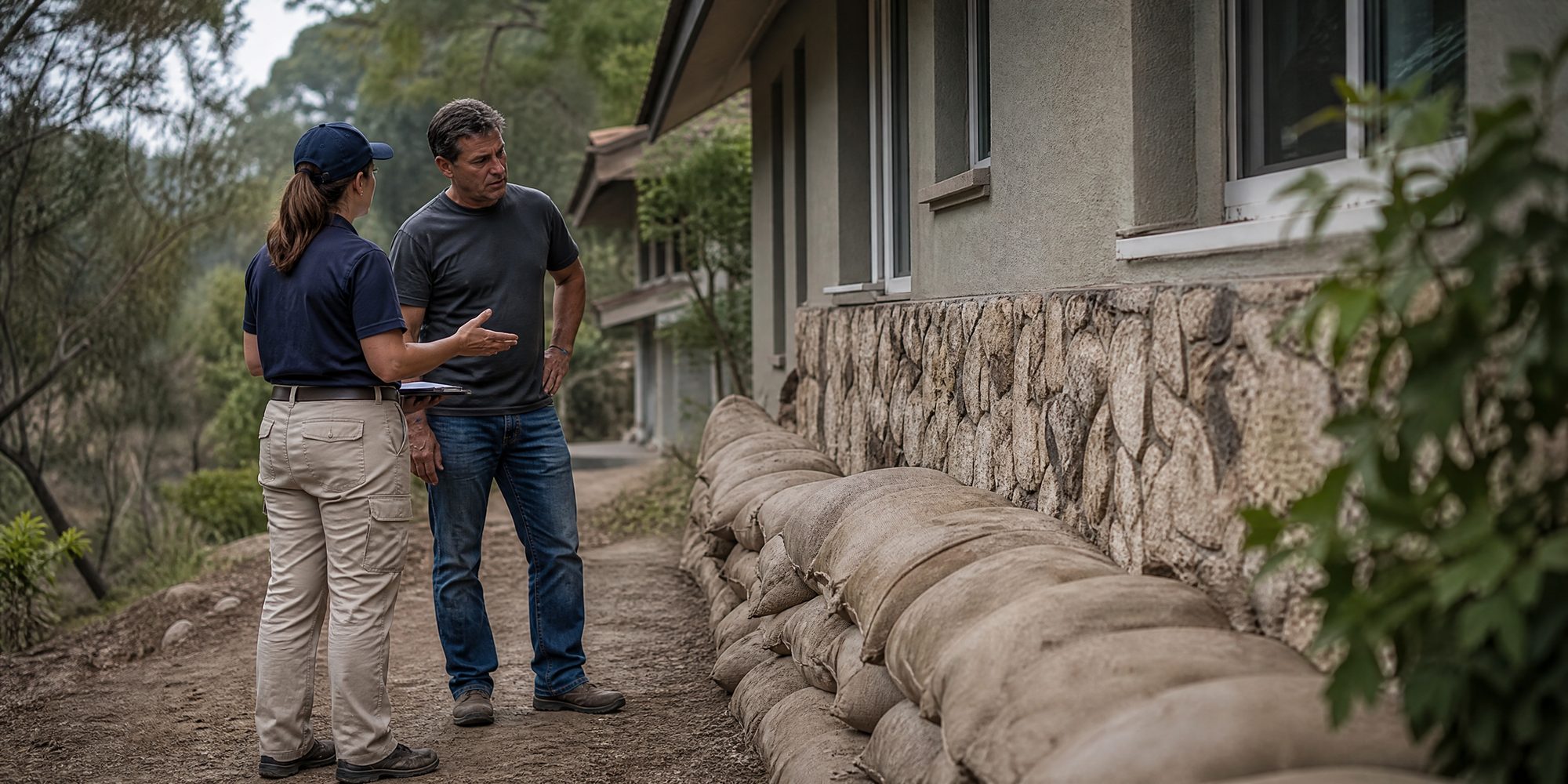
The bags are free, they are available all year, and the fire station closest to you may have nothing to put in them. That is the gap in how Los Angeles County hands out storm supplies, and the dry months are the time to find out which side of it you live on. In December it arrives as a phone call you did not make and a second trip you did not need.
So here is the system in one place. We pulled the map service behind Los Angeles County Public Works' sandbag locator on the morning of August 27 and counted every record on it: 241 locations, spread across 89 cities and unincorporated communities. Of those, 229 are flagged as carrying bags. Only 111 are flagged as carrying sand. Those are two different maps wearing one name, and the difference between them is a wasted morning.
What the forecast actually says
The reason to read this before the rain is the ocean. In its ENSO diagnostic discussion issued August 13, 2026, NOAA's Climate Prediction Center has an El Niño Advisory in force and puts the odds of a very strong event during the fall and winter of 2026–27 at greater than 90 percent. It goes further than that: the same discussion gives a 69 percent chance of a historic event, one that would exceed every El Niño in the record going back to 1950 — defined there as a three-month value of +2.5°C or more. July's Niño-3.4 index came in at +1.4°C and climbing.
What that does not mean is a guaranteed soaking. MySafe:LA, the fire-safety nonprofit that runs community preparedness programs in the city, put the caveat plainly in a June 24 explainer: "El Niño does not mean that Los Angeles will experience months of nonstop rain." It changes the odds, the piece says; it does not dictate the outcome. The last time forecasters called a monster, they were right about the ocean and wrong about the rain — Scripps Institution of Oceanography's post-mortem on the 2015-16 event found that most long-range models predicted a drought-ending deluge for California and the precipitation that arrived was far less than expected.
Which is the correct reason to spend twenty minutes on sandbags and no money at all. The supplies are free. The forecast is a probability. The only thing you are spending is the drive, and doing it now costs less than doing it in a storm.
If you live in the City of Los Angeles: 25 bags, and 40 places with sand
The Los Angeles Fire Department gives out free ready-to-fill sandbags year-round at all of its neighborhood fire stations, up to 25 per household. No storm has to be forecast; the bags sit there in July. Sand is the seasonal half — the department makes it available free "at select locations, as seasonal conditions warrant," and it publishes the list of those locations by neighborhood.
We read that list on August 27, 2026, and counted 40 entries. At 33 of them the sand sits at a fire station. At the other seven it does not, and five of those are worth writing down now, because a reader who assumes "fire station" will drive past them: the Council District 14 office at 2130 E. 1st Street in Boyle Heights, Normandale Recreation Center at 22400 Halldale Avenue in Harbor City, Peck Park at 560 North Western Avenue in San Pedro, the Council District 7 office at 7747 Foothill Boulevard in Sunland-Tujunga, and Banning Recreation Center at 1331 Eubank Street in Wilmington.
The remaining two split the errand across two addresses, which is the kind of detail that turns one trip into two. In Granada Hills the sand sits in the Knollwood Country Club parking lot at 12040 Balboa Boulevard, south of Fire Station 18, and the bags are at the station. In Sylmar the sand is at Sylmar Recreation Center on Polk Street and the bags are next door at Fire Station 91. Collect in that order and you are carrying empty bags to sand rather than the reverse.
Three things the department states about its own service, all of which decide how long this takes. It cannot fill, deliver, install or remove sandbags — that labor is yours or a contractor's. It asks you to call the station ahead of time to make sure supplies have not run out. And it notes that local soil will fill a bag perfectly well, which matters if the sand list has no entry near you.
The county's map, counted
Outside the city, Public Works publishes one locator for the whole county, and its own flags are the useful part. Of the 241 records we pulled, 129 list bags but no sand, and another 11 list sand but no bags — those are city yards and park bins where you are expected to arrive holding empty sacks. One record, the Hidden Hills city hall parking lot, is flagged for neither.
You're wondering whether that split follows the terrain. In places it plainly does, and in one place it plainly does not. Along the Santa Monica Mountains the sand is dense: Agoura Hills has six locations on the map and all six list sand, five of them parks and street-ends rather than stations; Calabasas has three, all with sand; Topanga's Fire Station 69 on Topanga Canyon Boulevard has both. Eight Malibu locations are on the map and four list sand, among them the Malibu Library parking lot at 23519 West Civic Center Way and the Zuma Beach entrance at 30100 Pacific Coast Highway.
Below the Eaton Fire burn scar, it is thinner than that. Altadena has three records on the county's map. Fire Station 11 at 2521 El Molino Avenue and Fire Station 12 at 2760 North Lincoln Avenue are both flagged for bags and neither is flagged for sand. The single Altadena entry carrying both is the Los Angeles County Public Works Fleet Maintenance Yard at 252 Mountain View Street. If you live on that hillside and you were planning to fill bags at the nearest firehouse, the county's own map says to plan on Mountain View Street instead — and to call first, because these flags describe a program, not this morning's inventory. La Cañada Flintridge is the same shape: two fire stations with bags only, and the sand at Camp 2 on Oak Grove Drive.
If your city runs its own fire department, your limit is different
The county map's real limitation is not the sand column. It is that a countywide-looking map is not countywide. Santa Monica, Long Beach, Beverly Hills, Culver City, Sierra Madre, Arcadia, South Pasadena, Alhambra, Downey, El Segundo, Manhattan Beach, Montebello and San Marino have no records on it at all, and Pasadena has exactly one — county Fire Station 66 on East Eaton Canyon Drive. A blank on that map is not a blank on the ground; it means the locator does not cover you, and your own city's page is the one to read. Two of them publish theirs plainly, and neither sets the limit Los Angeles sets.
Santa Monica gives out free empty sandbags at all city fire stations, capped at 10 per Santa Monica resident. The sand is in one place and it is available at any hour: the large bin in the Clover Park parking lot at 2600 Ocean Park Boulevard. The city asks you to bring your own shovel.
Long Beach distributes empty bags at all of its neighborhood fire stations, and its rule is the strictest of the three: "Sand and sandbags are available only to Long Beach residents. Residents are required to bring their IDs to pick up a maximum of 10 bags." When the city activates its sand sites, they are the lifeguard station at 72nd Place and Ocean Boulevard, Fire Station 7 at 2295 Elm Avenue, Fire Station 12 at 1199 Artesia Boulevard, Fire Station 13 at 2475 Adriatic Avenue, and Fire Station 14 off East Paoli Way — plus a bin at the Claremont Beach parking lot, 5400 E. Ocean Boulevard, for residents who already have empty bags.
Ten versus twenty-five is not a rounding difference. The same kind of free program gives one household two and a half times what it gives another a few blocks the other side of a city line, and the reader who needs more than the cap is on their own either way: Los Angeles names the fallback on its own page — a home improvement store or building supply center, several of which will deliver. Which cap governs your address is the whole reason to look this up in the dry season rather than in the rain.
The pages you are reading were written in February
Here is the caveat that applies to every list above, and it is not a criticism of anyone. Storm-supply pages are maintained on storm time. The LAFD list of sand locations carries a dateline of February 14, 2026. Long Beach's Storm Smart page, read this morning, still describes an active distribution for a system forecast to run from Sunday, February 15 through Thursday, February 19 — a storm that ended six months ago. The standing rules on those pages are current. The activations on them are not.
What that means in practice is a two-step: use these pages to learn the rules that govern your address — how many bags, whether you need identification, whether the sand is at the station or a mile away — and confirm the specific location by phone on the day you actually go. That is the fire department's own instruction, printed directly above its sand list.
Four rules that decide whether the trip works
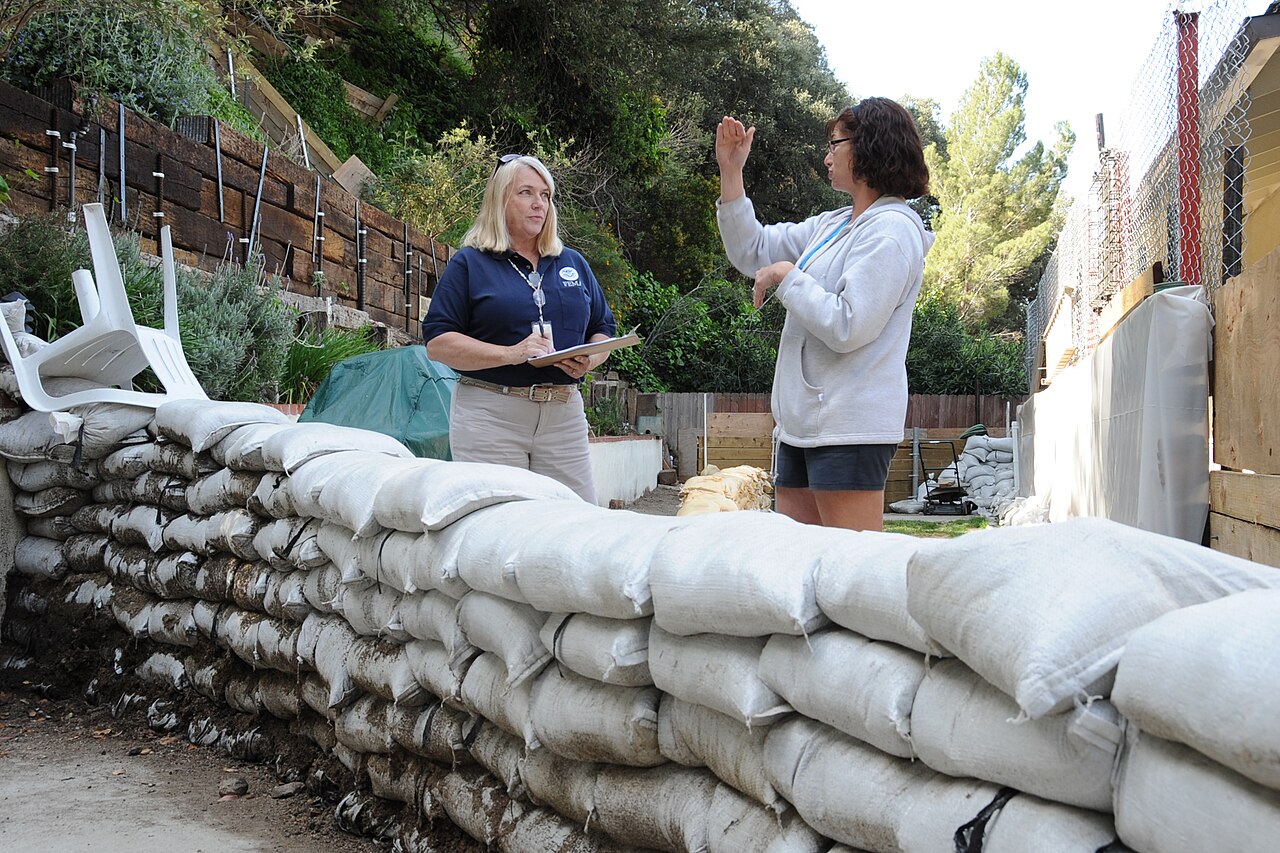
One: divert, do not dam. The fire department's instruction is to aim water, not to stop it: a bag that has been packed well and set down in the right line steers the runoff and the debris somewhere other than the thing you are trying to save. A wall built to stop water is a wall water gets around. A line laid to steer it is a line that works.
Two: bring a shovel, and expect to do the labor. Santa Monica says so on its page. Long Beach says so on its page. Los Angeles says it cannot fill, deliver, install or remove bags. There is no version of this errand where someone loads your car for you.
Three: call the location first. The county's own records carry a phone number for 238 of the 241 locations, in the same table as the sand flags, and the fire department asks in capital letters that you use it. Supplies run out. A flag in a dataset is a statement about a program, not a promise about a pile.
Four: dirt counts. If the nearest sand is across the Valley and the rain is Thursday, the city's own page says local soil fills a sandbag effectively. The bags are the part that is genuinely free and genuinely everywhere; the filling is a solved problem in most backyards.
One more piece of timing, for anyone reading this as a to-do list. Sandbags are the part of storm preparation you can finish today. The part you cannot finish today is insurance: a federal flood policy does not take effect for 30 days after purchase, which is why that clock, unlike this one, has already started.
Comments 0