 ™
™Every Free Hazardous-Waste Drop-Off in L.A., and the 16 Things They'll Turn Away
Nine permanent sites take household hazardous waste from any Los Angeles County resident, free. Here are the addresses, the days, the rules that decide whether you get in — and the refusal list the flyers leave off, including one item California has nowhere legal to take.
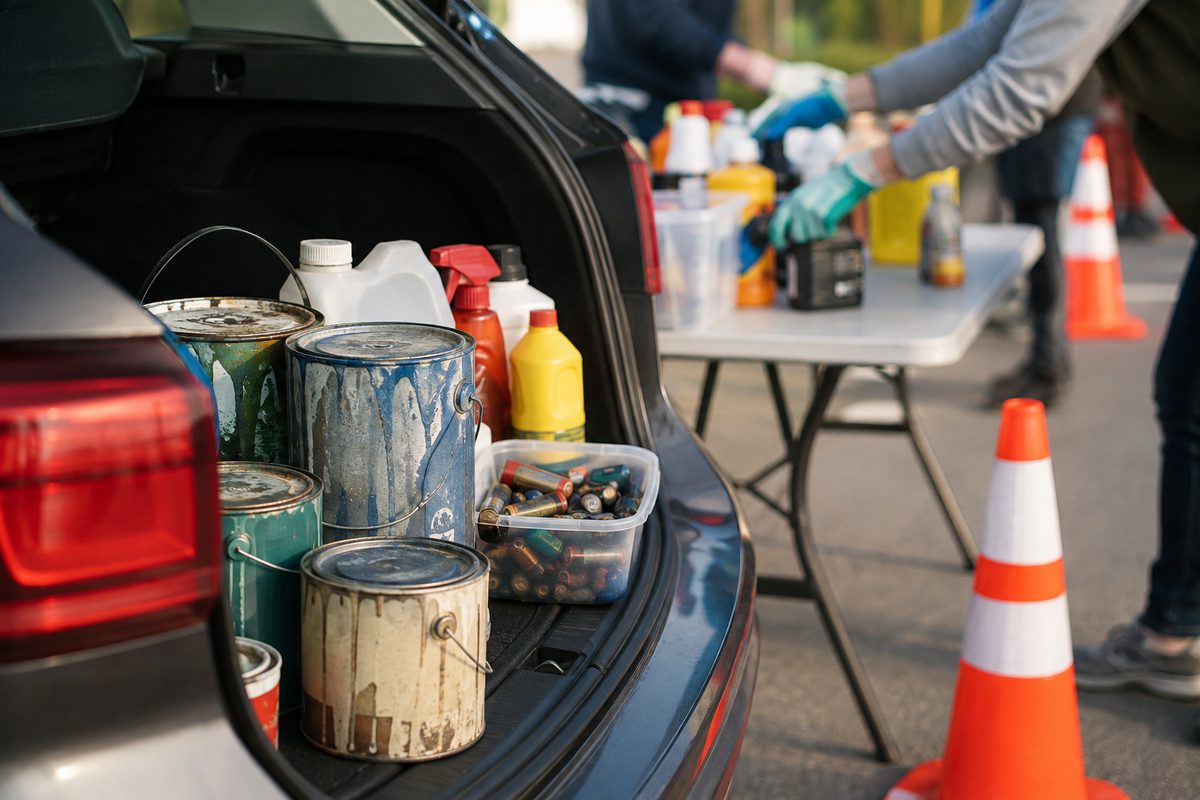
The garage shelf finally wins, you box up the half-gallon of deck stain and the dead car battery and the bag of fluorescent tubes, you drive across town on a Saturday morning, and a person in a reflective vest looks into your trunk and says no to two of the four things in it. This is an avoidable morning. The list of what Los Angeles will not take is published — it just lives at the bottom of a page nobody scrolls to, and it is longer and stranger than the list of what they will.
So here is the whole system in one place: the nine permanent sites where any Los Angeles County resident can drop off household hazardous waste for free, the four rules that decide whether you actually get in, and every item the centers refuse — with where each refusal is supposed to go instead. We read all seven of the city's facility pages and both county listings on August 8, 2026, and compared the two agencies' refusal lists against each other; they do not match, and the gap is on you to know.
The nine places, and the days they are actually open
Seven of them are S.A.F.E. Centers, run by LA Sanitation and Environment. The acronym is doing real work — it stands for Solvents, Automotive, Flammables, and Electronics, which is a fair description of what people actually bring. You do not have to live in the City of Los Angeles. The county's own page states that all Los Angeles County residents may use the city's S.A.F.E. Centers, plus the two county-run centers, free of charge. Businesses have to call ahead for an appointment; the facility pages set no such requirement for residents.
Hyperion, Playa del Rey — 7660 W. Imperial Highway, Gate B. Saturdays and Sundays, 9 a.m. to 3 p.m. Enter at Gate B off Imperial Highway; the queue starts on Vista del Mar, and left turns into the facility from Imperial are prohibited during busy periods. Bring your license: because the center sits inside the Hyperion Water Reclamation Plant, security at the gate requires a valid driver's license to enter.
S.A.F.E. Center at UCLA, Westwood — 550 Charles E. Young Drive West. This is the only one you can use on a weekday: Fridays, Saturdays, and the first Sunday of each month, 9 a.m. to 3 p.m. The remaining 2026 open Sundays are October 4, November 1 and December 6. Construction near the center runs August 3 through September 25, 2026, with an alternate access route posted, and the site closes for student move-in on September 18–19.
Nicole Bernson, Northridge — 10241 N. Balboa Boulevard. Saturdays and Sundays, 9 a.m. to 3 p.m. The line forms on Devonshire Street between Amestoy Avenue and Balboa; no left turns into the site from Balboa, and the page asks specifically that you not block the ARCO station driveways. This is also the one center whose page states flatly that it does not accept business waste.
Randall Street, Sun Valley — 11025 Randall Street. Saturdays and Sundays, 9 a.m. to 3 p.m., with the line forming southbound on Randall. This page carries the fine print that applies to all seven: the centers close during rain events and on every City of Los Angeles observed holiday, and shut for two weeks from December 24 through January 3. The remaining 2026 holiday closures are Labor Day, September 7; Indigenous Peoples' Day, October 12; Veterans Day, November 11; Thanksgiving, November 26–27; and Christmas Day.
Los Angeles–Glendale, Atwater Village — 4600 Colorado Boulevard. Saturday only, 9 a.m. to 3 p.m. This is the easiest one to get wrong, because six of the seven are weekend sites and this one is half a weekend site. Like Hyperion it sits inside a water reclamation plant, so a state-issued photo ID is required at the security gate before you reach the drop-off.
Washington Boulevard, downtown — 2649 E. Washington Boulevard. Normally Saturdays and Sundays, 9 a.m. to 3 p.m.; it was temporarily closed in August 2026, and as of September 7, 2026 the city's page lists it as "REOPENING 9/5/26," Saturdays and Sundays, 9 a.m. to 3 p.m. The line forms westbound on Washington when it is open, with no left turns in during busy periods.
Gaffey Street, San Pedro — 1400 N. Gaffey Street. Saturdays and Sundays, 9 a.m. to 3 p.m. Enter from Gaffey, cross the train tracks, then turn left; the center is on the left-hand side. Note the address, because it is also the Harbor-area bulky-item drop-off site — the same lot solves two different problems on different days.
Antelope Valley Environmental Collection Center, Palmdale — 1200 W. City Ranch Road. Open 9 a.m. to 3 p.m. on the first and third Saturday of the month. This is one of the two county-run permanent centers, and unlike the city sites it has a Reuse Center attached, which is the best-kept secret in this whole system — more on that below.
EDCO Recycling & Transfer Center, Signal Hill — 2755 California Avenue. Open 9 a.m. to 2 p.m. on select Saturdays, so this is the one to confirm on the county's calendar before you load the car. It also has a Reuse Center.
On top of the nine, the county and the Sanitation Districts run free one-day drive-through collection events, most of them Saturdays from 9 a.m. to 3 p.m., open to all county residents and requiring no appointment. The county's calendar lists the upcoming dates and locations. The city runs its own mobile collection events on the same pattern, in neighborhoods the S.A.F.E. Centers don't reach, and posts them on its events page.
Four rules that decide whether you get in
One: 15 gallons or 125 pounds, and it is not a house rule. Every center caps a single visit at 15 gallons or 125 pounds of household hazardous waste. Randall Street's page names the source — the State of California sets that as the transportation limit, which means the number governs what you are allowed to have in the car on the way over, not merely what the site will take from you. Two trips is the answer, and two trips is legal.
Two: they will ask where the waste came from. The city asks for the address the waste originated at, and the county's page puts it more bluntly: S.A.F.E. Centers cannot accept material from residents without a valid address. This is the screen that separates a household from a business, and it is why a contractor's leftovers are a different transaction entirely.
Three: it rides in the trunk, upright, sealed, unmixed. The county's preparation instructions are specific and worth following literally: pack everything in cardboard boxes, keep products in their original containers, label anything that isn't, group like chemicals and separate unlike ones, make sure lids are tight, and put the boxes in the trunk away from passengers with everything else removed. At the event, trained staff take the material out of your trunk while you stay in the car. Be prepared to leave your boxes behind.
Four: five specific items have their own handling rules, all of them listed on the S.A.F.E. Center pages and all of them capable of costing you the trip. Battery terminals must be taped — packing, electrical or duct tape, both terminals. Sharps must arrive in a state-approved or hard, puncture-proof container with a lid; loose sharps are refused, and that rule explicitly covers Epi-pens. Compressed gas cylinders are accepted up to five gallons and no larger. Treated or contaminated wood must be cut to under three feet. And asbestos — yes, they take asbestos — must have been abated by professionals, wetted, double-bagged in clearly labeled plastic, and cut to under three feet.
You're wondering about the light bulbs, because the accepted list says LED bulbs, fluorescent tubes and ballasts and the refused list says metal light fixtures. Both are true, and the city's own wording resolves it: bulbs and ballasts are accepted "with no metal fixtures." Take the tube out of the housing before you go.
The 16 refusals, and where each one actually goes
We counted the refusals on the S.A.F.E. Centers' own page: 14 bulleted items, plus a closing line that sends two more back to the bins at your curb. Sixteen things, in five groups, and the group tells you what to do next.
Things that can go off. Ammunition, firecrackers and explosives; marine flares; acetylene tanks; and CO2 and oxygen tanks or cylinders. For the first category the city's page gives one instruction and one number: call 1-877-ASK-LAPD, at 1-877-275-5273. Do not put any of it in a bin, and do not drive it anywhere until someone has told you to. Propane, butane, helium, MAPP gas and fire extinguishers are fine at five gallons or under; acetylene, CO2 and oxygen are not, at any size.
Things that are radioactive. Radioactive materials, and — this is the one that surprises people — smoke detectors, which the city lists under "not accepted" with the parenthetical "(radioactive)." No local drop-off is named for them. The header above that whole list is the only guidance offered: some of these items are accepted by county facilities and events, and you may also contact the manufacturer directly.
Things that belong to a different program. Business and commercial waste, laboratory waste, and medical or biological waste. A small business is not stuck: the Very Small Quantity Generator program lets qualifying businesses use the S.A.F.E. Centers for a fee, by appointment only, through Hyperion on the third Wednesday of each month — call (310) 387-1071. The catch is upstream of the appointment. You need an EPA identification number to participate, and the city's page notes that if you regularly generate any amount of hazardous waste you are required to have one anyway; a temporary number is available from the state's Department of Toxic Substances Control if you don't.
Things that are just large. Exercise equipment such as treadmills; fans, heaters, air conditioners and vacuums; metal light fixtures; and electric-vehicle batteries. The first three of those are a solved problem and the solution is free: the city's bulky item pickup is an unlimited curbside service at no additional charge, collected on your regular trash day, as long as you tell them at least one business day ahead through MyLA311, the online form, or 1-800-773-2489. Have an itemized list ready — "one mattress, two chairs, and a desk" — so they send a truck the right size. EV batteries are the exception with no city or county answer on the page; that one goes back to the dealer or manufacturer.
Things that belong in a bin you already own. Yard waste goes in the green bin. Glass and plastic bottles, cardboard, paper, aluminum cans and metal scrap go in the blue. Trash goes in the black. Three of the 16 refusals are, in effect, the city asking why you drove.
The bulky pickup has its own refusal list, and it is nearly the mirror image: no automotive parts or used oil, no construction materials, no commercial appliances, no paints, solvents or chemicals, no medicines or needles, no fluorescent lights. Which is the shape of the whole system, once you see it. The truck takes what is merely big, the center takes what is merely poisonous, and the only thing on both lists is electronic waste — televisions, computers and monitors go either way.
Four more refusals the county adds
The county's list of what its collection events and permanent centers will not accept is not the same list, and it names four things the city's page does not.
Tires. Refused everywhere in the household hazardous waste system. The county runs free tire collection events for residents instead — rims accepted, no business tires, no tractor tires — with the next one in Glendora on September 19, 9 a.m. to 3 p.m., per the county's tire page as of September 7, 2026. If you are moving 10 or more tires you need a county hauling permit, at (626) 430-5540. Paying for it is the fallback, and the county publishes the rates: $4.50 a passenger tire at Daniels Tire Service in Santa Fe Springs, $20 a tire at American Reclamation in Los Angeles, $139 a ton with a $10 minimum at Crumb Rubber Manufacturers in Compton.
White goods. Refrigerators, stoves, washing machines. Refused by the county's program, and collected free at the curb by the city's bulky item service — the clearest case in this piece of one agency's "no" being another agency's routine Tuesday.
Solar panels. Refused at every temporary event and every permanent center in the county system, with no exception offered. The county's instruction is to contact the manufacturer or use its posted list of recyclers that accept panels. If you are having a system removed, settle this with the installer before the panels are on your driveway.
Controlled substances. The county's events do not take them; the city's S.A.F.E. Centers list home-generated medications among accepted items. For the controlled-substance question the county's own pharmaceuticals page points residents to the DEA's public disposal locator and to MED-Project's California program, which lists drop-off sites and free mail-back envelopes. The same page's one-line rule is the one to remember: do not flush medications, and do not put them down the drain.
The flare problem, which is not L.A.'s fault
One item on the refusal list is refused everywhere, and the reason is worth knowing if you own a boat. Expired marine pyrotechnic flares are classified as hazardous waste by both the state's Department of Toxic Substances Control and the EPA, and they must be transported as explosives and disposed of at a facility permitted to handle explosives. The California Division of Boating and Waterways states the problem plainly on its own page: there are currently no permitted facilities in California that can accept, treat or dispose of non-military explosive waste streams, and only two in the entire United States — one in Missouri, one in Illinois.
The numbers around that gap are the part nobody quotes. Recreational vessels in California generate an estimated 174,000 expired flares a year, on a figure the state page dates to 2011. Proper disposal at an out-of-state permitted facility costs roughly $7 to $50 per flare. Some counties win CalRecycle grants to run temporary flare collection events, which are typically limited to boaters who live in, or keep a boat in, the grantee county.
Until one of those events comes around, the state's direction is to call DTSC at (800) 728-6942 or your local Certified Unified Program Agency. Two things not to do, both from the same page: never put flares in the trash or in any waterway, and never fire one off at a celebration. Discharging a flare in a non-emergency is a false distress message — a Class D federal felony under Title 14, Section 88 of the U.S. Code, carrying up to six years and up to $250,000 in fines, plus the cost of whatever search the Coast Guard launches on your behalf.
Two free things almost nobody uses
The Reuse Centers. At both county permanent centers — Palmdale and Signal Hill — there is a shelf of household cleaners, lawn and garden products, paint and similar goods that other residents dropped off unused or half-used, and any Los Angeles County household may take up to five items per week, free. You do not have to drop anything off to take something home. That is a publicly funded source of free paint, and it keeps the same hours as the centers it sits inside.
The library battery bins and the free sharps mailer. LA Sanitation has partnered with Los Angeles Public Library branches to take small single-use and rechargeable batteries, which spares you a weekend trip for four AAs. The branches take batteries and nothing else — no vape pens or e-cigarettes, no light bulbs, no cell phones, no e-waste, no trash. Separately, California's producer-funded home-generated sharps program will mail you a sharps container with prepaid return postage at no cost, which is a better answer than driving a needle box across town.
One more date, if bulk is your actual problem: the city opens five bulky-item drop-off locations from 8 a.m. to 4:30 p.m. one Saturday a month. The remaining 2026 dates are September 19, October 10, November 21 and December 12, at 11050 Pendleton Street in Sun Valley, 8840 Vanalden Avenue in Northridge, 1400 N. Gaffey Street in San Pedro, 2027 Stoner Avenue in West Los Angeles, and 2201 E. Washington Boulevard in Central Los Angeles.
Where the two agencies disagree, and what to do about it
When we checked on August 8, 2026, the city's page for the Washington Boulevard center gave dates for its closure — August 8 and 9, 2026. The county's directory of the same seven centers said only that Washington Boulevard "is temporarily closed," with no dates at all. Neither page was wrong; they are simply maintained by different departments at different intervals, and a reader who checked the county's list and drove downtown that weekend would have been working from the older of the two.
The rule that follows is dull and it will save you a morning: check the individual facility page, not the directory, on the day you go. The facility pages are where the closures, the construction detours and the line-forms-on-this-street details live, and they are the ones that get edited when something changes. This page will be re-verified and updated in place; the date under the headline is the last time every address, hour and rule on it was read off its source.
And before you load the trunk, the four questions that decide the trip: Is anything in there explosive, radioactive, commercial or merely large? Are the battery terminals taped and the sharps in a hard container with a lid? Is the whole load under 15 gallons and 125 pounds? Is the site you picked actually open that day of the week? Four yeses and you are back home by ten, with a shelf you can see the back of.
Comments 0