 ™
™L.A. Unified's First AI Meeting Filled Its Speaker List in Under Two Hours
The district opens its speaker sheet exactly 24 hours before a meeting starts. For the September 2 meeting that was 10 a.m. September 1, and by 11:50 a.m. the form offered no public-comment slot at all. Five more meetings follow, through April 7.
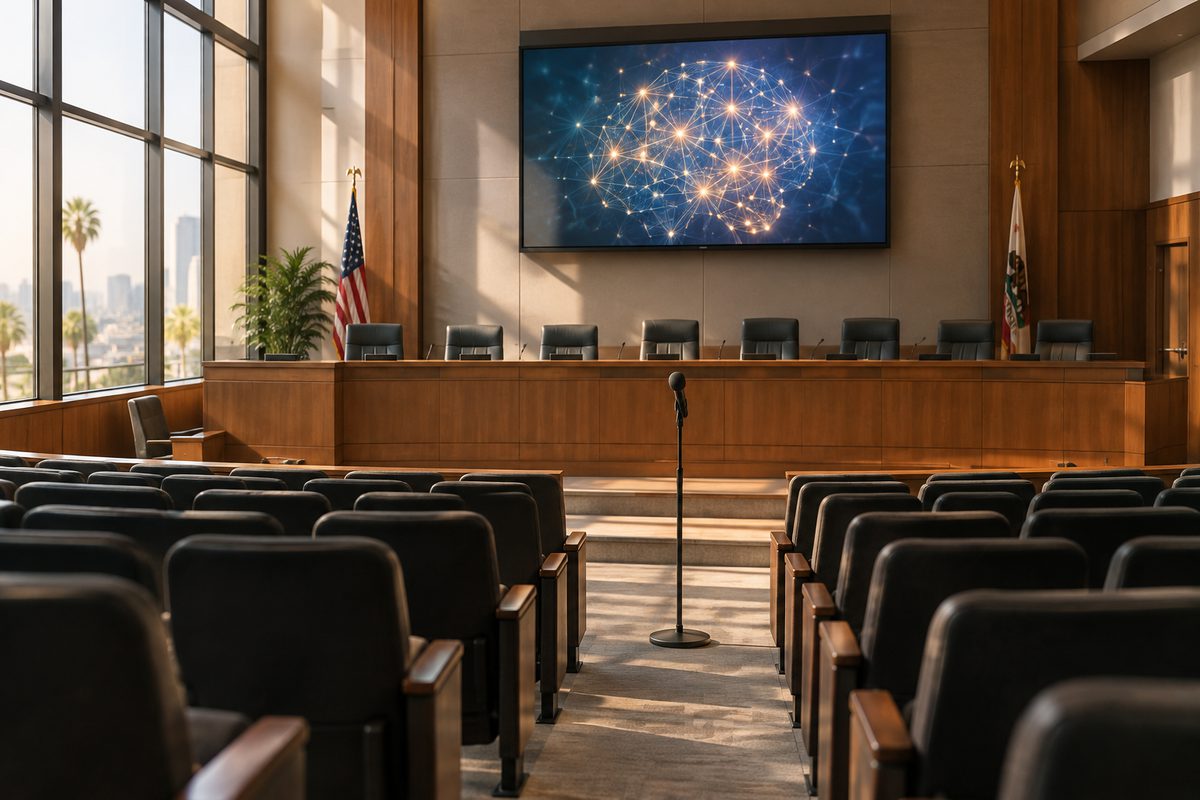
Los Angeles Unified is deciding what artificial intelligence is allowed to do in its classrooms, and the first meeting on that question was the morning of Wednesday, September 2. The board's new Generative AI Committee met that day from 10 a.m. to noon in the board room at 333 S. Beaudry Ave., LAist reported, and its meetings can be attended in person, online or by phone.
Speaking at it is a different matter, and the reason is a procedural detail most parents never see. The way to the microphone is a sign-up sheet the district opens exactly 24 hours before a meeting starts. For the September 2 meeting, that was 10 a.m. on Tuesday, September 1. We were watching the page, and by 11:50 a.m. the form had stopped offering a public-comment slot at all: "No more Public Comment section allowed as limit of maximum speakers reached." The window was under two hours wide.
So this is not a guide to speaking at that first meeting; that sheet closed on September 1. It is the timing you need for the five meetings after it, the rule you would be arguing about when you get there, and what the district already tried with artificial intelligence and what that cost. The committee decided nothing on September 2, and the reader who missed that morning has not missed the decision.
The four facts you need before the next meeting
Who. Three board members: Kelly Gonez, who chairs it, Nick Melvoin and Tanya Ortiz Franklin, per LAist. The committee was created in June, when the board adopted its student screen-time restrictions — a vote about devices and minutes, which is not the same subject as what the software on those devices is allowed to do.
What it produces. Not a rule. Gonez told LAist the goal is a set of AI policy recommendations that the full board could then vote on next year. Wednesday is the first of six scheduled sessions, and the thing that binds anybody is the board vote at the end of them.
Where. The board room at 333 S. Beaudry Ave., downtown, which is the district's headquarters building. Online and telephone participation are both offered.
When. 10 a.m. to noon, Wednesday, September 2.
The window opened at ten, and it was gone before noon
Speaking at a Los Angeles Unified meeting means registering in advance on the district's own speaker page, at boardmeeting.lausd.net/speakers. We watched that page across the morning of September 1, and the sequence is worth setting down in order, because it is the whole lesson.
At 9:27 a.m. the page carried no link at all — only one operative sentence: "Speaker Sign Ups Will Begin 24 Hours Before The Meeting Start Time. The Link Will Appear On This Page Automatically." Read that against a 10 a.m. Wednesday start and it does the arithmetic for you: the sheet opens at 10 a.m. Tuesday, which is the registration time LAist reported. The two agree.
By 11:50 a.m. the link had appeared, exactly as promised — a button reading "COMMITTEE MEETING ORDER OF BUSINESS 10 a.m., Wednesday, September 2, 2026" — and the form behind it was already closed. It offers no public-comment slot to select. In place of one it prints: "No more Public Comment section allowed as limit of maximum speakers reached." We loaded it twice, four minutes apart, and got the same page both times.
So the practical window for Wednesday was not 24 hours. It was the stretch between 10 a.m. and whenever the last slot went, and that was over before lunch. The district does not publish the cap, so we cannot tell you how many speakers it took — only that the form stopped offering the option in under two hours.
You're wondering whether that means the room is closed to you. Not quite. Attending is not the same as speaking: the meeting can still be watched in person at 333 S. Beaudry Ave., online, or by phone, and the five meetings after this one have not opened their sheets yet. What that morning bought you is the timing, and it is worth having: the sheet opens exactly 24 hours ahead, and on the evidence of September 2 it can be full inside two.
If you do get a slot, the form's own instructions are worth reading before the morning. Each speaker gets one opportunity to comment, and phone speakers call 1-888-475-4499, enter the Meeting ID printed on the agenda, press # and then # again at the Participant ID prompt, and hold. Callers are identified by phone number, so it has to be the same number entered on the sign-up form — a blocked or private line cannot be matched to a registration. When the line is unmuted, press *6 to come into the meeting.
And the underlying question — whether public comment on a committee that cannot pass anything is worth a morning — has an answer in the calendar rather than the room: this committee writes the recommendation, and a recommendation is much easier to change before it is drafted than after a board has voted on it. The unglamorous meeting is the one where the language is still soft.
The rule you would be arguing about
There is already an artificial-intelligence policy in Los Angeles Unified, which is worth knowing before Wednesday, because a comment that asks the district to write one is asking for something it has. Under the current policy, students aged 13 and older may use AI tools at their teacher's direction, and only after completing a lesson on "digital citizenship," per LAist. Three conditions are stacked in that sentence — an age, a teacher's instruction, and a completed lesson — and each one is a separate thing a speaker could ask the committee to tighten, loosen or delete.
Some parents want the whole thing thrown out. Anya Meksin, of the group Schools Beyond Screens, told LAist that "the current policy needs to be discarded completely, and we need to start from scratch." Gonez told the outlet that success on this committee "will look like ... being proactive to protect our students and safeguard their health, their wellbeing, and their development first." Those are the two poles the meeting starts between.
The screen-time policy adopted in June is a separate document and a separate rulebook, and it is the one already in force this school year — device limits by grade, a ban on district-issued screens through first grade, and take-home devices switched to a parent opt-in. LAist reported its price at the time of adoption: $4 million one-time for laptop carts where classes opt into them, and $1 million a year for the monitoring software that logs usage. If your question is about minutes on a Chromebook rather than about chatbots, that is the policy you want, and it sits alongside the state's phone rules in a separate guide.
The five meetings after this one
Every one of them is a Wednesday at 10 a.m., per LAist's published list: October 21, 2026; December 9, 2026; January 20, 2027; March 3, 2027; and April 7, 2027. That is a school year of meetings, ending in April 2027 — which is inside the window Gonez gave LAist for the recommendations reaching the full board.
Two things follow from that calendar, and after the morning of September 1 they are not abstract. First, the 24-hour rule applies to each of these the same way, so the alarm to set is 10 a.m. on the Tuesday before each Wednesday — not the meeting itself, and not later that day. What happened for September 2 is the argument for setting it: the sheet was gone inside two hours. Second, a parent who wants to speak about a specific thing — a tool their child was assigned, a lesson that went badly, a use they want protected — still has five chances, and the later meetings will have an actual draft to react to, which Wednesday's will not.
What the district already tried, and what it cost
This is not Los Angeles Unified's first artificial-intelligence program, and the last one is the reason some of Wednesday's temperature exists. In March 2024 the district launched "Ed," a student-facing chatbot built by the startup AllHere, on a contract worth up to $6 million over five years, Education Week reported. It began with roughly 1,000 students and expanded to some 55,000 at selected schools.
Then the vendor came apart. AllHere furloughed most of its staff and lost its chief executive, and the district switched the chatbot off on June 14, 2024, because nobody was left to supervise it, according to LAist, which reported that the district had paid the company roughly $3 million by then. The district said it retained ownership of Ed and that the tool could return once the human supervision was re-established.
None of that history is on Wednesday's agenda as such. It is, however, the answer to a question a speaker might otherwise spend a whole turn at the microphone establishing: the district has bought an AI product before, and it had paid out roughly half of that contract's ceiling by the time the product went dark.
What this piece does not tell you
How many speakers Wednesday took, or how long each gets. The form says every speaker has one opportunity to comment, and then it says the limit is reached — but the district publishes neither the cap nor the speaking time on that page, and we are not going to estimate either. What we can state is what we saw: no slot on offer by 11:50 a.m., under two hours after the sheet opened.
Exactly when the last slot went. We checked at 9:27 a.m., when the sheet had not opened, and again at 11:50 a.m., when it was full. Anything narrower than that would be a guess dressed as a finding.
What is on the agenda. We could not retrieve the committee's posted agenda from the board's own site, which refused our requests. Board agendas are published on the Board of Education's own site at boe.lausd.org, and the agenda is the document that tells you which of your questions is actually in front of the committee that morning.
Whether the current policy survives. That is the entire point of the six meetings, and anyone who tells you the answer in September is guessing.
Comments 0