 ™
™A Disabled Placard Parks Free at L.A.'s On-Street Meters. The Form Turns on One Signature.
Who qualifies, who is allowed to sign the certification, what it costs, and the curbs it never covers.
You're wondering what it costs. A permanent disabled person parking placard in California costs nothing — the DMV issues it, and any of your vehicles can carry it, for no additional fee. The line that stops most applications is the medical provider's signature, and the rules about who may write it are narrower than most people expect.
So this is the walk. We read the DMV's placard and fee pages, all three pages of form REG 195 itself, the four Vehicle Code sections that set the eligibility test, the parking privileges, the penalties and the one escape hatch for a ticket, LADOT's own rules on where a placard has to hang, and the City of Los Angeles program that decides whether a blue curb can ever go on your block. The questions below are in the order you actually meet them. Answer them in order and you'll know which placard you're applying for before you open the form.
The eligibility walk
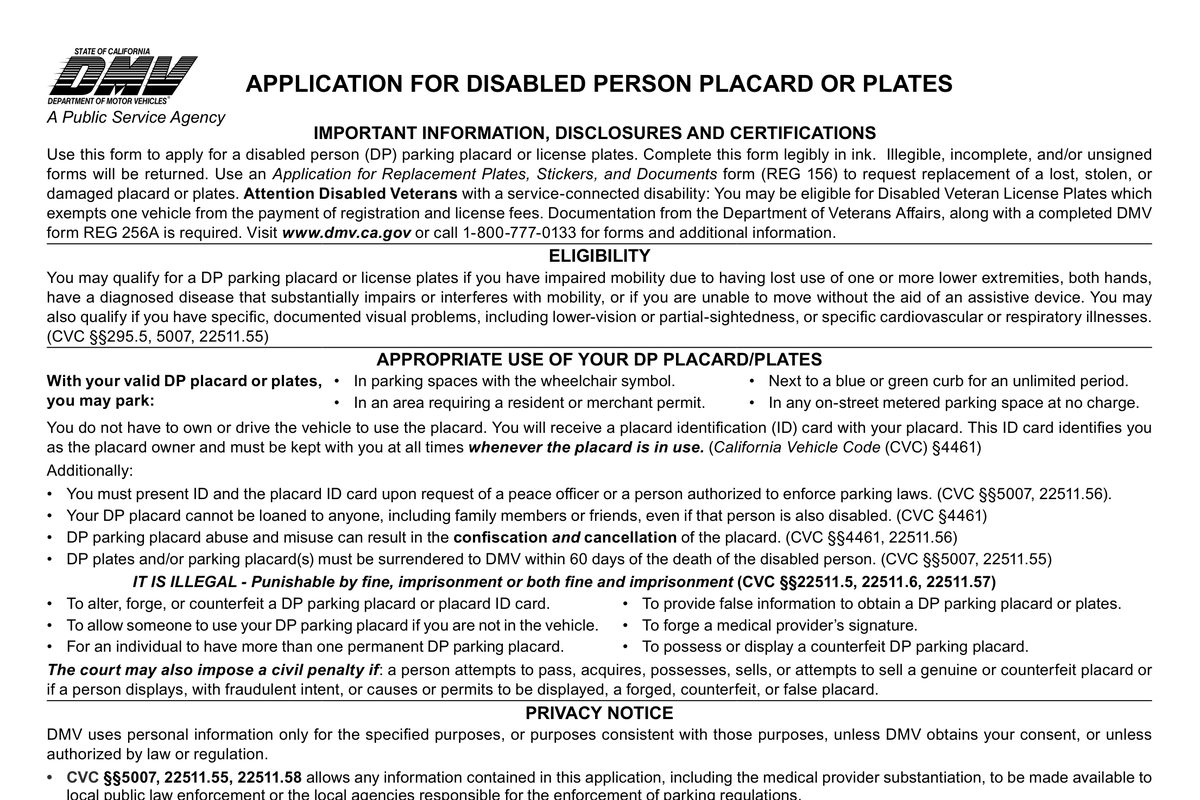
1. Does one of four descriptions fit you? The DMV's test is impaired mobility for any of these reasons: you've lost the use of one or more lower extremities or both hands; you have a diagnosed disease that substantially impairs or interferes with mobility; you can't move without the aid of an assistive device; or you have documented visual problems, including low vision or partial-sightedness. If none of the four describes you, don't stop there, because the form is more generous than the website. Page one of REG 195 itself lists a fifth ground the DMV's web page leaves out: specific cardiovascular or respiratory illnesses, cited to Vehicle Code sections 295.5, 5007 and 22511.55. If your mobility is limited by your heart or your lungs, you are reading the wrong list on the website.
2. The second description is the gray zone, and the law leaves it that way. "Substantially impairs or interferes with mobility" is not a list of diagnoses. Under Vehicle Code section 22511.55, the DMV requires a signed certificate from a medical provider before it issues an original placard — unless the applicant's disability is, in the statute's words, "readily observable and uncontested." That is the whole test. A provider who knows your condition decides whether your mobility is substantially impaired, and the DMV takes that judgment. If your condition is real but invisible, the certificate is not a formality; it's the case.
3. Is the condition permanent or temporary? This is the question that picks your placard, and the two answers behave nothing alike. The permanent placard is free, and it expires on June 30 of every odd-numbered year — the one in your glovebox right now expires June 30, 2027, whatever month it was issued. The temporary placard costs $6, runs up to 180 days or until the date your provider writes on the application, whichever comes first, and can't be renewed more than six times in a row. Six renewals at 180 days each is three more years of temporary placards. If you're approaching the sixth, the conversation with your provider is about whether the condition is still temporary.
4. Will one car carry you, or several? Placards and DP License Plates grant the same parking privileges — the DMV says so directly. The difference is mechanical. Plates stay bolted to one vehicle, which suits a disabled driver with their own car. A placard moves between vehicles, which is the answer when a family member or a caregiver does the driving. You're allowed only one permanent placard at a time.
5. Who's allowed to sign? The answer is not "a doctor." The DMV will accept the Medical Provider's Certification of Disability on form REG 195 from a licensed physician, surgeon, physician assistant, nurse practitioner or certified nurse midwife. A chiropractor may certify only a person who has lost the use of one or both lower extremities, or who has significant limitation in using them. An optometrist may sign, as may a physician or surgeon who specializes in eye diseases. If your condition is a mobility case and the provider who knows it best is a chiropractor, that signature covers you only under that narrow heading.
6. Do you need a signature at all? Two situations skip it. The first: you've lost a lower extremity or both hands and you appear in person at a DMV office with the completed form. The second: you already hold a permanent California DP placard, or DP or DV plates assigned to your vehicle, and you enter that plate number in part "A" of the application. Otherwise the certification section is required, and an application arriving without it is an application that hasn't started.
Where the walk ends. If one of the four descriptions fits and a qualifying provider will sign, you qualify — the DMV now takes new and replacement placard orders online, or you can mail the signed REG 195 to the address printed on the form. If none of the four fits, you don't, and no amount of documentation changes that. If you're in the gray zone at question two, the answer isn't the DMV's to give in advance; it's your provider's to write down.
The card that comes with it, which you also have to carry
A placard arrives with a placard identification card, and the ID card is not a receipt. The form says it identifies you as the placard's owner and must be kept with you whenever the placard is in use, citing Vehicle Code section 4461. It also says you have to produce your ID and that card on request of a peace officer or anyone authorized to enforce parking laws, under sections 5007 and 22511.56. You do not have to own the car, or drive it. But the card belongs in the wallet of the person the placard was issued to, and that person has to be in the picture.
The renewal that isn't automatic anymore
For years a permanent placard arrived in the mail every two years and nobody had to do anything at all. That changed. Since 2023, a holder who has had a placard for six or more years has to provide a signature to receive a new placard. Section 22511.55 sets the machinery: the DMV sends the renewal form at least 90 days before the June 30 expiration date, once six years after first issuance and every six years after that.
Two things worth repeating, because this is where people brace for the worst. There's no fee to renew. There's no new doctor's note — the signature the DMV wants at six years is yours, not a provider's. If the form doesn't arrive, the address on your DMV record is the thing to check first.
What the placard actually buys at an L.A. curb
The privileges come from state law, so they're the same in every city in California, and they're more specific than the shorthand suggests. With a valid placard or DP plates displayed, you may park in any space marked with the International Symbol of Access, next to a blue curb, and next to a green curb for as long as you like. You may park in an on-street metered space at no charge. You may park in an area posted for resident or merchant permit holders.
The statute behind the last two is Vehicle Code section 22511.5, which allows a placard holder to park for unlimited periods in preferential-parking zones and in any zone restricted as to the length of time parking is permitted, and in any metered space without paying the meter fee. LADOT applies the first half to its own program in plain words: individuals with disabled parking placards are not subject to Preferential Parking District restrictions. In a permit district where your neighbors buy annual permits, the placard is the permit.
There's also a rule that has nothing to do with parking and is worth knowing at a pump. Service stations must refuel a disabled person's vehicle at self-service rates — unless the station has only one employee on duty.
What it never buys, in three curbs and a crosshatch
The DMV publishes the limits as plainly as the privileges, and all four are painted on the ground. You may not park in a crosshatched space beside a marked accessible space; that hatching is the room a wheelchair lift needs to deploy, and a car in it closes the space it's attached to. You may not park at a red curb, which is no stopping, standing or parking. You may not park at a yellow curb, which is commercial loading. You may not park at a white curb, which is passenger loading and mailbox drops.
The limit that costs Angelenos the most money isn't on that list, though, and it's in the statute's own fine print. The unlimited-time privilege in section 22511.5 does not apply to a zone where state law or a local ordinance absolutely prohibits stopping, parking or standing of all vehicles. That's the difference between a time limit and a prohibition. A two-hour zone is a time limit, and the placard beats it. A posted hour that forbids parking outright — peak-hour tow-away on a commuter corridor, a temporary sign for filming or construction — forbids it for every vehicle, so there's nothing there for the placard to exempt you from. LADOT says the same thing from the other side, in the answer where it confirms the permit-district exemption: other restrictions, such as a red curb or peak-hour restrictions, remain in effect. Nothing on the DMV's list of privileges covers a posted street-cleaning hour, and nothing in LADOT's answer carves one out. Move the car.
The display rule that writes the avoidable tickets
Los Angeles is specific about where the placard goes, and the specificity is the trap. LADOT's instruction is that placards hang from the rear-view mirror with the registration information and expiration date visible through the windshield. A placard that isn't the hanging kind goes face-up on the dashboard, to the left of the steering wheel. And then the sentence people learn the hard way: a placard left on a seat, or tossed upside down on the dashboard, is grounds for a ticket.
If that already happened to you, the ticket has a remedy that is not printed on it. Under Vehicle Code section 40226, an issuing agency may charge an administrative fee of no more than $25 to cancel a citation for failure to display a placard, when the person cited can show they held a valid placard at the time. Los Angeles takes that option. LADOT's parking FAQ says that where the placard would otherwise have excused the violation, the city has the option to accept a $25 administrative fee instead of the fine on the citation — and that you must submit adequate proof along with the reduced payment. Send the proof and the $25 together. A $25 payment with nothing attached is a partial payment, and partial payments collect penalties.
The blue curb in front of your house, and why it probably goes to the corner
This is the one people ask for in a shape the city almost never grants. A blue curb in Los Angeles is an Accessible Parking Zone, and on January 24, 2017 the City Council adopted a Phase 1 program that generally restricts the placement of these zones to corner locations, so the zone serves the entire block. The Department on Disability states the principle behind it in one line: the zones are not "personal" parking spaces, and they must meet state and federal accessibility guidelines.
The guidelines are physical, which is why so many requests fail on geometry rather than need. The city's own placement fact sheet describes a qualifying corner as one where the sidewalk is at least eight feet wide and runs to the curb with no grass parkway, where a ramp gets a mobility device onto the sidewalk, and where nothing adjacent blocks a door or a lift from opening. It lists the things that defeat a location: driveways, bus zones, storm drain inlets, roadway slope. The principle it opens with is the one to carry into the application — no person should have to walk or wheel behind a vehicle other than their own.
To apply, you go through MyLA311, and the Department on Disability's own instructions give the route through it: scroll to "All Service Requests," click "Parking," then select "Accessible Parking Zones," and complete every required field. You'll be asked to upload a copy of your DMV Placard Identification Card or receipt, so have it out before you start — that's the identification card issued alongside the placard, not the placard itself. The Department on Disability also runs an Accessible Parking Zone Request Line at (213) 202-2685. LADOT handles the separate job of repainting a faded existing zone, and its colored curb page routes both a new zone request and a faded one through the same 311 system.
What lending it costs
The placard belongs to the person it was issued to, and the penalties are written for the relative or friend who borrows one for an afternoon. Under Vehicle Code section 4461, lending your placard, or displaying one issued to someone else or one that's been canceled or revoked, carries a civil penalty of not less than $250 and not more than $1,000. The same conduct is also a misdemeanor, punishable by a fine in that same range, up to six months in county jail, or both. The DMV adds the consequence that outlasts the fine: abuse can result in cancellation and revocation of the placard, and the loss of every privilege on this page.
The narrow exception in the code is the one that makes a placard work for a family. The holder may let another person use the placard only while in the presence or reasonable proximity of the disabled person, and only for the purpose of transporting them. Dropping your mother at the door and then driving off across town on her placard is the conduct the sentence is built to catch. The form puts it without the hedge: the placard cannot be loaned to anyone, including family members or friends, even if that person is also disabled.
One more date belongs in this section, because nobody goes looking for it. REG 195 states that DP plates and placards must be surrendered to the DMV within 60 days of the death of the disabled person, under sections 5007 and 22511.55. That clock starts in the worst week of somebody's year, which is exactly why it is worth knowing before it starts.
Do this first
Call the provider who treats the condition and ask whether they'll complete the Medical Provider's Certification of Disability on REG 195 — before you fill in anything else. Every other line on that application is information you already have.
Comments 0