 ™
AMS President Posts 'All Human' Riemann Proof Hours After Anthropic Claim
AMS president Ravi Vakil posted Alessandro Masullo's draft proof of the generalized Riemann hypothesis, then relayed reports of problems.
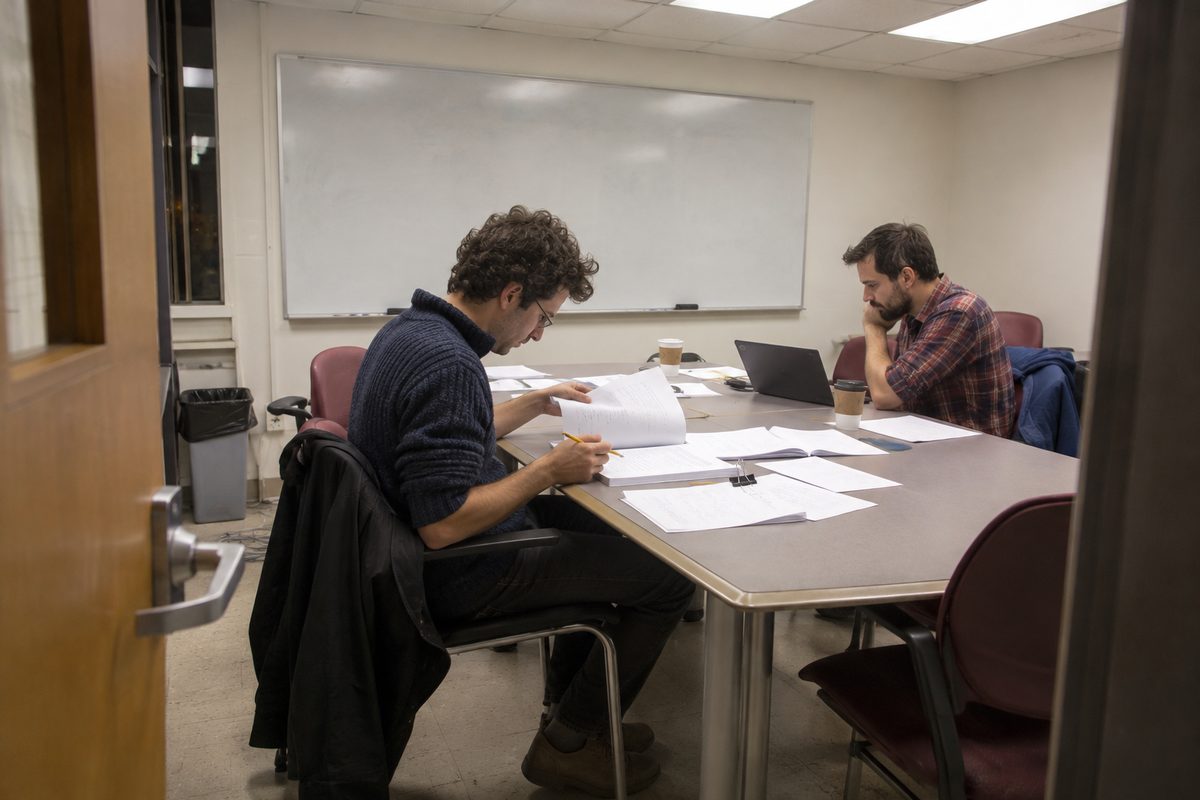
The American Mathematical Society's president posted a proof Friday that he presented as made without the help of AI. Ravi Vakil, a Stanford mathematician, put the draft on his blog. It was a proposed proof of the generalized Riemann hypothesis by Alessandro Masullo, who AFP reported is a postdoctoral researcher in Vakil's department. It went up hours after an Anthropic mathematician said he and Claude had cracked a problem that's stood since 1859.
The X account @MTSlive boiled the day down to one post calling Vakil's release an urgent response to the Anthropic news. That's the account's read.
Here's why people can't stop passing it around: two claimed proofs of the same famous problem landed in one day, one made with an AI and one pointedly made without. Levent Alpöge, an Anthropic employee, wrote on his website, "I believe I have, working with Claude, discovered a proof of the Riemann Hypothesis," Scientific American reported. He also claims the method covers the generalized version, the same target as Masullo's.
Alpöge released his proof only as code in Lean, a language computers use to check mathematical arguments. He told readers a full written version would be extremely long and that he hasn't mastered all the math in it yet, according to AFP. MIT mathematician Andrew Sutherland independently compiled that code, Scientific American reported, which shows the code runs. It doesn't show the code states the problem correctly.
The timing comes with a business story attached. Alpöge's claim landed a day after Anthropic's record stock market debut, and AFP reported he'd consulted CEO Dario Amodei before announcing and admitted the timing could look cynical. Anthropic didn't immediately respond to AFP.
Riemann's 1859 guess is about how the prime numbers are spread out, and the Clay Mathematics Institute will pay $1 million for a solution. Its rules require publication in a peer-reviewed journal and two years of scrutiny, AFP reported, so posting first doesn't settle who gets the credit. Brian Conrey, a Riemann hypothesis specialist, said of the Claude proof, "I don't think any human was about to find this," he told AFP. By the afternoon, a different Brian at Stanford was vouching for a human who may have found it months earlier.
Vakil wrote that Conrad had studied Masullo's draft for months and sent feedback. Conrad confirmed those details to Scientific American but wouldn't go further: "It's undergoing major revision." He described the choice to post as one between two bad options, announcing now or staying quiet and posting something later.
About eight hours after the first post, Vakil came out of his meetings with an update. Several people had contacted him about problems in the proof, he wrote, and they'd found them with help from different AI models. He added that he makes no claim the proof strategy is correct, and that every issue has to be resolved to the community's satisfaction before anyone accepts it.
So the day ended with two mirror-image proofs. A computer has compiled one, but its own author says he doesn't fully understand all of it yet. The other was written for people to read.
Source: X, retrieved November 21, 2026. Other sources: phys.org, scientificamerican.com, scientificamerican.com (2).
Comments 0