 ™
Anthropic Bought a One-Person Biotech That Used Claude to Juggle 11 Labs
Anthropic says Mithril's muscular dystrophy drug could reach human trials as soon as late 2028, if its candidates hold up.
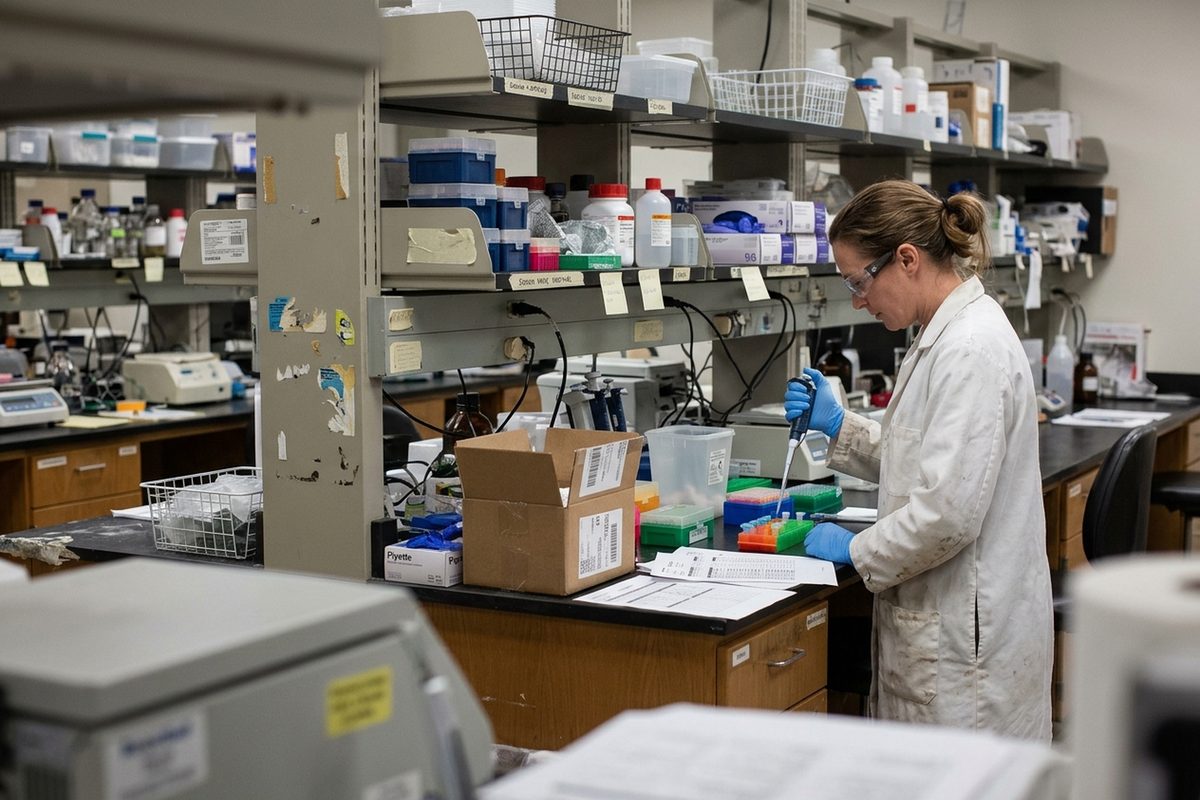
Cody Tranbarger was Mithril Medicine's lone full-time worker, and Anthropic says he kept 11 hired labs running by having Claude handle the experiments, logistics and contracts. Now Anthropic owns his company, and the drug programs that came with it.
Anthropic disclosed the deal Tuesday in a post on its research site. It promoted the news in an X post from @AnthropicAI, which had about 2.2 million views by Wednesday, according to X's own counts. The post's real news is bigger than one purchase: Anthropic scientists have spent months in research partnerships with six drug developers, and the company has started discovering drugs itself. The post went up a day after Anthropic filed to go public on the Nasdaq.
The partners are BigHat Biosciences, Bristol Myers Squibb, Divergence Labs, Enveda, Generate Biomedicines and The Column Group, a biotech investor. Mithril's work, aimed at two rare muscular dystrophies that hit children, became the first drug programs Anthropic runs itself, R&D World reported. The trade publication said the deal closed in July.
The lead program targets LAMA2-related congenital muscular dystrophy, a disease in which a faulty gene loosens the anchors that hold muscle fibers to the tissue around them, R&D World reported. Mithril's antibodies grab two targets at once to bridge that gap. Anthropic says the program went from idea to promising mouse results in under 18 months. In its technical report, which hasn't been peer reviewed, treated mice gripped about twice as hard as mice that got no drug.
Mithril's next milestone, R&D World reported, is naming official drug candidates in 2027. Anthropic's timeline puts a first human trial as early as late 2028, so long as those candidates don't stumble first.
The "one-person" label carries some weight here. R&D World reported that eight paid consultants and advisers worked behind Tranbarger, and that contract labs made the antibodies and ran the mouse studies. The mice weren't assigned to groups at random but by litter. The treated animals were also tested 126 to 161 days after the controls, with a colony move in between, and the report itself calls for a blinded repeat with both groups tested at the same time.
Claude made mistakes, too, and people didn't always catch them. Of six Claude errors the team picked apart, at least three reached outside labs in emails humans had edited before sending, R&D World reported. In one, a lab was told to put less material in each tube than it required, and the team fixed that before any tube got filled. Anthropic still wants more of this: it calls the arrangement "Pipeline-in-a-Person," the trade publication reported, and plans to test it across other rare-disease programs.
Not every partner result is about molecules. Enveda's manufacturing chemists were losing as much as three-quarters of their working hours to documentation, Anthropic says. With Claude reading Enveda's manufacturing records, it caught all 11 problems that human reviewers had found in 1,061 pages. It also flagged seven they'd missed, and cut human review from more than 25 hours to under three.
That's the core of Anthropic's argument: drug development doesn't have one choke point, so Claude has to help everywhere, from picking targets to filling out forms for regulators. Each result in the post comes from the company or partner that ran it, and Anthropic says the work is early and largely preclinical, meaning most of these drugs haven't yet been tried in people.
Bristol Myers Squibb is the furthest down that pipeline. It's using Claude to judge plans for an early-stage drug that's already in clinical trials, and to estimate the trials' odds of success. "From a single prompt, Claude generated a robust initial analysis," Michael Pourdehnad, the BMS senior vice president who leads early clinical development in hematology, oncology and cell therapy, said in Anthropic's post. Anthropic says both sides intend to broaden that effort in 2027.
Tranbarger now works on the research from inside Anthropic, with several new programs on his list. Until a human trial opens, the best evidence his one-employee company has produced is a group of seven mice that could grip harder than four others.
Source: X, retrieved October 28, 2026. Other sources: anthropic.com, anthropic.com (2), rdworldonline.com.
Comments 0