 ™
™The City's Soft-Story Retrofit File Stopped in May 2023. The Permits Didn't.
Search Los Angeles's open-data portal for “soft story” and you get exactly one dataset. Its last permit was issued on May 19, 2023. We pulled the city's live permit file and counted 1,329 more since — the most recent on August 6.
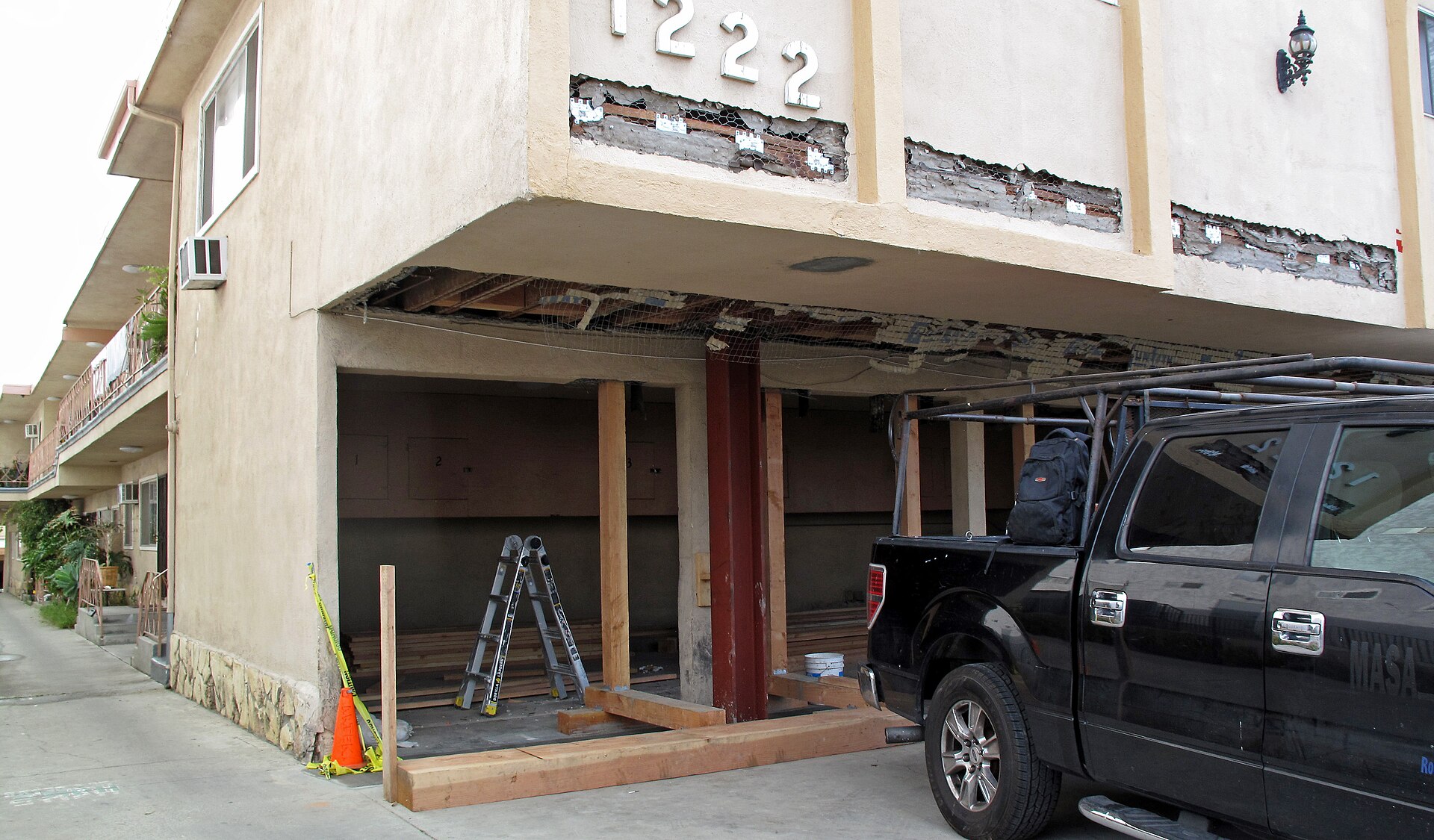
At 4:31 on the morning of January 17, 1994, the upper floors of the Northridge Meadows apartments came down onto the ground floor, which was mostly parking. Sixteen of the fifty-seven people killed in the Northridge earthquake died there — the highest toll at any single location, NBC Los Angeles reported on the disaster's 25th anniversary. Twenty-one years later — Ordinance 183893, effective November 22, 2015, council file 14-1697-S1 — the city ordered roughly twelve thousand buildings shaped the same way to be braced. The program runs on permits, and the city publishes its permits. So we searched the city's open-data catalog for “soft story.”
One result comes back. It is called LADBS Soft Story Permits, it holds 13,277 rows, and we counted them through the portal's own API this morning. The oldest permit in it was issued on April 11, 2013. The newest was issued on May 19, 2023.
Nothing has been added since. The file's data was last refreshed at 9:33 a.m. UTC on May 22, 2023 — a timestamp the portal publishes on the dataset itself, and one that has not moved in three years and nearly three months.
What was happening while the file sat still
The retrofits did not stop in May 2023. The record of them simply moved house.
The department's working permit file is a different dataset — Building and Safety – Building Permits Issued from 2020 to Present, 405,688 rows, last refreshed on August 10, 2026. We queried it for every permit whose work description mentions a soft story, and counted 1,329 of them issued after the frozen file's last entry, at 1,183 distinct addresses. All but one are classified “Bldg-Alter/Repair.” The most recent was issued on August 6 — seven days ago, on Kingsley Drive in Council District 10.
They are still coming at a steady clip. Month by month this year: 13 in January, 14 in February, 16 in March, 17 in April, 13 in May, 14 in June, 13 in July, and three in the first six days of August. The program is deep into its long tail — the annual counts run 3,139 in 2020, 1,765 in 2021, 1,343 in 2022, 858 in 2023, 474 in 2024, 256 in 2025 and 103 so far this year — but a tail is not a stop. It is about a dozen new retrofit permits a month, every month, in a city whose published soft-story file says none have been issued since the spring of 2023.
It did not go quiet alone
This is the part that argues against a conspiracy and for something more ordinary. We pulled the catalog record for every dataset on the portal attributed to LADBS — 126 of them — and found that 118 carry the identical refresh timestamp: 2023-05-22T09:33:24. One instant, one hundred and eighteen files, all stopping together. The soft-story permits were not singled out. They were standing in a crowd.
The portal's own metadata offers a second clue. It records the soft-story file's provenance as community. The department's Building and Safety Inspections file, which refreshed on August 10 like the rest of the live shelf, is recorded as official. Somebody rebuilt the department's permit publishing into a new generation of datasets — the ones whose names end in “(N)” — and those are maintained daily. The soft-story file was not among the things rebuilt, and nothing on the portal says so to a reader who searches for it.
That reader gets a dataset with the department's name on it, 13,277 rows deep, and no indication that it is three years stale. The catalog page still says LADBS. The rows still load.
The city's own scoreboard is two and a half years old
There is a second published record, and it has the same problem in a different format.
LADBS's soft-story program page carries a link labeled “View Soft-Story Compliance Report.” We downloaded it. It is a 16-page PDF, and its title page reads: SOFT STORY RETROFIT PROGRAM STATUS AS OF February 1, 2024. The file's own embedded creation date is February 1, 2024, at 10:51 a.m. Pacific. The web server reports it was last modified on April 20, 2026 — the file has been moved since, but the numbers inside it have not been.
Those numbers are worth having, because they are the most recent account of the program's progress the city currently publishes. As of that February 2024 snapshot, citywide:
- 12,347 buildings were in the program.
- 11,779 (95%) had met the two-year deadline — submitting plans, proof of a previous retrofit, or a demolition plan. 568 had not.
- 10,970 (89%) had met the three-and-a-half-year deadline to pull permits. 1,377 had not.
- 9,377 (76%) had met the seven-year deadline and obtained a certificate of compliance. 2,970 had not.
We added the fifteen council-district pages up against the citywide page: the per-district pending figures sum to exactly 2,970. The report is internally consistent. It is just old.
Since the date on its cover, the live permit file records 772 more soft-story permits at 694 addresses. That is 772 events the city's published compliance picture does not contain.
Where the unfinished buildings were
The February 2024 report breaks the program down by council district, which is the level at which a renter can find their own block. Two districts carry nearly a third of the entire inventory. CD 11 — Brentwood, Del Rey, Ladera, Mar Vista, Pacific Palisades, Playa del Rey, Playa Vista, Venice, West Los Angeles/Sawtelle and Westchester, per the district office's own list — holds 2,007. CD 5 holds 1,851. Then CD 2 with 1,400, CD 4 with 1,307, CD 10 with 1,241 and CD 13 with 1,166.
Buildings still lacking a certificate of compliance as of February 1, 2024, by district: CD 11, 512. CD 5, 374. CD 2, 346. CD 10, 289. CD 4, 264. CD 13, 227. CD 3, 219. CD 6, 149. CD 8, 136. CD 15, 120. CD 1, 118. CD 12, 76. CD 14, 71. CD 9, 37. CD 7, 32.
As a rate, the spread is narrower than the raw counts suggest and it runs the opposite direction from the inventory. CD 13 was the most finished at 81%; CD 4 and CD 5 both sat at 80%. The least finished were CD 3 and CD 9, both at 67%, and CD 8 at 69%. Fourteen points separate the top district from the bottom two, which in a program this size is the difference between 219 unfinished buildings in CD 3 and 227 in CD 13 — nearly the same count, out of inventories of 659 and 1,166.
The post-freeze permits track the inventory closely, which is what you would expect if the program is simply working through its remainder. Of the 1,329 issued since May 2023: 207 in CD 11, 192 in CD 2, 181 in CD 5, 134 in CD 13, 131 in CD 10, 126 in CD 4, then 59 each in CD 3 and CD 8, 56 in CD 6, 50 in CD 15, 45 in CD 1, 34 in CD 14, 26 in CD 12, 20 in CD 7 and 9 in CD 9.
What the ordinance actually requires
The program runs on Ordinance 183893 and Ordinance 184081. A building is covered if it meets all three of the department's stated conditions: two or more stories of wood-frame construction, built under code standards enacted before January 1, 1978, and containing ground-floor parking or similar open floor space. Buildings with three or fewer residential units are exempt.
The clock starts when the owner receives an Order to Comply, not on a fixed calendar date, which is why the program has a seven-year tail rather than a deadline day. Two years to submit, three and a half to permit, seven to finish.
For renters, the money matters as much as the engineering. The Housing Department's Seismic Retrofit Work Program page states that owners may pass through up to 50% of total retrofit costs, divided equally among all rental units and subject to LAHD approval, at a maximum of $38 a month for 120 months. Ten years of a surcharge that sits on top of whatever the annual allowable increase turns out to be — which this year, depending on the building, is 1.919%, 3% or 8.7%.
What we cannot tell you
Three things, stated plainly rather than smoothed over.
We do not know how many buildings have complied today. The last published figure is 76%, and it is dated February 1, 2024. Nobody at the department was asked to explain the gap — this piece is what the public record shows on its own, and the department's own contact line for the program is (213) 482-SOFT.
We do not know whether our permit count is the department's count. Ours is a text match on the free-text work description, which is the only handle the live dataset gives. As a check, we ran it against the window both files cover — January 1, 2020 through May 19, 2023 — where the frozen soft-story file holds 6,345 permits and our match returns 6,609, about 4% higher. So the method runs a little hot, probably by catching work that mentions a soft story without being an ordinance retrofit. It is a floor with a small margin on top, not a certified figure.
And a permit is not a finished building. The 1,329 are permits issued; the certificate of compliance is a later event, and the dataset that would count those is the one that stopped.
How we did this
Every number above came out of two public endpoints on August 13, 2026, and anyone can re-run them. The frozen file is the JSON resource at data.lacity.org/resource/nc44-6znn.json, queried with $select=count(1) for the row total and $select=min(issue_date),max(issue_date) for the range. The live file is data.lacity.org/resource/pi9x-tg5x.json, filtered with $where=upper(work_desc) like '%SOFT%STORY%' and grouped by year, by month and by cd. Refresh timestamps come from each dataset's own metadata document at data.lacity.org/api/views/ plus the dataset id. The 126-dataset census came from the Socrata catalog API filtered to attribution=LADBS. The compliance figures were read off LADBS's own PDF, page by page.
Los Angeles publishes an enormous amount about itself, and the publishing is the easy part. Keeping a file alive after the person who built it moves on is the hard part, and it is the part with no ribbon-cutting attached. The soft-story dataset did not break. It just stopped, quietly, in a crowd of a hundred and eighteen, on a Monday morning three years ago, and the buildings kept getting braced anyway.
Comments 0