 ™
Musk Says Lenders Have Walked Away From AI's Chip Renters, and Few Will Survive
Elon Musk says lenders have shut out companies that live only on AI data centers. CoreWeave, Nebius and IREN are already down 47% to 68% from their highs.
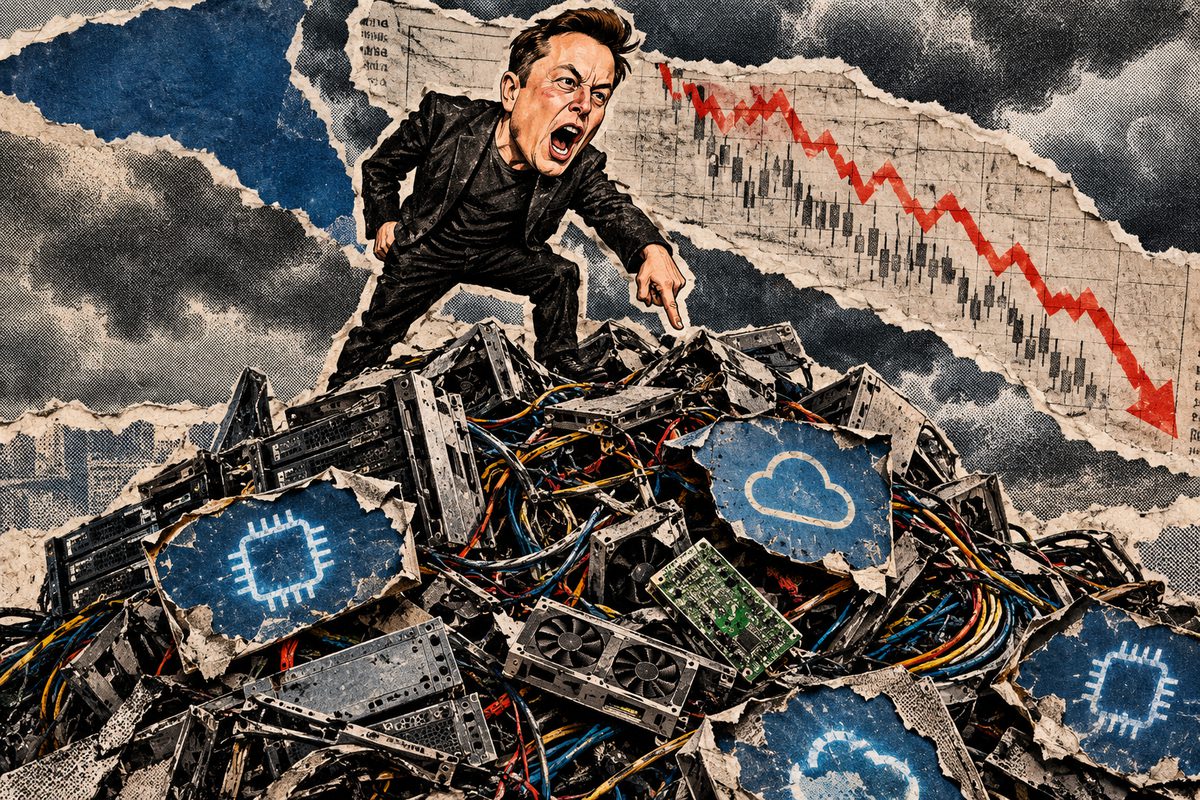
Elon Musk says the money is gone.
"As of the past few weeks, debt markets have almost entirely shut off access to money for any company that doesn't have substantial revenue independent of AI data centers," Musk wrote on X on Sunday.
Then he said what that means for the companies that do little else. "That means the 200+ neoclouds are going to see guppy-level death and consolidation," he wrote. "Some will make it through, but not many."
A neocloud buys Nvidia's AI chips by the warehouse and rents them out by the hour to whoever is building or running AI. CoreWeave, Nebius and IREN are three of the best-known on the stock market, and they paid for a lot of those chips with borrowed money.
Their stocks got the message before Musk sent it. CoreWeave closed Friday at $54.24, down 62% from its high of the past year. Nebius closed at $158.74, down 47% from its June peak. IREN closed at $24.91, down 68%, and five cents above the bottom of its range for the past year.
How the money machine works
The business runs on a loop. Borrow to buy chips. Rent the chips out. Use the rent to pay the interest. Then borrow again for the next, faster chips, because the customers want those too.
The loop holds as long as two things stay true. Borrowing has to stay affordable, and lenders have to believe the chips will earn back what they cost before newer ones make them look old.
In October, both started to slip.
What changed in a few weeks
Money got more expensive first. The Federal Reserve raised interest rates on Sept. 16, a quarter point to a range of 3.75% to 4%. Then gas prices jumped 9.1% in September and pushed inflation to 3.7% over the past year, the Bureau of Labor Statistics reported Oct. 14. Higher inflation is the kind of number that keeps rates up.
Gartner, the tech research firm, added a forecast this month. It expects more than 80% of neocloud providers to stop operating on their own by 2030, and it says more than $3.5 trillion of AI infrastructure spending is at risk of being written down by the end of that year, CRN Asia reported. A write-down is the accounting word for admitting something is worth less than you paid. The firm's reason is simple: what people and businesses pay for AI won't be enough to make all that spending pay off.
Then the bond market spoke. On Oct. 15, the cost of insuring CoreWeave's debt against default hit a record of about 1,195 basis points, The Motley Fool reported. In plain money, that's $119,500 a year to protect $1 million of its debt. Some CoreWeave bonds traded near 79 cents on the dollar, and one due in 2031 yielded more than 16%.
Short sellers moved in. People betting against CoreWeave, IREN, Nebius, Applied Digital and Core Scientific had made about $6 billion in paper profits in October as of Thursday, Reuters reported, citing data from ORTEX. Their bets covered roughly $17 billion worth of the five companies' shares.
By Thursday the worry had spread past the chip renters. The extra interest that companies around the world pay over government bonds hit its widest gap since May 2025, Bloomberg reported, and it blamed growing worry about how fast companies are borrowing to spend on AI. Citadel's Ken Griffin has warned of a bubble. Blackstone's president, Jon Gray, sees it the other way: he calls demand "almost parabolic."
The math
Look at the bills and the worry makes sense.
From April through June, Nebius paid $119 million in interest. Its earnings before interest, taxes and the cost of its equipment wearing out came to $118.4 million, Barchart reported. The interest was bigger than the pot it is supposed to come out of.
On Thursday, Nebius said it had borrowed $3.5 billion from Citigroup for 364 days, at a floating rate of 2.75 percentage points over a benchmark, a margin that can rise to 3.5 points, TheStreet reported. A one-year loan is a bridge to the next loan. Nebius's revenue chief, Marc Boroditsky, drew a line between his company and the one whose bonds are taking the worst of it. "We're not carrying the kind of debt that they are," he said of CoreWeave.
CoreWeave's interest bill was $640 million in its second quarter, up from $267 million a year earlier, while its adjusted operating income was $128 million, 24/7 Wall St. reported. It has $104 billion of signed work it hasn't delivered yet. IREN lost $684 million last quarter and expects to spend $25 billion to $30 billion on building and buying in its 2027 fiscal year.
The strange part: the chips are selling
None of this is because nobody wants the chips. Boroditsky said the going rate for renting AI computing has climbed faster than expected. Chase Lochmiller, who runs Crusoe, an AI data center company, said Nvidia's A100, a chip that first went on sale in 2020, rents for more today than it did in 2020 or 2021.
So the customers are real. The bill is the problem. A company that has to borrow every year to keep up is only as strong as its next loan, and Musk says the next loan just stopped coming for anyone without another business to lean on.
The company that got its loan
Musk's own company had one. "SpaceX closed $40B of debt for GPUs, but we're investment grade and have Starlink & launch revenue," he wrote. In a reply about 40 minutes later, he added, "This is primarily callable debt for GPU purchases that will arrive in Q1 and Q2. Not a major factor this quarter." Callable means SpaceX can pay it back early.
SpaceX hasn't named the lenders, the rate or the due date, and it was unclear what Musk meant by "closed" or whether investors had agreed on the price, Reuters reported.
SpaceX isn't watching from the shore, either. Its AI revenue grew almost tenfold to $7.56 billion in the quarter that ended Sept. 30, out of $14.58 billion in total, and its finance chief, Bret Johnsen, expects $35 billion to $40 billion in capital spending this quarter, Reuters reported. The short seller Jim Chanos has called SpaceX "the largest global neocloud, starting in 2027," TIKR reported.
Musk's post was a reply to the investor Chamath Palihapitiya, who had called neoclouds "disorganized and poorly capitalized," Tesla North reported. When another user suggested SpaceX wanted the smaller players to sink so some would sell out to it, Musk answered that too. "SpaceX is not buying any neoclouds. Pointless."
Guppies, for the record, have babies by the dozen, and the grown fish eat a lot of them. The biggest fish in this tank says it isn't hungry.
Source: Elon Musk on X, retrieved October 25, 2026. Other sources: investing.com (Reuters), srnnews.com (Reuters), finance.yahoo.com (Bloomberg), fool.com, au.finance.yahoo.com (TheStreet), finance.yahoo.com (Barchart), 247wallst.com, crnasia.com, federalreserve.gov, bls.gov, teslanorth.com, tikr.com, stockanalysis.com.
Comments 0