 ™
™The Boyle Heights Odor Order Runs 87 Conditions. None of Them Is a Fine.
Air regulators cited the burned Lineage warehouse 19 days running, then asked their hearing board for something other than money. We read the order they filed — all 87 conditions — in eight honest bullets.
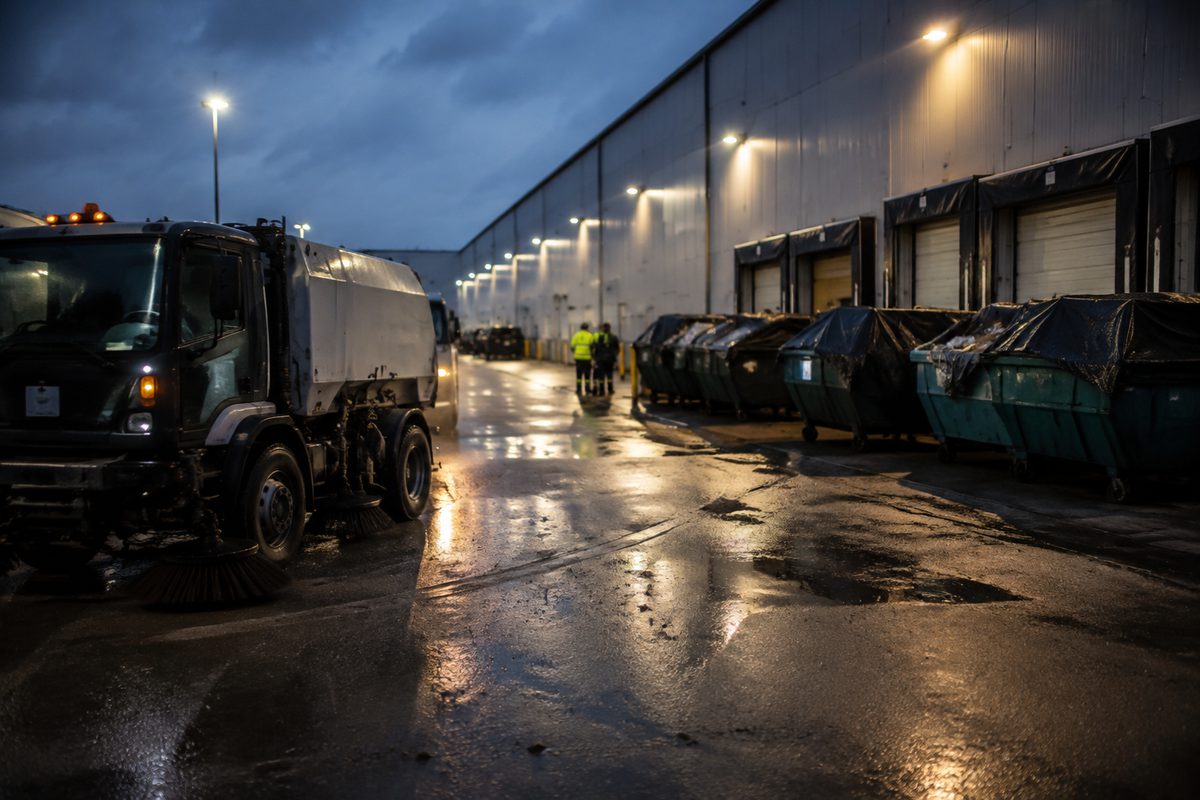
The fire was out on June 25. The smell arrived around July 12. Between those two dates, 88 million pounds of frozen food in a Boyle Heights warehouse stopped being frozen, and the paperwork that followed is now the most detailed public record anyone has of what is happening on Los Palos Street.
On Thursday the South Coast Air Quality Management District's hearing board unanimously approved an abatement order against Lineage Logistics, and imposed no financial penalty — a penalty several elected officials, Mayor Karen Bass among them, had asked for, LAist reported. That is the headline everywhere, and it is accurate. It is also the least interesting thing in the file.
The document the district filed with its own hearing board — the stipulated findings and proposed decision, stipulated to by both sides before the hearing opened — runs 42 findings of fact and 87 numbered conditions. We read all of it. Eight things in it are worth a reader's time.
1. The fire did not make the smell. Switching the freezers off did.
Los Angeles Fire Department crews reached a large roof fire at the 500,000-square-foot cold-storage warehouse at 1400 S. Los Palos Street on June 17, and declared it under control on June 25. The order records a detail that most of the coverage skips: as part of the emergency response, the refrigeration systems in the facility were shut down. The eastern half of the building, Freezer 2, burned. The western half, Freezer 1, did not — it simply warmed up, with roughly 88 million pounds of food inside it.
That is the mechanism for everything that followed. The district's own finding is that complaints of "rotten food and garbage-type odors" began on or around July 12, twenty-five days after the fire and seventeen after it was out. A fire is an event. Spoilage is a schedule.
2. Nineteen violations in nineteen consecutive days, all for the same sentence
From July 12 through July 30, district compliance staff issued 19 notices of violation, one per calendar day, each with its own case number — P82956 on July 12, P82955 on the 13th, P75935 on the 14th, and on through P81667 on the 30th. Every one alleges the same two things: a violation of district Rule 402 and of California Health and Safety Code section 41700, the state's public-nuisance provision, which bars discharging "quantities of air contaminants or other material that cause injury, detriment, nuisance, or annoyance to any considerable number of persons or to the public."
The count has kept moving. The order notes, in its own conclusion, that the district "continues to receive public complaints of odors and issue Notices of Violation"; by the day of the hearing LAist put the total at 24 since July 12. The complaint tally in the filing is nearly 4,000, all of them since that same date — a number district inspectors say they verified in the field and traced back to the facility as the source.
3. A notice of violation is not a bill, and never has been
This is the gap the coverage keeps falling into, and it is worth stating plainly: a notice of violation from South Coast AQMD does not carry a dollar figure. It is an allegation. The district's own page on resolving one says minor cases may go to a penalty assessment program and that all others "are referred to a South Coast AQMD prosecutor and resolved through an amicable settlement or in the courts in either civil; or criminal prosecution." It lists nine circumstances weighed in setting any penalty, among them the extent of harm, how long the violation persisted, what the company did to mitigate it, and the economic advantage it gained by not complying.
So 24 notices of violation and zero dollars is not a contradiction. It is the ordinary state of an enforcement file three weeks old. What it is not is a promise that money is coming.
4. The hearing board could not have fined Lineage if it wanted to
The panel that met this week is not the district's governing board and does not work for it. In the district's own explainer, written for the Aliso Canyon proceedings a decade ago, the hearing board is described as "an independent administrative law panel" of five members — an engineer, an attorney, a medical doctor and two public members — appointed by the governing board but acting independently of it. What it is authorized to do is issue orders for abatement: require a company found out of compliance to comply, and order equipment or other actions to get there.
The order says the same thing about itself, in the paragraph nobody quoted. Nothing in it, it states, "shall be deemed or construed to limit the authority of the District to issue Notices of Violation, to seek civil penalties or injunctive relief, or to other administrative or legal relief for violation of District rules." Thursday closed one track. It did not close the other.
5. What money would look like, if the district goes and gets it
The ceilings are set by statute. Health and Safety Code section 42402 makes a violator strictly liable for up to $5,000; up to $10,000 where the conduct was intentional or negligent; and up to $15,000 where a source of air contaminants causes actual injury to a considerable number of persons or the public. Subdivision (d) is the multiplier: "Each day during any portion of which a violation occurs is a separate offense."
Run the 19 documented days against those ceilings and you get a range of roughly $95,000 to $285,000 — the statutory maximum, before any court weighs the nine circumstances, and before the notices issued since July 30. For comparison, Lineage vice president of global safety Dominic DiCarlo told the hearing the cleanup itself will cost between $80 million and $100 million, LAist reported. A penalty at the top of the range would be about three-tenths of one percent of what the company already expects to spend. Both figures are doing quiet work.
6. Most of the 87 conditions are about the next thirty minutes
Read end to end, the order is less a policy document than an operations manual written by someone who has watched a loading dock. Waste dropped from a loader bucket may fall no more than three feet. Burned debris loaded into a truck must be under a two-inch foam barrier within five minutes; roll-off bins must be tightly covered with no leaks within thirty; no food waste may sit on the loading dock more than thirty minutes before loading; no loaded truck may idle on the premises more than twelve consecutive hours.
The odor encapsulant sprayed over exposed waste must be inspected at least daily, and any crack or separation repaired "no later than one (1) hour after identification." Granular activated carbon media gets replaced every seven days, or sooner if odors come through the exhaust; a unit showing breakthrough shuts down immediately and gets fresh media within three hours. Volatile organic compounds and ammonia are measured at each unit's inlet and outlet at least once every eight hours. A mobile wet scrubber sweeps the streets a quarter mile out from the building. District inspectors must be let onto the site within thirty minutes of arriving.
7. Nine signs, sixteen square feet each, four-inch letters
Condition 66 is the one that will read strangest to anyone who has filed a complaint. Lineage must immediately install at least nine signs — three on Union Pacific Avenue, one on Indiana Street, two on the Los Palos fence, three on the Noakes Street fence — each at least sixteen square feet, lettering at least four inches tall, lower edge between six and eight feet above grade, unobstructed. The required text: "TO REPORT AIR QUALITY ISSUES SUCH AS ODORS, DUST, OR SMOKE FROM THIS FACILITY, CALL THE SOUTH COAST AIR QUALITY MANAGEMENT DISTRICT AT 1-800-CUT-SMOG." The same language goes on the company's fire-response website, at no smaller than 13.5-point type, on the top half of the front page.
The neighborhood had already found the phone number. It used it nearly 4,000 times. Councilmember Ysabel Jurado, testifying in person, put the objection this way, as quoted by The Eastsider: "Residents should not have to file complaint after complaint to force a multibillion-dollar corporation to contain the harm that it created." Bass, appearing by teleconference, told the same hearing that what Boyle Heights faces "is not just a nuisance, it is a public health crisis that requires urgent and actionable measures," and asked for permanent odor monitoring stations, weekly briefings in Spanish and English, a community fund and relocation assistance. The order delivers the monitoring and the briefings. It does not create a fund, and it does not relocate anyone.
8. One number in the order is worth checking before you quote it
Condition 2 is the pace of the cleanup, and it is the condition everything else hangs on. As filed, it reads that Lineage "shall remove no less than the equivalent of ten (10) percent of the initial 88 million pounds of estimated food waste from the site each calendar week." LAist's account of the approved order describes the same requirement as 10 percent — about 8.8 million pounds — each day. The hearing board approved a modified version of the order on Thursday, and the signed final text was not posted where we could read it as of Friday afternoon, so we are reporting the filed language and flagging the gap rather than picking a side.
The difference is not academic. DiCarlo told the hearing that about 80 percent of the 88 million pounds had already been removed, and The Eastsider reports cleanup began July 7 — roughly 70 million pounds across about 30 days, or something near 2.3 million pounds a day. Measured against the daily reading, that pace is about a quarter of what is required, and Lineage has been out of compliance with the order's central condition from the moment it took effect. Measured against the weekly reading, the same pace clears the floor by a factor of about two, and the condition binds nothing the company was not already doing. One version is a deadline. The other is a ratification.
What actually happens next
Two dates. The order sets a status hearing before the board within 60 days of Thursday, and the board keeps jurisdiction over the matter until April 1, 2027, or until Lineage has fully complied, whichever comes first. Separately, Bass has told the company to have the waste out by August 14; Lineage chief operations officer Jeff Rivera said before the hearing that it was aiming to finish within 45 days, per LAist. Neither of those is in the order.
Lineage was represented at the hearing by Kevin Poloncarz of Covington & Burling. The warehouse sits within 100 feet of the residential neighborhood immediately north of it — finding of fact number three, stipulated to by both parties.
Comments 0