 ™
™L.A. County Took 657 Days to Seek Landfill Relocation Aid, a State Audit Finds
The state auditor found the same health department pushed for relocation within 22 days of the Aliso Canyon gas leak.
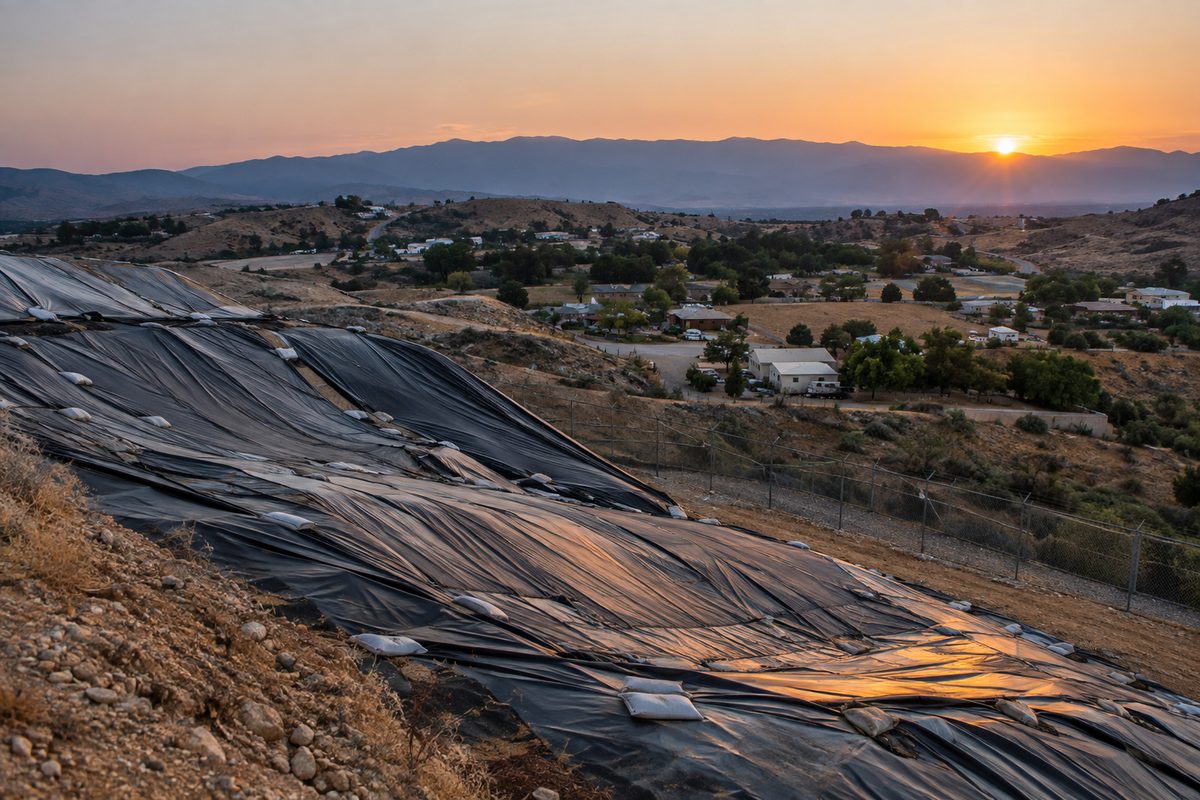
Neighbors of the Chiquita Canyon Landfill waited 657 days for L.A. County's health department to ask its owner to pay for them to move. The count is the California State Auditor's, published Tuesday in a report on how the Los Angeles County Department of Public Health handled the high-temperature chemical reaction burning underground at the landfill outside Castaic and Val Verde. The nearest households that complained of headaches, nosebleeds and nausea sit about three-tenths of a mile from the fence line, by the department's own analysis.
The reaction began in early 2022, and the landfill stopped taking waste in January 2025. Assemblymember Pilar Schiavo requested the audit, LAist reported. The report hands the county one clear pass: it credits the department's Solid Waste Management Program, which serves as the county's CalRecycle-certified local enforcement agency, with acting promptly and reasonably, ordering the operator to cover the reaction area and install temperature probes. What the auditor faults is the health work around that: watching the air, and telling the people living under it what the readings meant. We read the report and lined up its numbers.
What the clock says
657 days. The stretch between July 2023, when the department began responding to residents' health complaints, and May 2025, when it directed Chiquita Canyon Landfill, LLC to fund temporary relocation for affected residents. The department told the auditor it had held off because the operator was already running a financial-assistance program; the auditor noted that program didn't exist until March 2024 and was never meant to cover a move. As of the close of the audit's fieldwork, the report found no evidence the operator had complied with the directive.
22 days. What the same department took to act on relocation during the 2015 Aliso Canyon gas blowout, which its own documents at the time described in nearly identical health terms: no immediate danger, no expected permanent effects, short-term symptoms lasting as long as the odor did. LADPH's current leaders told the auditor the two events aren't comparable, because Aliso Canyon arrived fast and could worsen fast. The directives they wrote in 2015 don't mention either concern. The leaders the auditor interviewed have no firsthand knowledge of that response, the report notes, and could only speculate about their predecessors' decisions.
509 against 177. Days the county took to go to court over relocation: 509 for the landfill, 177 for Aliso Canyon. Los Angeles County sued the operator in federal court in December 2024, asking in part that it subsidize relocation and home hardening for affected residents. That case is still open. In its written response to the audit, the county says it won a preliminary injunction, lost time to the operator's appeal, and then watched a court rule its proposed remedy, temporary relocation for 938 homes, too broad.
What the county knows about residents' health
33. Average responses per month to the department's online odor-and-health survey during its long tail, January 2025 through February 2026. About 70% of everything the survey ever collected came in during the first stretch, late October through December 2024, the window residents had been told it would cover. The department then decided to leave the survey open and made no announcement; the only notice the auditor could find was rewritten copy on the survey's own web page.
More than 1,000. Total survey responses, from an unknown number of people. At a February 2026 meeting of the landfill's community advisory committee, the department's deputy director of health protection said the count could be 1,500 individuals, or one person 1,500 times, or 700 people twice: “I don't know and I don't think we captured it.” The auditor reviewed the raw data and agreed it can't be sorted that way. After Aliso Canyon, the report points out, the department knew how many households it had surveyed.
About 65. People who called, emailed or texted the department's public health nurse between July 2023 and January 2025, logging more than 650 contacts between them. That hotline is what the department fell back on after it closed the survey. By June 2026 the nurse was reporting very few contacts of any kind. So the county's working picture of who's sick near the landfill is mostly from late 2024, which the auditor says is neither current nor complete.
What residents were told
Nine months. The first gap in substantive written communication, March through November 2024. A second ran through nearly all of 2025 and January 2026. Between the February 2024 release of its consultant's health risk evaluation and a February 2026 fact sheet on odors and health effects, the department published no comprehensive written update at all. That's two years in which residents kept asking what a reference exposure level is. The February 2026 sheet, when it came, explained the term in plain language.
17 of 19, then 6 of 16. Advisory-committee meetings where the department spoke, before and after the start of 2025. When it did speak, the audit found, its updates averaged under 10 minutes inside meetings that ran two to three hours, and the committee didn't always give it a chance to answer the questions residents raised in public comment. The deputy director told the auditor the format allowed ample time.
17% to 60%. The share of residents who speak a language other than English at home in the communities closest to the landfill, by U.S. Census data cited in the report, depending on the community. The department never translated its consultant's health risk evaluation, or a summary of it, out of English. Its chief science officer said the material was too technical. The same contractor's soil-and-air investigation in City Terrace, published in 2023, had its executive summary translated into Spanish.
More than 90%. The share of stops where the department's canvassers left paper at the door because nobody answered, out of roughly 1,400 addresses in Val Verde, Hasley Canyon and Castaic in November and December 2024. The report calls that leaflet the most frequent way people learned the survey existed. It described a look back over the previous month. The survey's website described an open-ended daily diary. The audit treats the mismatch as one reason the data came back thin.
One finding in the auditor's report carries no number at all. Residents named mental health among their top concerns as early as September 2023, and anxiety, insomnia and stress were among the symptoms most often reported to the department. The department passed along the county Department of Mental Health's contact information once, in a February 2024 update to the Castaic Town Council, and the audit found nothing after that. Asked why, the chief science officer said mental health wasn't LADPH's purview. On another health-hazard response, the audit says, the department coordinated those resources itself.
Who acts next
Four of the auditor's six recommendations go to the Board of Supervisors. Two of those, both due by November 2026, are these: direct the department to post monthly assessments of any exceedance of a health-protective air threshold it finds, and direct it to go collect residents' symptoms on a schedule rather than wait for the phone to ring. In the county's September 3 response, the department wrote that the board wouldn't implement either. The auditor's reply, printed alongside it, is blunt: “The board's refusal to implement this recommendation indicates that it shares LADPH's disregard for the importance of collecting up-to-date health information from residents.”
The department did agree to write policies and procedures for health-hazard responses, to review its past responses, and to pursue enforcement if the state upholds its order against the operator. Its broader objection is that the audit graded it alone: the report “largely evaluates LADPH actions in isolation and not as part of a response structure created by federal, state, and local agencies,” the county wrote, naming the multi-agency team that includes the U.S. EPA, CalRecycle, the state air board and the South Coast air district. Schiavo, in a statement to LAist, put it the other way: “This audit confirms what residents have been telling us for years: the response to this public health crisis has not matched the seriousness of what families are experiencing.”
Two deadlines are live. The operator told the advisory committee in July that it expects to finish deploying the 100 acres of geomembrane cover the U.S. EPA ordered by December 1, which would still leave about 66 acres uncovered that the county's May 2025 order requires, according to the county's own enforcement manager. CalRecycle's hearing officer is meanwhile reviewing the operator's appeal of that order. If the order stands and the operator doesn't comply, the county can fine it up to $5,000 a day, move to suspend its permit, or go to superior court.
Sources: California State Auditor Report 2025-128, released September 29, 2026: the fact sheet, the full report (PDF), and the county's written response printed inside it. Also LAist. Retrieved September 30, 2026.
Comments 0