 ™
™
'Coyote vs. Acme' Is the Best Time We've Had at a Movie in Years
Warner Bros. shelved this finished Looney Tunes courtroom comedy in 2023 and took a $30 million write-off. It reached theaters on August 28, and it turns out to be a Frank Capra picture with a coyote in the plaintiff's chair.
The Walls of Jericho were a rope and a blanket, and in 1934 they were the most persuasive piece of legal fiction in American movies. Clark Gable strings them across a motel room in It Happened One Night, the blanket does the work of the entire Production Code, everybody watching knows the rule is nonsense, and the picture spends ninety minutes waiting for it to come down.
Ninety-two years later, a movie hangs it up again.
This time the motel is outside Albuquerque, the man who tears the blanket down is a personal-injury lawyer with a strip-mall practice and a billboard, and the party in the other bed is a coyote. It goes by fast enough to miss, and the film has the nerve to leave it there and keep going. Coyote vs. Acme is the best time we've had at a movie in years, and the reason is that blanket.
Dave Green, whose previous two features were Earth to Echo and Teenage Mutant Ninja Turtles: Out of the Shadows, robs Frank Capra twice here, out in the open, without a wink. The last act puts Will Forte in front of the Senate, which is Mr. Smith Goes to Washington, and Catherine Wheatley got there first in Sight and Sound — she calls Forte "a modern-day Jimmy Stewart," and he's one. Homage is a debt at this desk, and the question is always whether the film pays it. This one pays it back with interest, in a currency Capra didn't have.
Here's the part nobody says out loud, the movie included. Chuck Jones and Michael Maltese put Wile E. Coyote on a screen for the first time on September 17, 1949, in a short called "Fast and Furry-ous," and they built him to make fun of chase pictures. He was a genre joke before he was a mascot, and he's spent seventy-seven years being the second thing. Every live-action Looney Tunes feature since has treated him as merchandise with a name. Green uses him the way he was designed to be used and aims him at a different genre: what 1949 did to the chase picture, this does to the courtroom drama.
The first joke is in the fine print
You get it before the studio logo's finished. The Warner Bros. shield comes up, the camera pushes into the small type underneath, and beside an asterisk it says the studio is a wholly owned subsidiary of the Acme Corporation. Then 1992, an Acme laboratory, a cartoon scientist drawn as a caricature of Peter Lorre who's just got a package out of the building. Live-action security men corner him, he tells them they can't keep it hidden forever, and they disappear him down one of the company's own portable holes. Then a card comes up saying the film is based on a true story. Not one of those is explained, and none of them needs to be. That asterisk is the funniest piece of corporate typography we've seen in years.
The trap it was walking toward
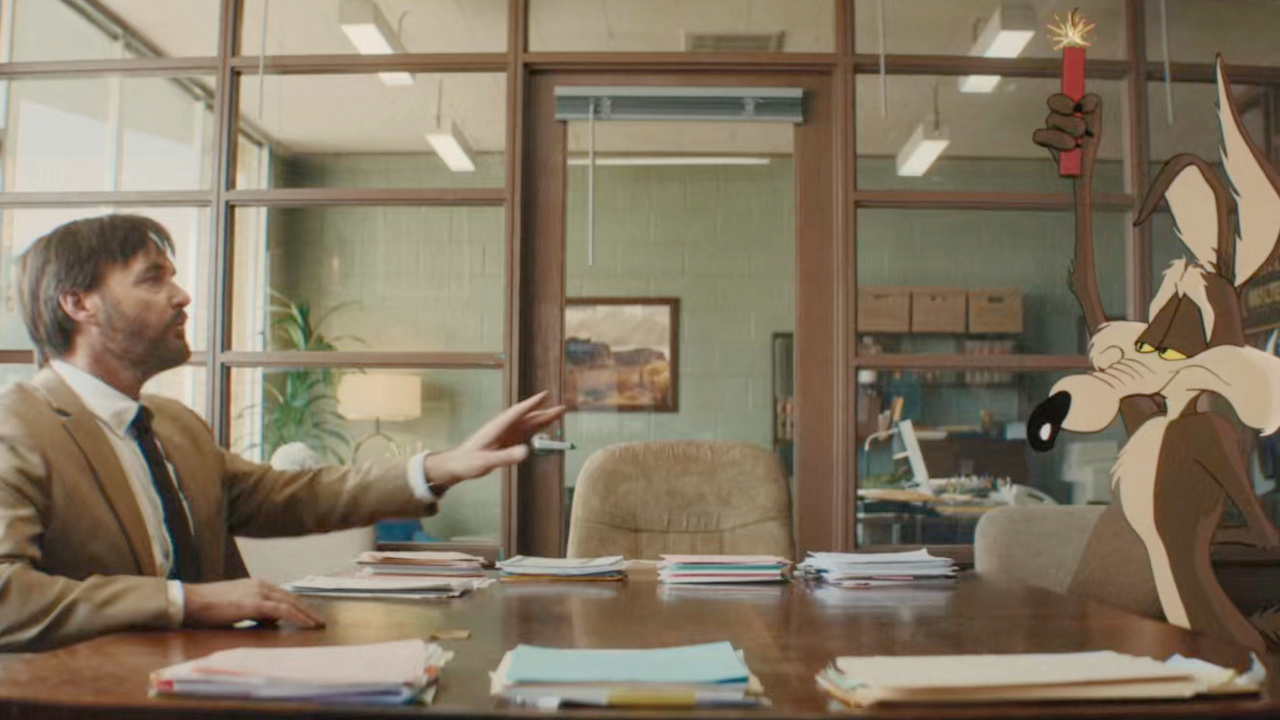
Praise is worth nothing until failure was on the table, so here's the specific way this could have died. Wile E. Coyote is funny because his pain doesn't count. That's the contract, and it has held through seventy-seven years of anvils: the joke survives every one of them because nobody in the frame is permitted to treat the damage as damage, least of all him. A film that puts those injuries into evidence has to make them matter, and the instant they matter the gag's dead and you're sitting in a hundred minutes of product-liability procedure with a sad dog at the plaintiff's table.
Green's answer is so simple it's almost rude. He never lets the coyote speak. Not a word, not a whimper of narration. Wile E. communicates in hand-lettered signs, held up fast and swapped faster, and the film's longest joke is a legal system built out of words trying to take a statement from a client who works in placards. He retains counsel by dumping every Acme product that ever hit him onto the floor as evidence, which is the greatest act of client intake ever put on film. Offered fifty thousand dollars to go away, he tears up the contract and sets it on fire. He stays a cartoon, the injuries stay funny, the case stays serious, and three things with no business holding together at once do.
The firm he walks into is Avery, Jones and Maltese, in a strip mall, with volumes marked Anvil Law on the shelves. Tex Avery. Chuck Jones. Michael Maltese. Two of those three men invented this coyote and the bird he's chasing, which makes the lawyers defending him named after the people who drew him. Nobody in the movie mentions it. Of course they don't.
Ian Frazier's 1990 New Yorker piece, the one this is adapted from, is an opening statement — Harold Schoff, for the plaintiff, before Judge Joan Kujava in Tempe, Arizona, itemizing eighty-five defective purchases and asking $38.75 million. Then it stops, because an opening statement is where that joke ends. Everything past the first minute of this movie is the part Frazier had no reason to write.
Adults in chairs, arguing about consumer goods
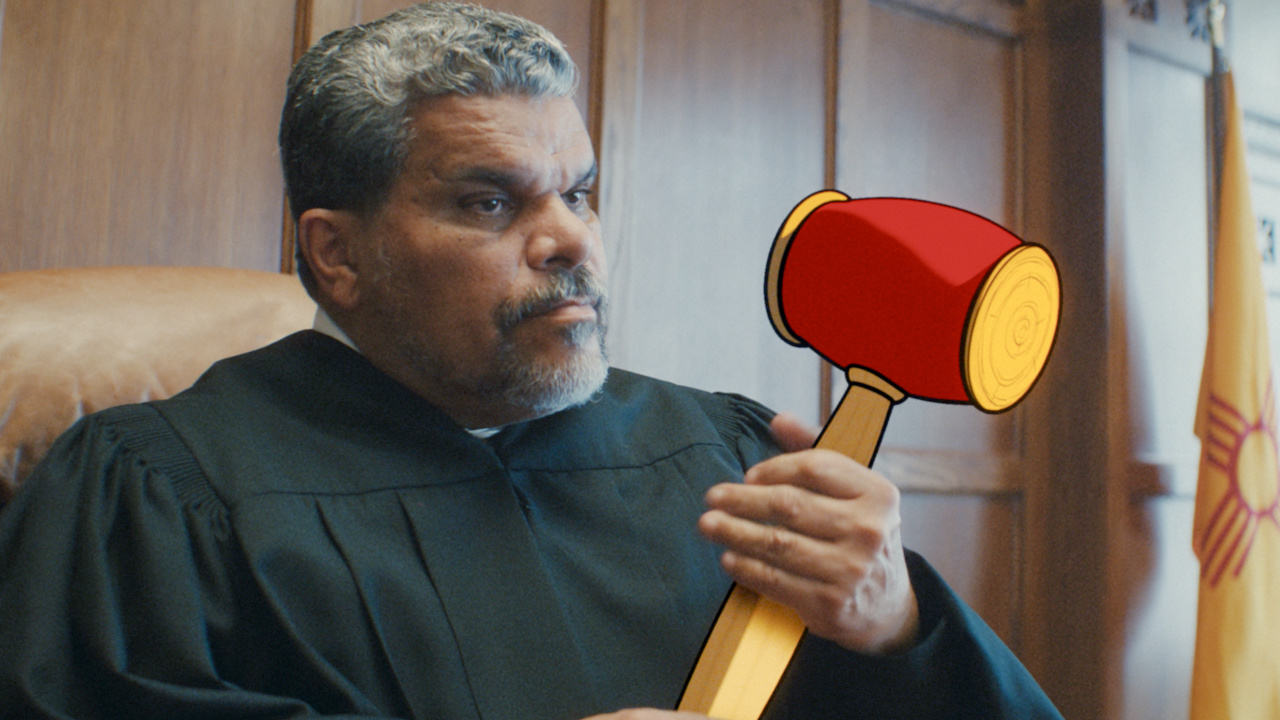
The middle of this film is grown-ups in a courtroom disagreeing about defective merchandise, and that's the best thing about it. On paper the talky hour is the toll you pay for the cartoon. It's the other way around. Luis Guzmán is most of the reason. His Judge Troppogrosso runs the room at exactly the temperature the joke requires, which is to say dead straight, and the gift Guzmán has always had is that he cannot be impressed. The jury box holds humans and Miss Prissy. There's a button on the bench for ejecting a witness from the stand, it gets used, and the judge declines to find that remarkable, which is the whole gag and it belongs entirely to him. Hand the man a courtroom every year.
Will Forte has the hardest job on the call sheet, and from the outside it looks like doing nothing at all. Kevin Avery is a billboard lawyer whose whole faith is procedural: file the thing, cite the thing, and the system will be embarrassed into behaving. Forte plays that faith as a belief a grown man actually holds, which is the choice that keeps it from collapsing into a bit. Then he argues on behalf of a client who answers in cardboard, and he never once tips you the wink that this is strange. Take him out and the picture is a cartoon with a lawsuit in it. Wheatley's Jimmy Stewart line is right, and it's a little generous to Stewart, who at least had other actors to look at.
Buddy Crane is Acme's counsel and was Kevin Avery's rival at Harvard, and John Cena plays him in a good suit and a bolo tie sized like a confession. He's never cruel. He's barely even rude. He simply never once looks like a man entertaining the possibility that he's wrong, and he holds that face through every reversal in the picture. Behavior is funnier than jokes, and a very large man declining to be troubled is behavior. His best move is procedural: Kevin calls Acme's head of public relations, the Tasmanian Devil, and Buddy has him removed from the courtroom before he can say anything. Cena has been funny before by doing more. Here he does almost nothing and lands everything, and it's the most precise work he's put on film.
Lana Condor has the job the movie can't do without, and she makes it look like the easiest part in the building. Paige Avery is Kevin's niece and an intern at the firm; her uncle wants the settlement and she wants the trial. In a lesser version she's the naive one, and the film spends two hours correcting her. Condor doesn't play naive. She plays awake — cheerful in the specific way of a person who has already finished arguing with herself — and the part is structural. In a movie whose plaintiff can't say a word, everything he isn't permitted to express has to land somewhere, and it lands on her. She carries all of it without ever once looking like she's carrying anything. The investigative half of the plot is hers, which is how Pepé Le Pew gets back into pictures for the first time since Space Jam: A New Legacy cut him in 2021. Granny demonstrates one of her husband's old inventions, a spray that repels predators, and Pepé bounds into frame at precisely the wrong moment. That's the correct amount of Pepé Le Pew.
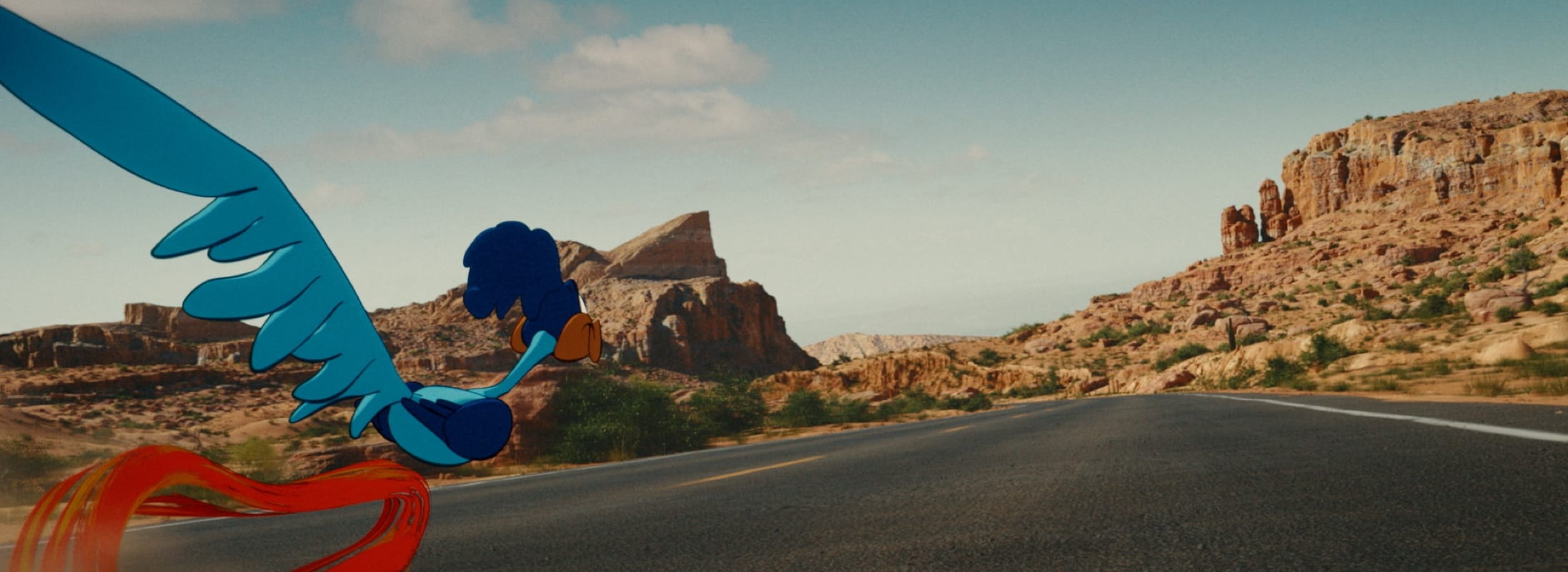
The Road Runner gets the best decision in the film and it belongs to the sound department. His beeps here are recycled from the original cartoons — the bird has been a piece of archive tape since Truman was president. And late on, the bird answers the coyote in the coyote's own medium: he holds up a sign. Green has settled the sixty-year argument about the noise itself, too — "it is spelled 'beep' in the movie," he says, which is a ruling only a man who took the case seriously would bother to hand down.
Everything the bird gets from a tape machine, Eric Bauza has to make by hand. He carries ten Looney Tunes parts in this picture — the credit pages agree on Daffy Duck, Foghorn Leghorn and Elmer Fudd, and cheerfully contradict one another about the rest — and not one of them shows up as an impression. That's the difficulty nobody bills him for. These are voices the public already owns, with settings it knows by heart, and the lazy version is a party trick collected in an afternoon. Bauza plays them as residents. The world around this courtroom feels lived in because of him. He has three Emmys for doing this, and after this picture the number looks low.
Three minutes, no dialogue
Then the film stops. The coyote can't tell his lawyer what's been done to him, so he shows him. Over the edge of a chasm. Down to the bottom. Back at the top a second later, and again. It runs about three minutes, there's no dialogue in it, and it isn't played for a laugh.
Sentiment has to be earned in the scene it's spent, and this earns it by changing nothing. Same fall. Same cliff. Same coyote you've been laughing at since you were four. Green declines to stop. He doesn't slow it down for significance, he doesn't cut away to a face for permission, and a gag you've known your whole life turns into a fairly accurate description of most people's week.
The screenplay is by Samy Burch, whose only other produced feature is May December, and we know how that sentence sounds. Take it or leave it: both are films about a visitor who arrives to study a life that got turned into other people's entertainment without permission, and in both the studying is the moral problem. Here the visitor bills by the hour.
What the vault was actually for
Worth setting down plainly, because the film has spent three years being congratulated for something it didn't do.
It was shot in and around Albuquerque between March and May of 2022, and finished. On November 9, 2023, Deadline reported that Warner Bros. Discovery would shelve the completed picture and take an estimated $30 million write-down on a roughly $70 million production. Nothing had gone wrong on the shoot, the cut wasn't unfinished, and it had tested 14 points above the norm for a family film. Four days later the Hollywood Reporter's Aaron Couch and James Hibberd reported that the studio had backed up far enough to let Green shop it elsewhere.
Then the part that tells you what the exercise was. On February 9, 2024, TheWrap's Drew Taylor reported that Warner Bros. wanted $75 million to $80 million, that Netflix, Amazon and Paramount all made offers, and that none was allowed to come back with a better one. A Warner Bros. executive had told the producer Chris DeFaria on a call that January, "They just want to get this behind them," and, "They want to close the books." The write-down was worth $35 million to $40 million to the company. On March 20, 2025, Variety's Rebecca Rubin reported that Ketchup Entertainment, an independent that had already put The Day the Earth Blew Up into theaters after Warner shopped that one too, was closing at a price reported around $50 million.
So the asterisk under the Warner shield is a coincidence with superb timing and nothing more. That joke was in the can a year and a half before the company did the thing it describes, and everyone calling the movie prophetic is handing Warner Bros. Discovery a writing credit nobody there earned.
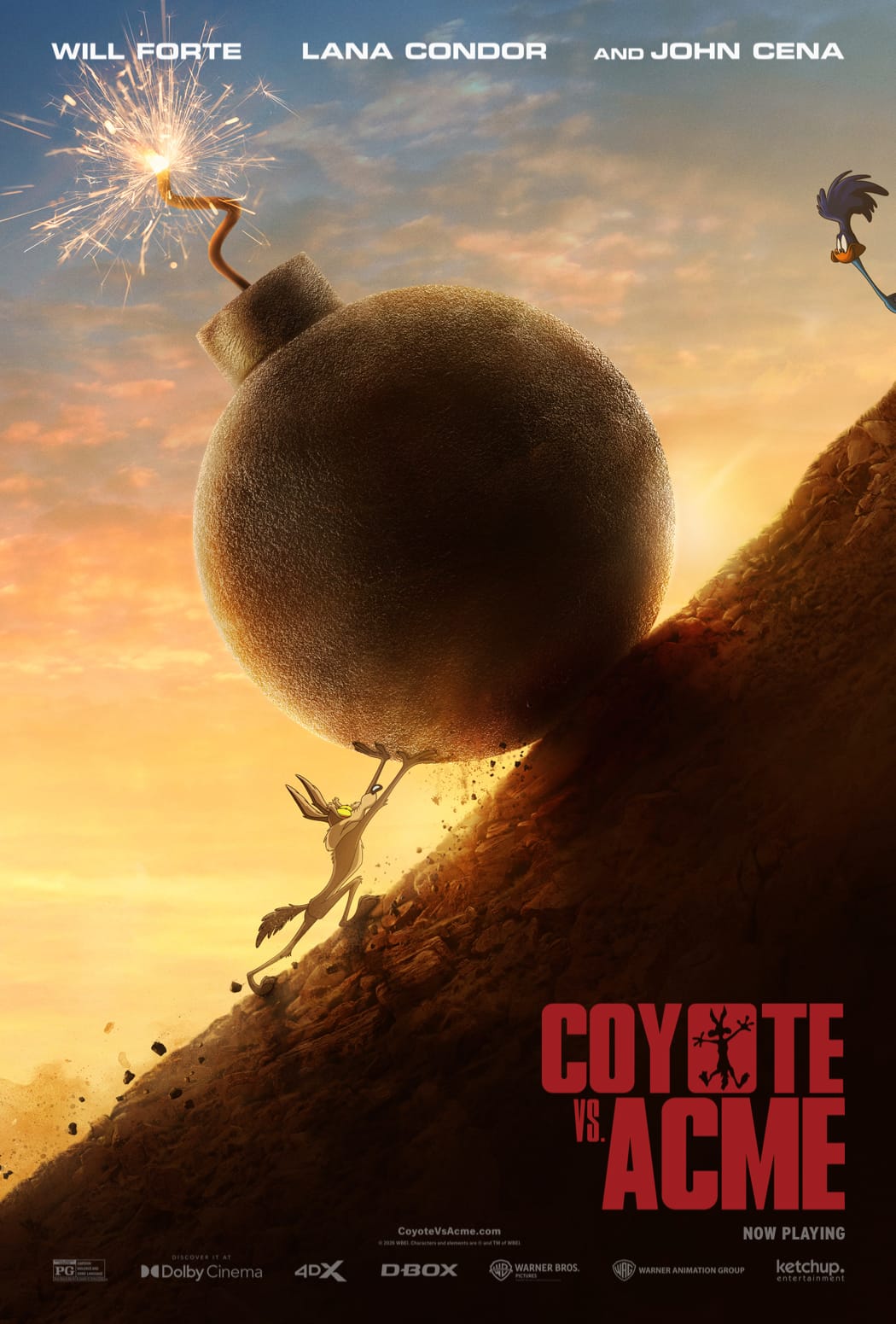
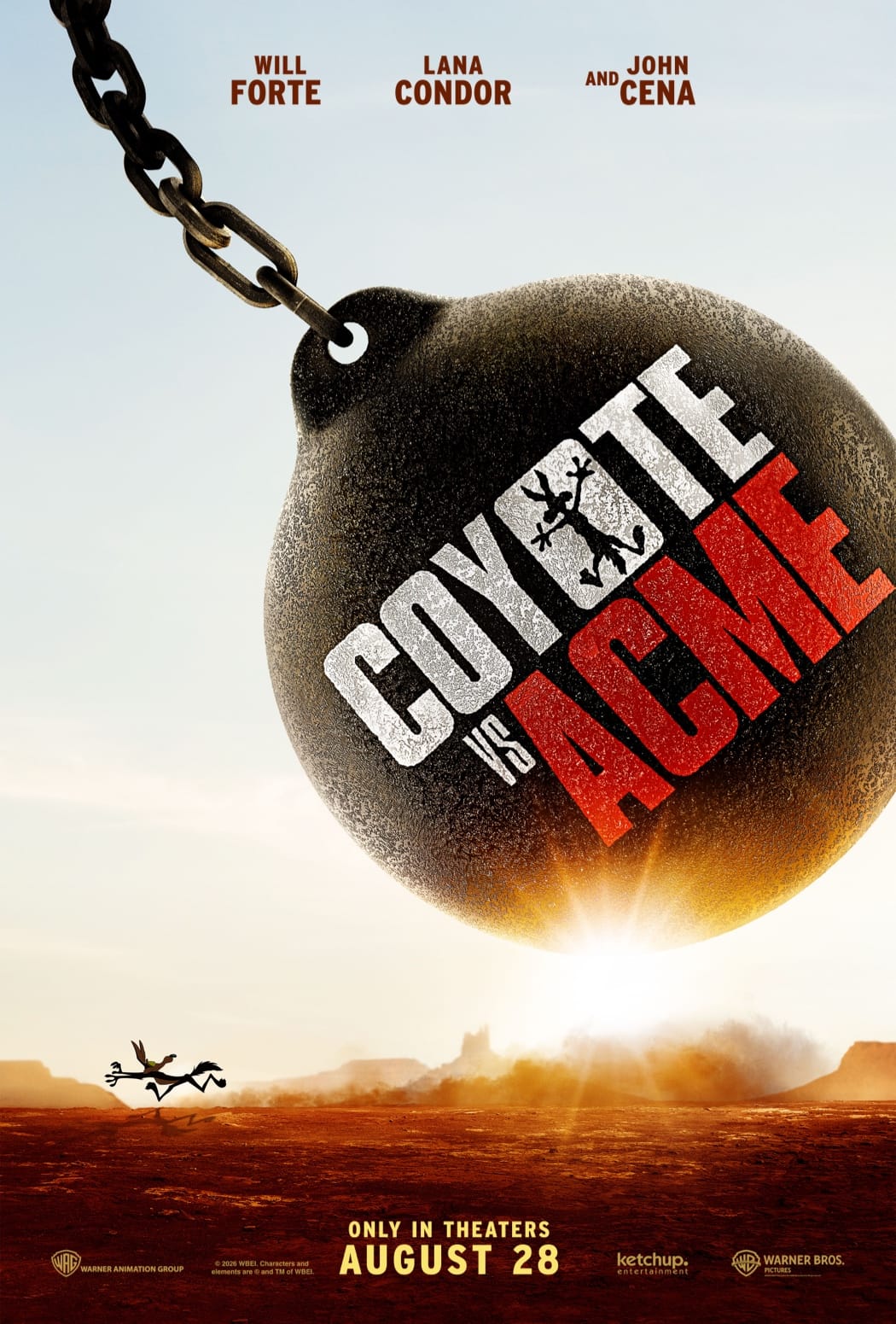
The one-sheet on this page is the distributor's own, off the film's official site, and its bottom edge makes the point without any help. Beside the ketchup. entertainment logo sit the Warner Bros. Pictures shield and the Warner Animation Group shield, and under the title, in type you have to lean in to read, the copyright line says © 2026 WBEI. The company that decided this film was worth more written off than released is still on its poster.
We read the aggregators on August 28 and again on August 29. Rotten Tomatoes went from 187 critics to 197 in a day and held at 95 percent, average rating 7.9 out of 10, beside a 94 percent audience score from more than 500 verified ratings; Metacritic moved from 42 critics to 44 and stayed at 77. We aren't unanimous company: Variety ran its review under the complaint that the fizz of anarchy is missing, which is the honest case against a Looney Tunes picture this disciplined.
Go, and take the right person
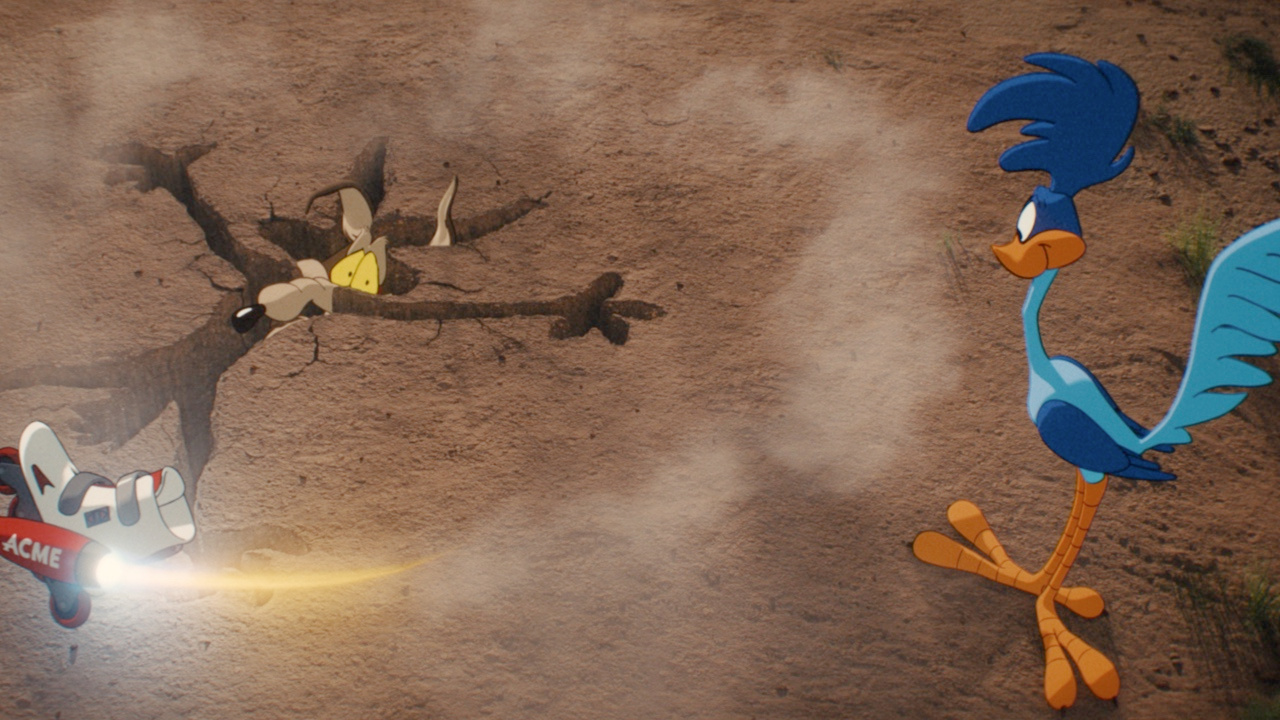
Go this weekend, and go to the largest screen your neighborhood has. The achievement is the compositing — ink sitting in the same room as photographed light, with a startling amount of the comedy resting on that seam holding — and a phone will take it away from you. It's rated PG for cartoon violence and some language, and it runs a hundred and one minutes, or a hundred and three depending which classifier you ask. A long stretch of the middle is adults talking, so bring a child who can sit through a deposition. If yours isn't there yet, play them one Road Runner short first. "Fast and Furry-ous" is one cartoon long and it'll do more than any trailer.
Two things we're keeping back. Wile E. has a reason for wanting a trial instead of a check, the film holds it a long time, and the back half turns on it. There's also a card at the end of the credits. Both are better cold.
Here's the one we'll give away, because it costs nothing and it's the best joke in the picture. Early on, needing to explain his own limitations, the coyote holds up a sign reading I HAVE A LIMITED NUMBER OF SIGNS. It plays like a throwaway. It's also a load-bearing beam, and the movie collects on it much later, once he and his lawyer have stopped being a client and an attorney and started being friends, and Wile E. works down through the stack and reaches the end of it. Seventy-seven years of placards. A hand-lettered card for every disaster a desert can produce. Nothing in the pile for this one.
Sources, all read August 28 and 29, 2026. On the shelving and the sale: Deadline on the 2023 write-off; the Hollywood Reporter on the reversal four days later; TheWrap on the failed sale and the quoted phone call; Variety on the Ketchup Entertainment purchase. Credits, character names, the firm's name and the order of events: the film's cast and production record, checked against the credit pages at Rotten Tomatoes and Metacritic. Eric Bauza's ten Looney Tunes roles and his three Emmys are CBS Los Angeles's figures; the Wikipedia and Rotten Tomatoes credit lists agree that three of those parts are Daffy Duck, Foghorn Leghorn and Elmer Fudd and disagree about the rest, which is why we name only the three. Ian Frazier's “Coyote v. Acme” ran in The New Yorker's February 26, 1990 issue; the court, the judge, the plaintiff's counsel and the damages figure are read off the piece itself. Scores, release date and rating: Rotten Tomatoes and Metacritic, which both list the runtime at 101 minutes; the British Board of Film Classification measured the print it classified at 102 minutes 47 seconds, and we print both rather than pick. Catherine Wheatley's review, and the motel and chasm scenes described from it, ran in Sight and Sound; the dissent quoted is Variety's. Dave Green's ruling on the spelling was given to SlashFilm. The poster is the distributor's own theatrical one-sheet, from the film's official site. The verdict above is the desk's own and it rests on a person at this paper having watched the film in a theater. We are not printing a screening date, a ticket price, or whether anything was comped, because none of it was logged at the time, and we would rather say so plainly than print a detail we cannot stand behind.
Comments 0