 ™
™County Estimates 1,600 Unsheltered People Live Around LA's 2028 Olympic Venues — With No Plan Yet for Where They Go
Los Angeles County's homelessness agency was told to plan for Secret Service security perimeters as wide as a mile. Officials have applied for nearly $93 million in state money and are asking LA28 to help pay.
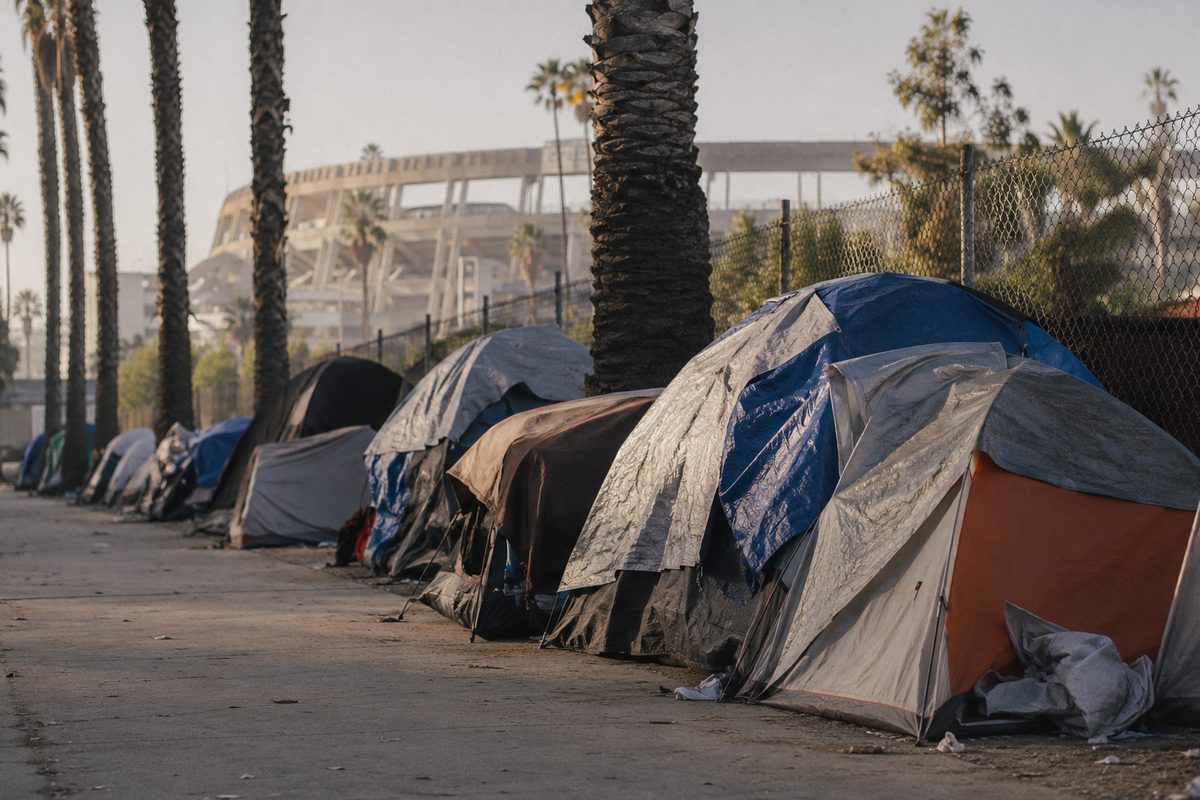
Los Angeles County officials estimate that about 1,600 unsheltered people are living in the areas around projected venues for the 2028 Olympic and Paralympic Games, and there is no plan yet for how they would be relocated, where they would go, or who would pay for it. That is the finding of a report published by LAist on August 4, 2026, two years out from the Games.
The figure comes from Carter Hewgley, chief strategy officer for Los Angeles County's Department of Homeless Services and Housing, who told LAist the number reflects the department's current needs assessment. Hewgley said his office had been told to plan for security perimeters as wide as a mile. He also said plans are likely to change as the Games get closer.
Red zones and yellow zones
The perimeters are set by the U.S. Secret Service, which is in charge of Games security. A Secret Service spokesperson told LAist the agency has not yet determined the exact areas that will need heightened security.
Brandon Dean, chief of special operations for the Los Angeles County Sheriff's Department, told LAist that perimeters will be divided into "red" zones directly around venues, where people and vehicles are screened before entering, and "yellow" zones marking a larger outer perimeter. Dean said he expected unhoused people would be able to remain in yellow areas, but not in red zones.
Venue locations named in the reporting include the Venice Beach Boardwalk, the Sepulveda Basin and Exposition Park. The Metro Los Angeles area — which includes Crypto Arena, the Peacock Theater and the Los Angeles Convention Center — saw its unsheltered population rise by about 20% this year, according to LAist. Countywide, the latest count found 49,002 unsheltered people. In the city of Los Angeles, homelessness is up 59% since 2016, the year before the city secured the bid to host the 2028 Games.
No single authority, and no dedicated money
There is no single authority coordinating or responsible for addressing homelessness during the Games, LAist reported. Gita O'Neill, interim chief executive of the Los Angeles Homeless Services Authority, told a Los Angeles City Council ad-hoc committee on the Olympics that organizers should establish an interagency task force to manage the issue before and during the Games.
Los Angeles City Council President Marqueece Harris-Dawson has introduced a motion requesting a report on how the city plans to clear encampments around Olympic locations, including how it would locate housing for people and recover the costs.
"If we've got a place where we know there's an encampment and we know there's going to be an activity there, how do we do encampment resolution?" Harris-Dawson told LAist. "How do we make sure it's done in a humane way? And how do we make sure it's paid for?"
City officials say they are committed to clearing encampments only if they can offer people at least temporary housing, but as of August 2026 there is no additional funding for such a project. Hewgley said officials have applied for nearly $93 million in state funding for "encampment resolution" around Olympic venues, some of it following the county's Pathway Home model, which clears encampments and moves people into interim housing.
City officials are also asking LA28, the private Olympics organizing committee, to help pay. Under an agreement with the city, organizers are expected to cover Games-related city services beyond what is "normal and customary." A recent LA28 human rights report submitted to the City Council deferred to city officials on homelessness, pledging to coordinate with local agencies and providers and to notify authorities as early as possible if an unhoused person needs to be relocated.
Los Angeles City Councilmember Katy Yaroslavsky, who chairs the budget and finance committee, pressed LA28 senior human rights advisor Julieta Valls Noyes at a council committee meeting. "Will LA28 ensure that the city or homelessness outreach organizations have the resources to engage unhoused residents who may be living inside a venue area or security perimeter?" Yaroslavsky asked. "Because, you know, we're not going to be able to do this on top of what we're already doing without help."
Noyes replied that she believed the mass displacement seen at past Olympics would be less of an issue in Los Angeles because organizers are relying on existing facilities rather than building new ones.
The 1984 benchmark
The last time Los Angeles hosted the Games, in 1984, police officers on horseback scattered people living on the streets of Skid Row beforehand, LAist reported; one police captain told the L.A. Times it was an effort to "sanitize" the city.
John Raphling, an organizer with the Los Angeles Community Action Network, told LAist that enhanced enforcement around big events is "never made up for with an enhanced effort to actually solve the problem… through keeping people in their permanent homes and developing more affordable housing and preserving the existing affordable housing."
Randall Kuhn, a UCLA professor who runs a monthly survey of the county's unhoused population, said he is worried about parts of downtown Los Angeles that are dense with tents being caught up in Games security plans. "What do they intend to do? What is the plan?" Kuhn said. "Is there an intention to provide any kind of genuine pipeline of care, a genuine pipeline to permanent housing? Or is this just gonna be sweeps that just push people just outside the perimeter?"
Comments 0