 ™
Claude's Riemann Hypothesis Collaborator Is Pictured at a Turkish Math Village
Anthropic's Levent Alpöge says he and Claude found the proof, and the Lean math community has certified the computer-checked version.
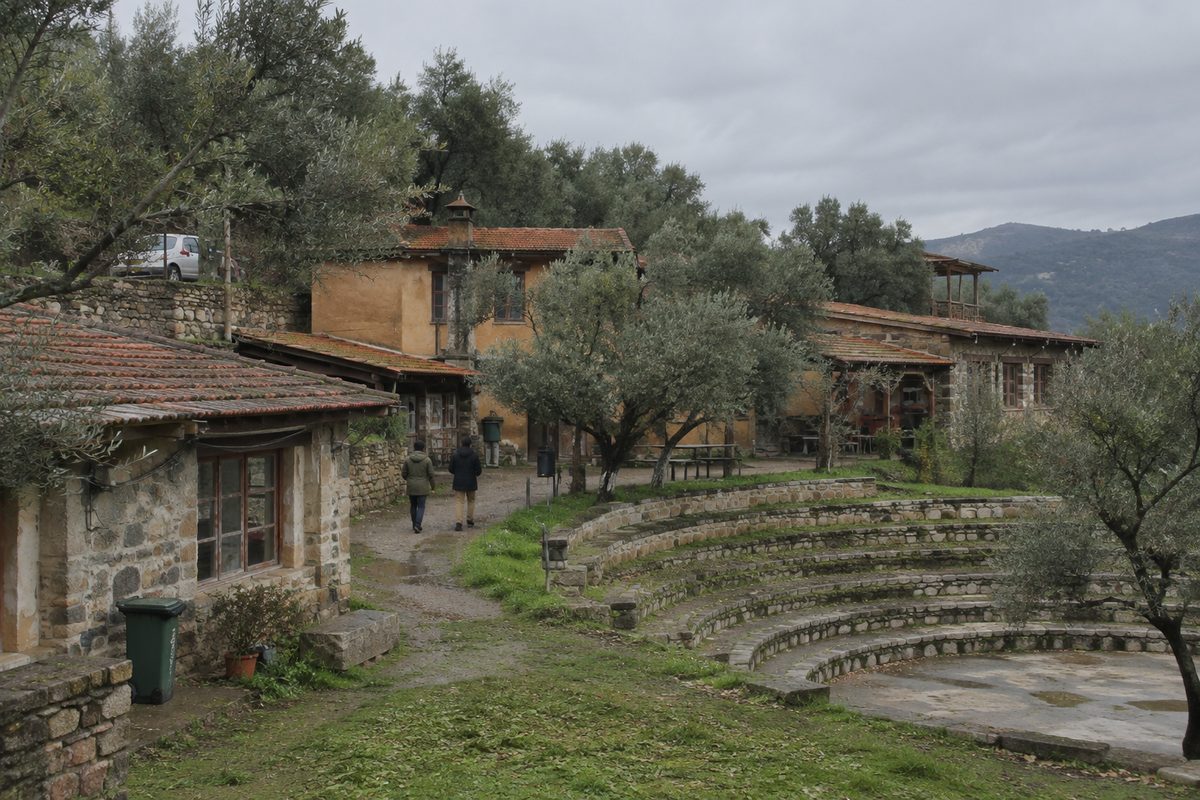
Levent Alpöge says he and Anthropic's Claude found a proof of the Riemann hypothesis, one of the most famous unsolved problems in mathematics. The photo of him people kept sharing Friday night puts him somewhere built for chalk, not code: a hillside math village in western Türkiye.
Derya Unutmaz, MD, who goes by @DeryaTR_ on X, posted the picture with a caption naming the place: the Nesin Mathematics Village, outside the village of Şirince near İzmir.
The caption is why it's spreading. On Friday, a four-page note claiming the proof appeared on Alpöge's personal site, and by Saturday Scientific American was reporting that the Lean and Mathlib communities had certified both the statement and the proof as correct.
"I believe I have, working with Claude, discovered a proof of the Riemann Hypothesis," the note opens, OfficeChai reported. It also claims the broader Generalized Riemann Hypothesis. There's no readable paper. The argument came out as code in Lean, a programming language that lets a computer verify a proof one step at a time, IBM Think reported.
He gives the machine plenty of credit. "Claude flew, and danced, and sparkled near that finish line," Alpöge wrote, in a passage TechRadar quoted. OfficeChai reported that one footnote makes a joke out of the scratch work: more than 250,000 pages of informal material written by AI.
That length is why the Lean code mattered so much. Kevin Buzzard, a mathematician at Imperial College London, had raised the first question: does the theorem in the code actually match the Riemann hypothesis, or something subtly different? MIT's Andrew Sutherland and other researchers then built the code independently without trouble, and a final check that the code doesn't quietly change the meaning of its own symbols has finished, according to Scientific American's Saturday update.
The setting in the photo is far older-fashioned than any of that. Mathematician Ali Nesin started the village in 2007, when 90 university students pitched tents in an olive grove about a kilometer from Şirince, Middle East Eye reported in 2019. One early student remembered the first building as chairs and two blackboards. By 2019, volunteer lecturers there were teaching about 10,000 students a year.
Upstairs from the library, in a Middle East Eye photo, university students sit in a classroom for a lecture covering number theory and the zeta function. That's the function the Riemann hypothesis is about. As OfficeChai explains, the hypothesis says all of its nontrivial zeros sit on a single line, which would mean the primes are spread out about as evenly as they possibly could be.
Alpöge saw the obvious objection coming, too. The note landed a day after what TechRadar called Anthropic's record-breaking $1.7 trillion stock market debut. Alpöge called the timing horrible and wrote that the obvious cynical view of it "is false," TechRadar reported.
A checked proof still isn't an understood one. Oxford's James Maynard, a Fields Medal winner, told IBM Think that proving the result valid wouldn't necessarily show why it works. Youness Lamzouri of the University of Lorraine said figuring out the ideas could take months or even years. "Mathematics is mainly about understanding why something is true," Lamzouri told IBM Think.
The computer says it's true. The why is still a job for people with blackboards.
Source: X, retrieved November 22, 2026. Other sources: scientificamerican.com, officechai.com, ibm.com, tech.yahoo.com, middleeasteye.net.
Comments 0