 ™
™The L.A. Screens That Can Still Run Film, Ranked by What's in the Booth
Three L.A. rooms are rated for nitrate, the stock Kodak finished converting away from in 1952. One runs film and nothing else. And the beloved single screen in Gardena has a film projector it isn't currently switching on.
A movie theater is a room with a machine in it, and for most of this century the machine has been a hard drive. Fine. But a working film booth is now a capital asset that a handful of Los Angeles rooms have chosen to keep, at real expense, and it is the only thing in moviegoing you cannot fake with a firmware update. So we compared the published projection specifications, seat counts and posted prices for every Los Angeles-area venue whose own material confirms a film projector, and ranked them on what the booth can physically do.
The criteria, stated once and applied without mercy. Format range first: nitrate outranks 70mm outranks 35mm outranks 16mm, because the rarest capability is the one that decides what a room can ever show. Then how often film is the house default rather than the special occasion. Then the room itself. Ties go to whoever posts a price where a reader can find it.
Number one is not close, and the reason is a film stock that has not been manufactured since the Truman administration.
1. The Egyptian Theatre — 6712 Hollywood Blvd.
Nitrate, 70mm, 35mm and DCP, in a 516-seat house built in 1922, per the American Cinematheque's own venue page — which also states the thing that ends the argument: the Egyptian is one of only five theatres in the United States that can project nitrate film. Kodak's own chronology of film marks 1948 as the year it announced a 35mm tri-acetate safety base to replace nitrate and 1952 as the year the conversion finished — "No more Nitrate." Every nitrate print in existence is therefore at least seventy-four years old, and this is one of five rooms in the country licensed to run one.
The economics behind that are not subtle. Netflix bought the theatre in 2020 and reopened it on November 9, 2023 after a restoration Variety reported at $70 million. Under the programming split, Netflix takes Monday through Thursday and the Cinematheque takes Friday through Sunday. Whatever you think of a streamer owning a movie palace, the streamer bought the palace a nitrate license.
2. The Billy Wilder Theater — the Hammer Museum, Westwood
The Hammer Museum's courtyard-level theater is the screening room of the UCLA Film & Television Archive, and its published technical specifications read like a taunt: 16mm mono optical and magnetic, 35mm in mono, Dolby Digital, DTS and four-track magnetic, 70mm in DTS and six-track magnetic, and the line that matters — "Rated for Nitrate." Four gauges and a nitrate rating, onto a screen the same document lists at 15.5 by 37 feet.
It sits second and not first because it is a university venue on a museum's schedule rather than a nightly cinema, and because the Egyptian has 516 seats and a marquee on Hollywood Boulevard. It does have the one advantage no commercial house can buy: the archive that programs it also owns the prints.
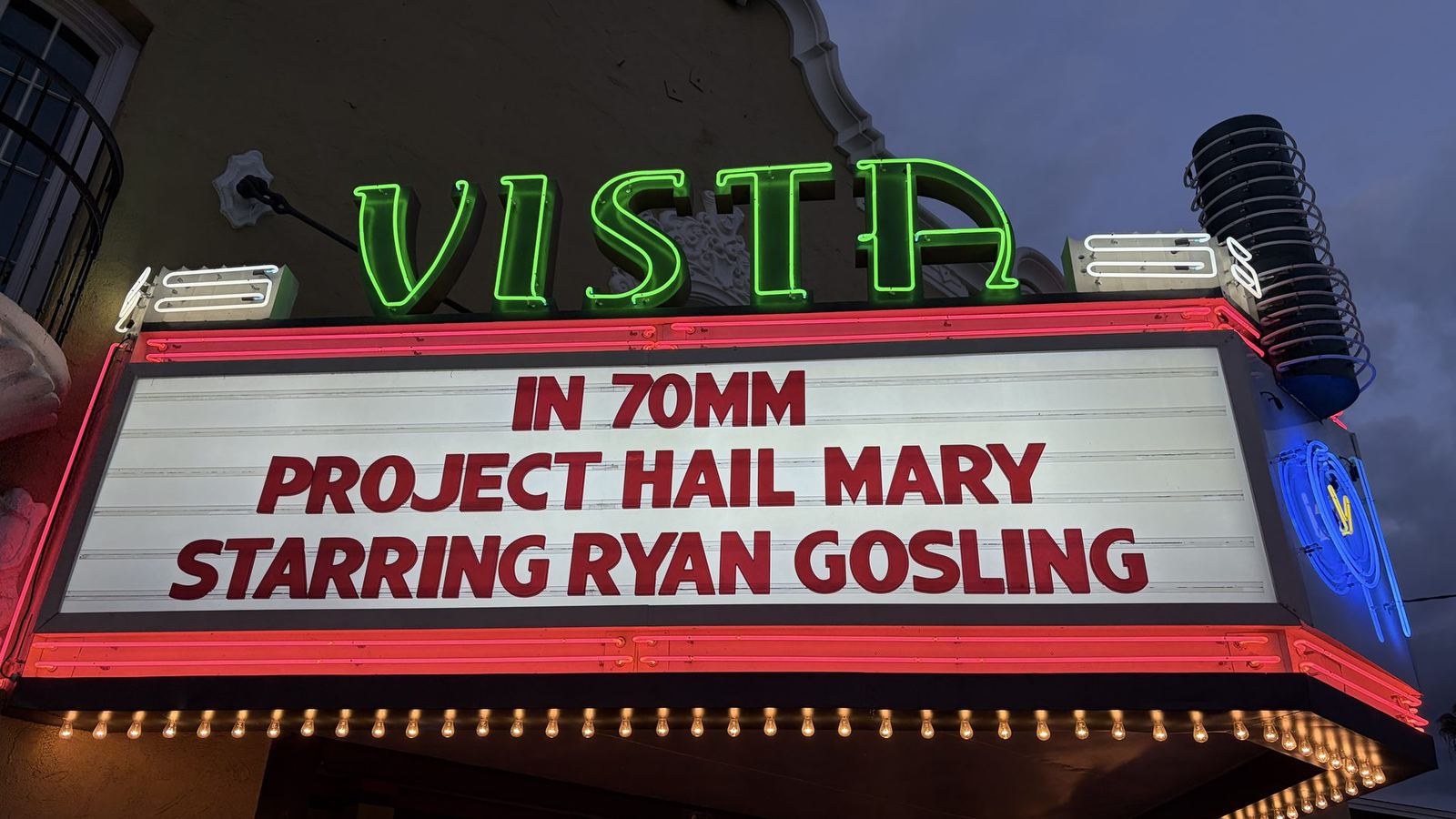
3. The Vista Theatre — 4473 Sunset Dr., Los Feliz
The pick we expect to argue about. The Vista cannot run nitrate and has fewer formats than the room ranked below it. It also has no way out. Its own site advertises the policy in five words — "All Shows Presented in Glorious 35mm or 70mm" — with no digital option listed anywhere, on a schedule that, on the August day we checked, mixed Christopher Nolan's The Odyssey in 70mm with titles from the 1930s and '40s.
That is the argument, and we'll defend it: format range measures what a booth can do, but a house that has kept no digital fallback has made film the product rather than the amenity. Quentin Tarantino has owned the 400-seat 1923 house since July 2021; it reopened November 17, 2023 with a new 70mm system and a café named for a 1973 Pam Grier picture, per LAist. Yes, we put a two-format house above a nitrate house. The nitrate house has a laser projector for the other six nights.
4. The David Geffen Theater, Academy Museum — 6067 Wilshire Blvd.
945 seats, and a booth that runs nitrate, 35mm and 70mm alongside 4K digital cinema with Dolby Vision, Dolby Atmos, Dolby Digital and DTS, per the museum's own theater specifications. On capability alone this is a top-two room in the country, never mind the city.
It is also, by a distance, the cheapest nitrate-capable seat in Los Angeles. The museum's visit page posts film screenings at $10 general admission, $7 for seniors 62 and over, $5 for students, $5 for children 17 and under and $5 for matinees, with members paying $2 less on the adult ticket and $1 less on every other tier — and states plainly that museum tickets are not required for film screenings. A $5 matinee in a 945-seat theater with a nitrate license is the best deal on this page and it is not particularly close either.
5. The New Beverly Cinema — 7165 Beverly Blvd.
Two gauges, no digital, seven nights a week. The New Beverly's own site states the format on every listing — "All Shows Presented in Glorious 35mm (unless noted in 16mm)" — and posts the prices most theaters bury: $12 for midnight shows, no discounts or passes, and $10 for the Kiddee Matinee, which comes with a free bag of popcorn for patrons twelve and under.
Sherman Torgan converted a shuttered adult theater into the repertory house in 1978; Tarantino, a benefactor for a decade before he bought it, is now owner and head programmer, and the theater's about page quotes his standing instruction: "I want the New Beverly to be a bastion for 35mm films. I want it to stand for something." It ranks fifth because 16mm and 35mm is a narrower ladder than the four rooms above it, not because anyone here is confused about which of them programs film most often. That would be this one.
6. The Aero Theatre — 1328 Montana Ave., Santa Monica
425 seats, 35mm, 70mm and DCP, in a 1940 Streamline Moderne house designed by R.M. Woolpert and named for the aerospace industry, per the American Cinematheque, which renovated it and reopened it in 2005 as the Max Palevsky Theatre at the Aero and upgraded the projection and sound again in 2019 and 2021.
Two upgrade cycles in three years on a booth that already worked is the tell. The Aero loses the format argument to everything above it and wins the argument nobody scores: it is the only 70mm room on this list you can walk to from the beach, and it is the home of an annual all-night horror marathon, which is a use case a hard drive has never improved.
7. The Nuart Theatre — 11272 Santa Monica Blvd.
35mm alongside 4K DLP digital and 7.1 Dolby surround, per Landmark's own listing for the theater, which also confirms the standing appointment: The Rocky Horror Picture Show, every Saturday at midnight.
The provenance is the ranking. The Nuart opened in 1930 with Sweethearts on Parade; the group that became Landmark Theatres bought it in 1974 and turned it into an arthouse by landing the Los Angeles first run of Pink Flamingos as a midnight show; Rocky Horror has run at midnight since 1976, and the shadow cast Sins O' The Flesh formed out of those audiences in 1988, per LAist. Fifty years of a single midnight is a programming record no format spec can beat, and the booth can still thread a print.
8. Brain Dead Studios — 611 N. Fairfax Ave.
163 seats with digital and 35mm projection, per LAist, in the room that opened in the 1940s as the Silent Movie Theatre, where John and Dorothy Hampton ran silents for thirty-eight years before it passed through several hands, spent a decade as Cinefamily and then sat empty until a streetwear label reopened it in October 2020.
The pricing is the most interesting thing on this list. Brain Dead's posted monthly film membership is $28 for unlimited standard tickets, one per screening, plus ten percent off merchandise and concessions and priority entry. Three visits a month and the model beats every single-ticket price on this page. Last in a ranking of eight is still eighth out of every screen in the county.
The four we could not rank, and why
Gardena Cinema, 14948 Crenshaw Blvd. The 1946 single screen has been run by the Kim family since 1976 and is listed by the L.A. Conservancy as a culturally significant property and a legacy business; it now operates as a nonprofit under Judy Kim. It holds both a film projector and a digital projector, and only the digital one is currently in use. A booth that isn't running is not a ranking entry, and we would be delighted to be corrected by a schedule.
The Los Feliz 3, 1822 N. Vermont Ave. Built in 1935 to a Clifford A. Balch design, triplexed in the early 1990s, and programmed by the American Cinematheque alongside the Egyptian and the Aero, per the Cinematheque's theatres index. The Cinematheque publishes format specifications for those two houses and not for this one. We did not rank what we could not verify.
Old Town Music Hall, 140 Richmond St., El Segundo. The building opened in 1921 as the El Segundo State Theater; two musicians installed a 2,600-pipe Mighty Wurlitzer, built in 1925, and reopened the roughly 180-seat room as Old Town Music Hall in November 1968, and it has operated as a 501(c)(3) since 1990, per the venue's Wikipedia entry. Its own site describes silent pictures run with live accompaniment on that organ, but publishes no projector gauge, so it stays off the ordinal list — with the note that a 1925 Wurlitzer is a format none of the eight above can match.
Alamo Drafthouse Downtown Los Angeles. Widely reported since it opened to keep a reel-to-reel 35mm system in one of its auditoriums. The chain's own location page publishes no projection specification, and reported-elsewhere is not the standard this list uses.
The re-rank is already scheduled
In July, Sony Pictures and Alamo Drafthouse announced plans to restore the Cinerama Dome and reopen the adjoining 14-screen complex — the former ArcLight — as an Alamo with 35mm capability for archival prints and premium screens including 70mm auditoriums, as Variety reported; Deadline put the reopening in early 2028. If it opens as described, a top-five spot changes hands on Sunset and this page gets rewritten.
Until then: three nitrate rooms, one film-only house, and a $5 matinee that gets you into the best-equipped theater in the county. We compared the specs; the rest is yours to argue with. The emails go to the desk.
Comments 0