 ™
™Every L.A. County Pier Where Fishing Needs No License, Ranked by What the Rest of the Night Costs
The state waives the license on a public pier and the county names seven of them. Malibu charges $12 for the car, Redondo charges $2 an hour, and the pier we put first has a free aquarium standing next to the parking kiosk.
The cheapest legal thing you can do on the water in Los Angeles County costs nothing and requires no paperwork, and the state says so in writing. The Department of Fish and Wildlife's rule is one sentence: "When recreationally fishing from a 'public pier' in ocean or bay waters, a fishing license is not required." A public pier, by the state's own definition, has to be connected to the shoreline, allow free and unrestricted public access, and have been built or currently function for the primary purpose of fishing. Los Angeles County's fishing page names seven of them — Cabrillo, Hermosa, Malibu, Manhattan Beach, Redondo, Santa Monica and Venice — and the state's list is longer than the county's, which is a jurisdiction line and not a legal one.
So the rod is free at all seven. Everything else about the evening is not, and that is what we ranked. The criteria, stated once: an entry has to appear on the state's public-pier list, because that is the thing that makes the rod legal without a license; the order argues from what each agency actually posts — hours, parking rates, rules, and what is standing at the end of the pier when you get there; and every figure below came off a city, county, state or operator page on the day we checked. We read the rules, compared the posted rates and counted the fine print. Nobody from this desk cast a line.
1. Cabrillo Beach Fishing Pier, San Pedro — $9 caps the car, and the aquarium next to it is free
Number one is not close, and the arithmetic is public. The Cabrillo Marine Aquarium's own admission page — which is also where the city posts the rate for the Cabrillo Beach lot — posts cars at "$3/hr per car with a $9 daily max," boats and oversized vehicles at $3 an hour to a $15 ceiling, and a $9 flat fee on city-observed summer holidays and special event days. Nine dollars is the worst case for a whole day, which is less than the Malibu gate charges before you have opened the trunk.
The building it pays for is the argument. The aquarium is "FREE to visit year-round, with a suggested donation of $10 for adults and $5 for children and seniors," open Tuesday through Friday from noon to 5 p.m. and weekends from 10 a.m. to 5 p.m., closed only on the Fourth of July, Thanksgiving, Christmas Eve and Christmas Day. No other pier in this county ends the day with a free aquarium and a nine-dollar ceiling on the car. The aquarium closes at 5. The fish do not.
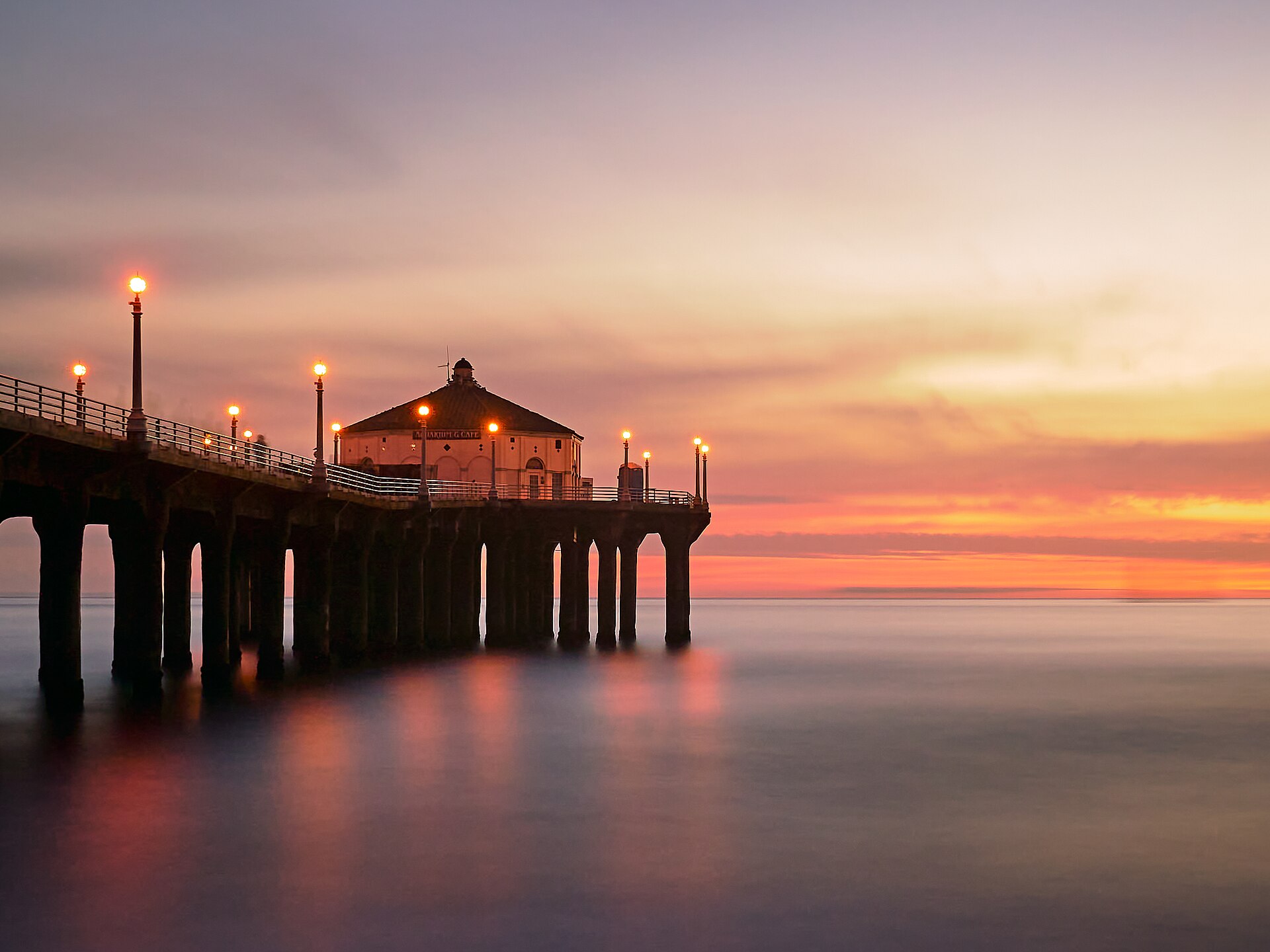
2. Manhattan Beach Pier — 928 feet, with the aquarium built into the end of it
The city's own facts page is admirably brief about it: "Manhattan Beach has a scenic 928-foot-long pier at the end of Manhattan Beach Boulevard. Fishing is permitted all year." The county's page for the same beach counts over 450 public parking spaces, restrooms, showers and lifeguards during daylight hours, and repeats the year-round fishing. What sits at the far end is the octagonal Roundhouse, "managed and operated by the nonprofit oceanic and environmental organization Oceanographic Teaching Stations, Inc.," per the aquarium's own about page, which posts April-through-September hours of "Mon-Fri: 2PM – 7PM" and "Sat-Sun 10AM – 7PM." On a weekday that is five hours, and the last of them is the good one.
It ranks second on two omissions rather than any flaw in the pier. The aquarium's pages we checked post hours and no admission price. The city's facts page posts the length and not the pier's hours. That is two of the three numbers an evening angler needs, missing from the two agencies most responsible for them, on the best-looking pier in the South Bay.
3. Hermosa Beach Pier — 1,140 feet, 6 a.m. to 10 p.m., and the longest list of things you may not do
Hermosa is the most thoroughly documented pier on this list, and the documentation is the reason it places here. The city's facility listing puts the pier at 1,140 feet from the Strand, at 1 Pier Avenue, open daily from 6 a.m. to 10 p.m., with restrooms. Sixteen hours of posted access, matched on this page only by Santa Monica — and Santa Monica does not post a length.
The rules are the trade. Fishing is allowed under Fish and Wildlife regulations, but the city's pier regulations prohibit overhead casting and throwing bait or litter, ban dogs outright, ban alcohol and smoking including vaping, ban skates, skateboards, bicycles and scooters, make it unlawful to dive or jump from the structure, and require swimmers and surfers to stay at least 100 feet away. Violations go to a state hotline, 888-334-2258. Read that list as an angler and it reads differently: the 100-foot rule is the reason you can cast off a crowded pier at 7 p.m. on a summer evening without hooking a bodyboarder. The dog ban is the line that will ruin somebody's evening at the gate.
4. Redondo Beach Pier — $2 an hour, 1,350 spaces, and pay stations that do not make change
The cheapest hourly rate we found posted at any pier on this list, attached to the most parking. The city's waterfront parking page prices the Pier and Plaza structures at "$2.00 per hour" across "1,350 spaces (combined)," both of them pay-by-space: note your space number on arrival, pay at any station, keep the receipt, and extend time using the code printed on it. The Pier structure is at 100 West Torrance Boulevard; the Plaza sits at North Harbor Drive and North Pacific Avenue.
The warning is printed in the city's own words — "Please use exact change or credit cards. The pay stations do not offer change. Refunds are not provided" — which is a specific way of saying bring a card. It ranks fourth because the city tells you precisely what the car costs and, on the pages we read, nothing about when the pier itself opens or closes. For a category where the whole appeal is fishing after work, that is the one number missing.
5. Santa Monica Pier — the famous one, fifth, and here is the case
The pick we expect to argue about. The most photographed pier in California is fifth on a list of seven, and its own paperwork does most of the arguing. The pier's FAQ says it is open "Daily from 6AM to 10PM," confirms fishing is allowed, and notes that "The Pier parking deck is open Monday-Thursday 9AM-8PM" — a deck posted for four days of the week, at the pier that draws the other three. Underneath it, at 1600 Ocean Front Walk, the Heal the Bay Aquarium charges $12 for adults and teens 13 and up, $10 for students and seniors 65 and over, $5 for children 4 to 12, $6 with an EBT card, nothing for children 3 and under with a paid adult and nothing for active and retired military and veterans — and opens Saturday and Sunday only, noon to 4 p.m. Eight hours a week.
The line that settles it is a health line, not a crowd complaint. Per Heal the Bay's own guide to fishing this stretch of the bay, the state's "do not consume" zone for white croaker begins at Santa Monica Beach just south of this pier and runs down to the Seal Beach Pier; the underlying advisory is the state Office of Environmental Health Hazard Assessment's. So the most famous pier on the list is also the exact point where the state's advice about eating what you catch changes. In its favor, and we would rather print it than receive it: Santa Monica is one of the few piers here whose operator publishes its hours at all, and it opens at 6 a.m. seven days a week. Fifth is not a punishment. It is what happens when a landmark is judged on its posted numbers instead of its skyline.
6. Venice Pier — reopened in 1997, and squarely inside the zone
Venice has the best comeback story on this page and the worst catch list. Heal the Bay's guide to the pier dates the structure to 1965, notes it "was closed for more than a decade starting in 1986 due to damage and disrepair, but was triumphantly re-opened to the public in 1997," and inventories what comes over the rail: mackerel, sardines, topsmelt, jacksmelt, corbina, white croakers, surfperch, opaleye, rays and some sharks. The county counts three parking lots with over 1,200 spaces behind it.
Now cross that catch list against the advisory. The same guide places Venice inside the red zone and names five species that should not be eaten from these waters — white croaker, topsmelt, barred sand bass, black croaker and barracuda — for elevated DDT, PCBs and mercury. Two of the five are on the list of what people routinely pull off this pier. It ranks sixth because more of the likely catch here is on the do-not-eat list than anywhere else we looked, which makes it a fine evening and a bad grocery run. Decide which one you are having before you pack the cooler.
7. Malibu Pier — $12 to park at a pier where the fishing is free
Last, and the state's own price sheet is the prosecution. California State Parks' listing for Malibu Lagoon State Beach, which takes in the pier, posts hourly parking at "$3.00," vehicle day use at "$12.00," and day-use parking hours of 8:00 a.m. to sunset, with fishing among the listed activities. Three hours at that meter costs $9, which is the all-day maximum at Cabrillo.
So the same government that waives your fishing license at this pier charges twelve dollars for the car that carries the rod, and closes the lot at sunset, which is the hour the fishing gets good. It is the most expensive posted door and the shortest posted day on this page. The pier is beautiful, and it sits north of the do-not-consume line the state draws at the Santa Monica Pier. Neither fact is a rate, and this ranking is about rates.
Not ranked, and why
Belmont Pier in Long Beach, the Avalon pier on Catalina, and the Shoreline Village and Shoreline Aquatic Park piers all appear on the state's public-pier list but not on the county's fishing page, which is a jurisdictional line: Long Beach and Avalon run their own waterfronts. The license rule at each is identical to the seven above. Avalon additionally requires a boat ticket, which is a different ranking with a different first line.
Jetties and breakwaters are out on the state's own stricter test: to qualify for the license waiver, they must additionally "form the most seaward protective boundary of an ocean harbor." A rock pile with people fishing on it is not automatically a public pier. Private piers are out on the definition's first clause — "free, unrestricted public access" — which is the part that does the work.
Two lines of fine print before anybody loads a car. The waiver ends where the pier ends, and the county says so bluntly: "Even if you hooked the fish on the pier and only came down onto the beach to land the fish, you would need a valid license." And no license does not mean no rules — minimum sizes, bag limits, report cards and seasons all still apply on a public pier, and the county's own summary caps you at two rods and lines. The rod is free at all seven of these. The car runs from $2 an hour to $12 a day, the aquariums run from free to $12, and the only real difference between the best evening on this list and the most expensive one is which agency put its prices on a page.
Comments 0