 ™
™The Perseids Peak Over a Moonless Sky. The Hard Part Is Being Somewhere That's Open at 2 a.m.
The moon sets 12 minutes after the sun on Wednesday and doesn't come back until after sunrise. Five places within reach of Los Angeles where you can legally still be standing at 2 a.m., two famous ones where you can't, and the closure orders that quietly took the old favorites off the board.
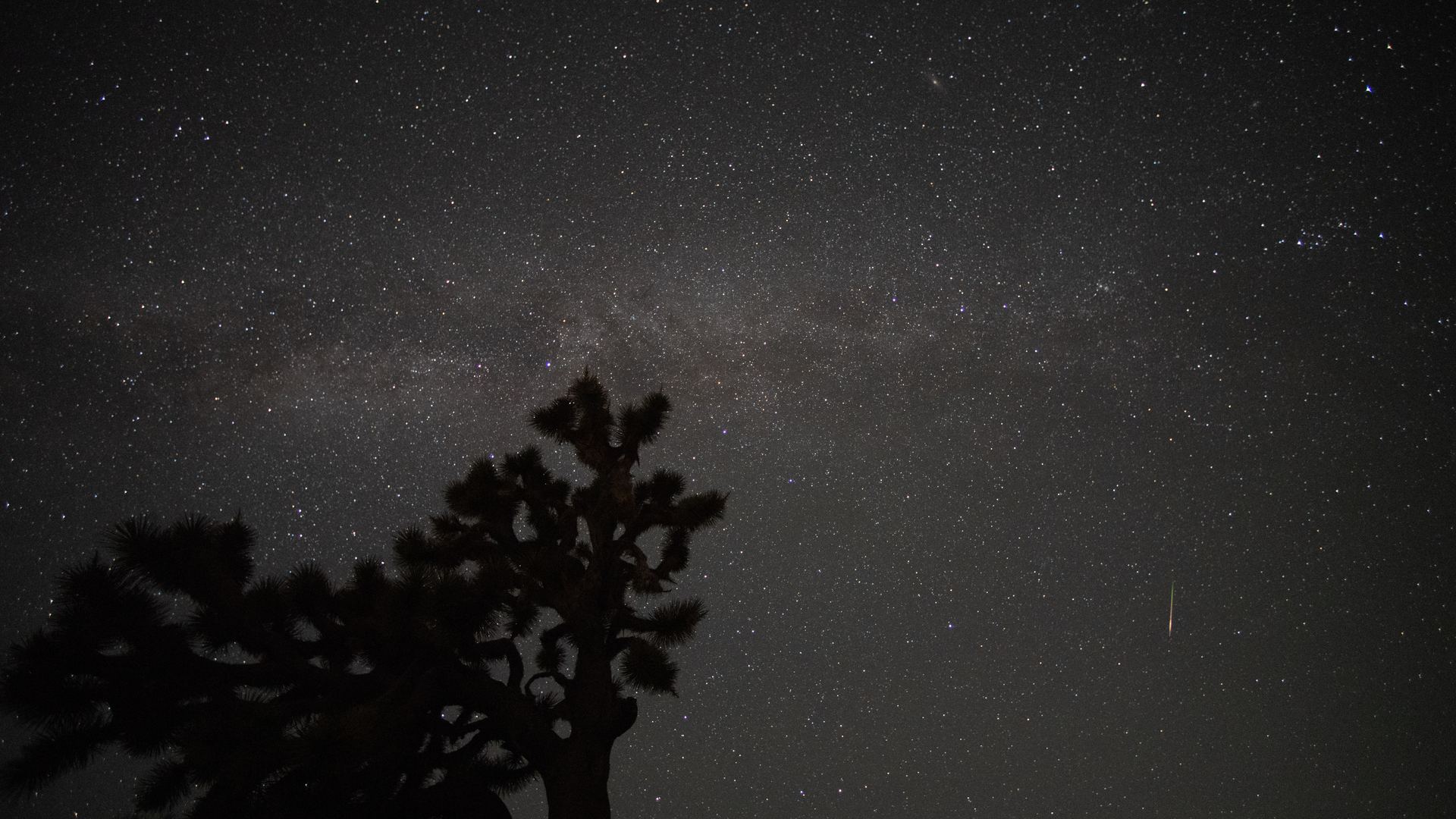
The arithmetic on this one is unusually kind. The moon is new at 10:37 a.m. on Wednesday, August 12, and on that date in Los Angeles it sets at 7:55 p.m. — twelve minutes after the sun, per the U.S. Naval Observatory's rise-and-set tables. It does not come back up until 7:14 the next morning, an hour after sunrise. Civil twilight ends at 8:10 p.m. From then until roughly 5:47 a.m. on Thursday there is no moon in the sky at all, which is why the American Meteor Society calls the conditions for this year's Perseids "optimum" and lists the moon at 0% full on peak night.
So darkness is handled. What isn't handled is where you are allowed to be standing when it happens — and in this county that turns out to be the harder problem. The shower does not get good until after midnight, and almost everything close to the city is shut by then. Not "quiet." Shut, by posted hour or by forest order.
Here is the clock, and then the map.
The shower itself. The Perseids run from July 17 to August 24 and peak on the night of August 12–13, with a zenithal hourly rate of 100 — a laboratory number that assumes a perfect sky and the radiant directly overhead. The society's own honest translation: "Normal hourly rates seen from rural locations range from 30–50 shower members per hour at maximum." The debris belongs to comet 109P/Swift-Tuttle, whose nucleus NASA puts at 16 miles across, on a 133-year orbit; it last came through the inner solar system in 1992, and the grains it left behind hit the atmosphere at 37 miles per second. NASA's viewing window: "best viewed in the Northern Hemisphere during the pre-dawn hours, though at times it is possible to view meteors from this shower as early as 10 p.m."
The weather, with the caveat it deserves. The National Weather Service forecast in effect Monday, August 10 puts patchy fog over downtown Los Angeles after 11 p.m. Wednesday under a mostly cloudy sky — the marine layer arriving at precisely the hour the sky is worth looking at. Inland and higher up, the same forecast package calls for mostly clear skies and a low of 52 at the top of Mt. Pinos, and partly cloudy at Joshua Tree and Borrego Springs. It is a two-day-out forecast on a monsoon-flavored week, with a slight chance of thunderstorms in the mountains before 11 p.m. Wednesday, so re-read it Wednesday afternoon at the Weather Service's own page before you commit to a two-hour drive.
Open all night, no asterisk
Mt. Pinos, the Chula Vista parking lot. The end of Mt. Pinos Road, at 8,300 feet, in the Los Padres National Forest — and the closest thing Southern California has to an officially sanctioned stargazing lot. This is not our characterization: the Forest Service's own recreation page says the lot "serves as a popular snow play area during winter and for star gazing due to the exceptional dark skies" — the agency naming the night use itself, on the page it publishes about the site. What it costs: nothing in August. The Adventure Pass is required in this lot and along Cuddy Valley Road only when snow is present; the page states plainly that "no fees are required during the spring thru fall months." The catch: there is no potable water, the Forest Service tells you to arrive "completely self-sustainable," and it will be in the low fifties at 3 a.m. while it is 80 at your house. If you want to sleep rather than drive back, the 12-site Chula Vista walk-in campground is a 500-yard walk from the lot, with a 14-day stay limit. One thing to read first: Los Padres forest order 05-07-00-26-05, in effect since June 4, bans campfires outside designated sites — a free California campfire permit exempts you for a stove, and nothing exempts you for a bonfire.
Joshua Tree National Park. "Joshua Tree National Park never closes," says the park's own stargazing page, which is the single most useful sentence in this article. It carries DarkSky International's Dark Sky Park designation, and the park is specific about which parts are actually darkest: Cottonwood Campground has the darkest skies of the nine campgrounds, and for people who'd rather not camp, "the Pinto Basin Road between Cholla Cactus Garden and Cottonwood has the least traffic and darkest skies." What it costs: $30 for a private vehicle, good for seven days, per the park's fee schedule; $25 for a motorcycle, $15 on foot or by bike. The catch: the light pollution is not uniform inside the boundary — the park says the towns around it affect different areas differently, which is the whole reason the Pinto Basin sentence exists. Drive the extra half hour into the interior.
Anza-Borrego Desert State Park. An International Dark Sky Park, and the neighbor of Borrego Springs, which holds the separate Dark Sky Community designation — the park says so on its own page. Day use is $10 per vehicle. The unusual part is the camping rule: the park defines its entire backcountry as a camping facility, which means open-desert overnights are permitted rather than tolerated, with a 30-day-per-year occupancy limit and 10 p.m. quiet hours. The catch: it is a genuinely hot August night out there — the Weather Service's Wednesday-night low for Borrego Springs is 77, with a Thursday high near 100. Bring more water than you think this requires, and don't plan on sleeping in the car with the windows up.
Open at 2 a.m. only if you are camping
Red Rock Canyon State Park. Twenty-five miles northeast of Mojave on Highway 14, and 120 miles north of Los Angeles by way of the 5 and the 14. Read the hours line on the park's own page carefully, because it contains the trap: day use runs sunrise to sunset, and "the campground is open 24 hours." Those two clauses are the difference between a legal night and a conversation with a ranger. What it costs: $6 per vehicle for day use, $25 a night for one of the 50 primitive sites at Ricardo Campground. The catch: Ricardo is first-come, first-served, with no reservation system at all, on peak night. Arrive in daylight or have a second plan.
Chilao, on the Angeles Crest. The nearest high ground to the city that is unambiguously yours at 2 a.m.: 5,300 feet, 26 miles northeast of the 210 in La Cañada Flintridge on Highway 2, 84 sites across the Little Pines and Manzanita loops, $20 a night per site plus $5 for a second vehicle, per the Forest Service's campground page. The catch is everything around it. Three standing orders shape this drive, and none of them is posted where you'd see it at 11 p.m.: the Eaton Fire area closure (order 05-01-26-04) runs through December 31, 2027 and takes the Mount Wilson Toll Road, Henninger Flats, Echo Mountain, the Sam Merrill trails, Idlehour, Castle Canyon and both Mount Lowe trails off the board entirely; Rincon–Redbox Road (2N24) has been closed since July 31 under order 05-01-26-13 for a rockslide; and the forest's fire danger has been posted at "Very High" since July 24. If you are only stopping at a turnout to look up, the Adventure Pass rules are on your side — the pass is $5 a day or $30 a year, and is not required "when traveling through the Forest and not stopping, when stopped for activities incidental to through travel." Parking a car somewhere in the dark for four hours is not incidental to through travel. The campground is the version of this plan that survives contact with a badge.
Closed before the good part
Griffith Observatory. The instinct is understandable and the Observatory itself would like you to stop having it. From its own page on meteors: "Because Griffith Observatory is surrounded by urban light glow, Griffith Park and the Observatory are not recommended as meteor shower observing locations, and are not open after normal closing time (10:00 p.m.)." The building is free, open Wednesday from noon to 10 p.m., and worth the trip on its own merits — the public telescopes, the planetarium, the view. It is simply not this trip. The shower's best hours begin after the gate closes, and the sky above the Observatory is the sky the rest of this article is trying to get you away from.
The Santa Monica Mountains. Closer, darker than the basin, and governed by a rule almost nobody reads until it is on a windshield. The National Park Service's hours page for the recreation area lists trails as "Open 24 hours" and parking lots as "8:00 am to sunset." Both halves are true at once: you may legally be on the trail at 2 a.m., and your car may not legally be in the lot that gets you there. That is a solvable problem if you have a legal roadside space and the discipline to find it before dark, and an expensive one if you improvise at midnight. Note too that those hours are the Park Service's own. The recreation area is run in partnership with other agencies — the Park Service's FAQ notes that California State Parks operates campgrounds inside the same mountains, under its own rules — so the hours you checked apply to the sign you are standing under and not to the next canyon.
The part that costs nothing
No equipment improves this. A telescope makes it worse: the whole sky is the instrument, and magnifying any part of it shrinks your odds. The Observatory's own instructions run to two sentences and are the only technique anyone needs — "Dress warmly and lie back on a deck chair or lounge, so you are looking up at the sky. Don't look at bright lights like flashlights or cell phone displays which can desensitize your eyes for ten minutes or more." Add the one from the same page that governs the schedule: "Most meteor showers are strongest after midnight and until dawn."
Which is the real argument of this piece. The moon has already done you the favor; the sky on Wednesday night is moonless from 7:55 p.m. straight through to sunrise. Everything left is logistics — a gate hour, a $6 day-use sign that stops at sunset, a forest order from January that closed the trail you were picturing. Check the hours, then check the forecast Wednesday afternoon, then leave earlier than you want to. The best hours of this thing start at midnight and every one of them is free.
Hours, fees, forest orders and rise-and-set times above were checked against the agencies' own pages on August 11, 2026. Park hours and closure orders change; the linked agency page wins over this one, and this page gets re-verified and updated in place at this address each August.
Comments 0