 ™
Mount Pinos Beats Joshua Tree for the Best Stargazing Near L.A.
The order weighs each spot's published Bortle sky-darkness rating against the drive from downtown Los Angeles.
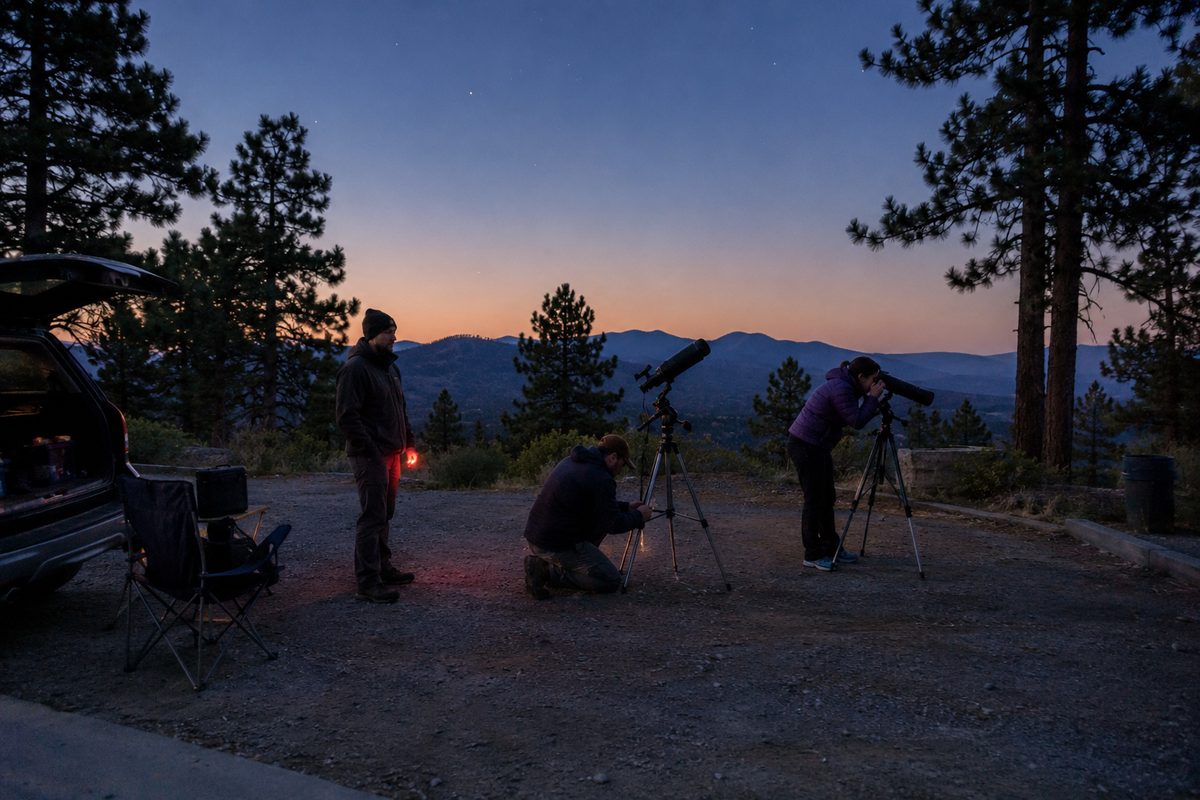
The best place near Los Angeles to see stars isn't Joshua Tree. It's Mount Pinos, 8,831 feet up in the Los Padres National Forest, and its season is nearly over.
Downtown lives under a Bortle 7 to 9 sky, according to Telescope Advisor's guide to stargazing near Los Angeles. The Bortle scale runs from 1, the blackest sky left on Earth, to 9, where the Moon, the planets and a handful of bright stars are about all that's left. This list weighs each site's published rating, from that guide and from Anand's Blog, an Orange County stargazer's own ranking, against the drive from downtown. Fees and rules are as each agency posted them Thursday. Nobody from the Globe went to any of these sites.
1. Mount Pinos. Telescope Advisor rates it Bortle 3 to 4, about 90 minutes from downtown, and notes that the Los Angeles Astronomical Society observes there. It isn't as dark as the desert. Anand's Blog argues that "the elevation does most of the work," putting you above the marine layer and the smog. It's cheap, too: the Forest Service lists no day-use fees at trailheads in the Mt. Pinos district, and Chula Vista Campground is one of its free, no-reservation sites.
2. Anza-Borrego Desert State Park. If darkness within a day trip were the only test, this would win. Telescope Advisor rates it Bortle 2 to 3 and about two and a half hours out, and Anand's Blog rates it a 2. California State Parks says the park is an International Dark Sky Park and Borrego Springs a Dark Sky Community. The blog gives the credit to the mountains ringing the valley, which block the glow from San Diego and the Coachella Valley.
Then there's the fine print. The park's camping rules say campground visitors who aren't staying overnight must be out by 10 p.m., so stargazing from a campground means a $35 tent site at Borrego Palm Canyon Campground. The visitor center and trailhead lots charge $10 a car, but the visitor center lot closes at 7 p.m. and the trailhead lots at sunset.
3. Joshua Tree National Park. The hot take, and I'll defend it: the famous one finishes third. Telescope Advisor gives it the same 2-to-3 rating and the same drive as Anza-Borrego. Anand's Blog rates even its darkest corner, the Pinto Basin, a step brighter at 3. The park itself says light from nearby towns cuts into its skies, and it sends stargazers to Pinto Basin Road between Cholla Cactus Garden and Cottonwood.
The best objection is access. Joshua Tree never closes, and its four designated stargazing lots, Hidden Valley and Cap Rock among them, have one rule: stay awake and within 20 feet of your car. Fair enough. Getting in still costs $30 a car for seven days, per the Park Service, except on fee-free days for U.S. citizens and residents. The next ones are Oct. 27 and Nov. 11.
4. Death Valley National Park. It's the darkest sky on the list and the farthest drive. The Park Service says DarkSky International rates it Gold Tier, the group's top rating. Anand's Blog puts it at Bortle 1 to 2 and the drive at four and a half to five hours, though that clock starts in Orange County. The blog's author, writing from his own nights there, says it's the one place where "the rating undersells it." The park's next Dark Sky Festival runs Feb. 5-7, 2027.
5. Angeles Crest Highway. It's about 45 minutes from downtown. Telescope Advisor rates its turnouts, between 5,000 and 7,000 feet, at Bortle 4 to 5 and names Charlton Flat and the Vincent Gulch pull-off as local favorites. The city's glow still sits on the southern horizon, and there are no facilities. Mount Wilson, about an hour out, gets the same rating.
6. Griffith Observatory. It's 30 minutes away and Bortle 8 to 9, according to Telescope Advisor, which calls deep-sky viewing there impractical. It's a fine place to look at Saturn. It's a better place to look at Los Angeles, and that's the problem.
Which brings it back to No. 1. Telescope Advisor says snow often closes the road up Mount Pinos from December through April. The Forest Service starts requiring an Adventure Pass for snow-play parking up there around Dec. 1. That gives the best dark sky near L.A. less than six weeks before it becomes a sledding hill.
Source: telescopeadvisor.com, retrieved October 22, 2026. Other sources: ndranandraj.com, fs.usda.gov, State of California, nps.gov, nps.gov (2), nps.gov (3).
Comments 0