 ™
™All Seven Metrolink Lines, Ranked by What a $10 Weekend Pass Buys. One Doesn't Run.
One test decides the order: what the pass can actually do starting from L.A. Union Station on a Saturday — beginning with whether there's a train back.
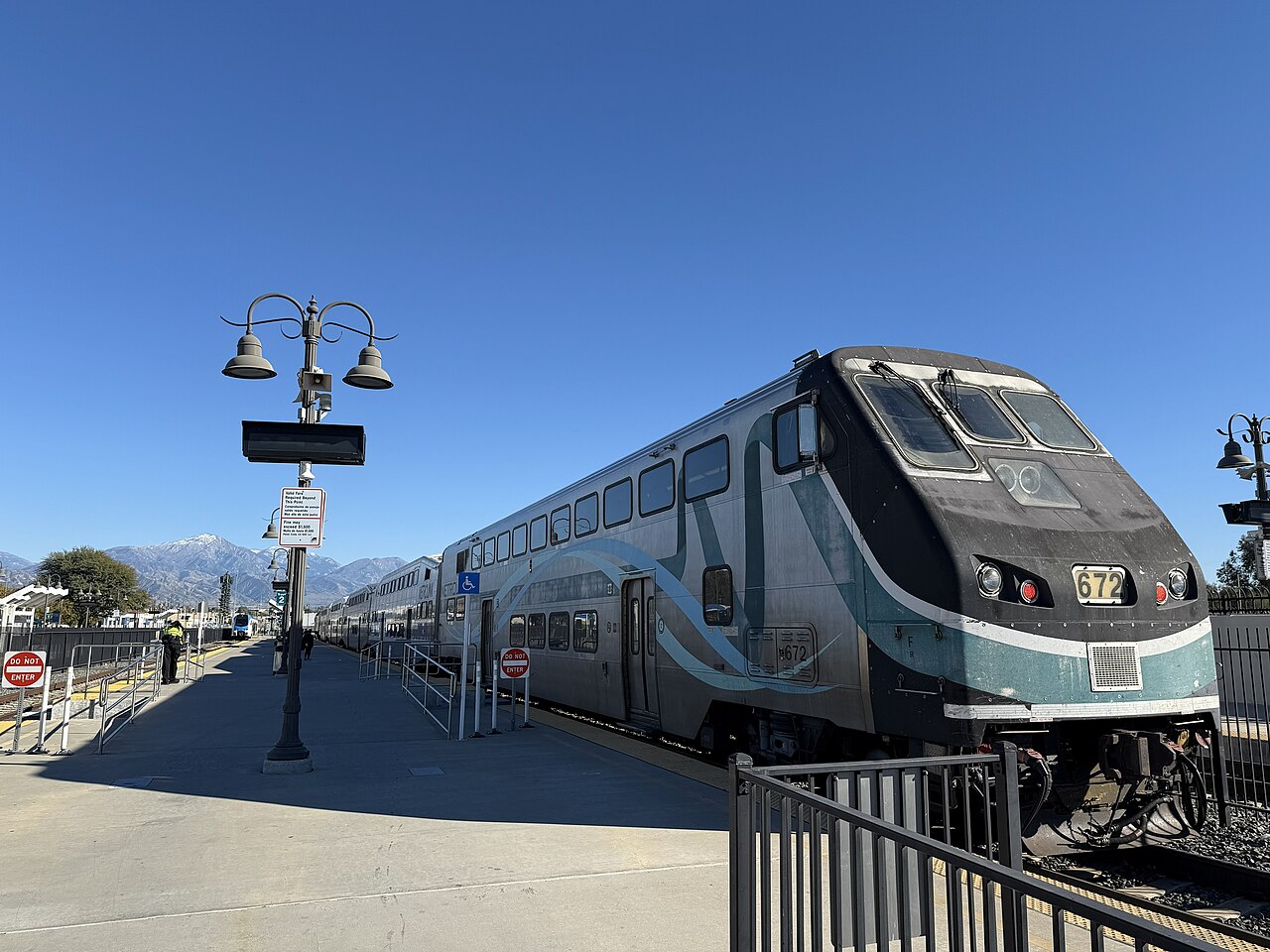
Ten dollars is the best transportation deal in Southern California, and it has three weekends left. Metrolink's SoCal Day Pass costs $10 on a Saturday or a Sunday, covers the entire system, and carries up to three children 17 and under free alongside the adult who paid. On Monday, October 5, it becomes $12. What it buys between now and then depends almost entirely on which of the seven lines you pick — and on one of them it buys nothing at all, because that line doesn't run on a weekend and Metrolink's own holiday-pass page excludes it by name.
So here are the criteria, stated once. We read the all-lines timetable effective May 4, 2026 and counted every Saturday–Sunday trip on all seven lines: 28 Metrolink departures from L.A. Union Station on a weekend day, and two lines that produce none. We priced the pass and the October increase off Metrolink's own fare pages on September 14, 2026, and we checked the posted advisories for every weekend the pass is still $10. The order is what the pass can actually do starting from Union Station — how many trains, how long a day it supports, and whether there's a train back. Nobody from this desk rode anything.
1. Antelope Valley Line — twelve trains each way, and the only weekend schedule in the system that runs on the clock
First place isn't close. The Antelope Valley Line prints twelve weekend departures out of Union Station and twelve back, and it puts every one of them at the same minute past the hour: 7:39 a.m., 8:39, then 10:39, 11:39, 12:39, and on through 8:39 p.m. Two hours are missing — nothing at 9:39 a.m., nothing at 6:39 p.m. — and those gaps are the worst thing on this line's page. Every other line here would take this schedule, gaps and all.
Six of the twelve go the distance to Lancaster, arriving at 9:52 a.m. and then 1:52, 3:52, 5:52, 7:52 and 9:52 p.m.; the other six turn around in Santa Clarita. The full run is 2 hours 13 minutes outbound and 2 hours 9 minutes back, for the same $10 that buys one stop. The catch is on the calendar, and it's a bad one: Metrolink's posted advisories show a complete suspension of this line on Saturday and Sunday, September 19 and 20, for track work, with no alternate transportation. The best weekend line in the system is shut on the next weekend you could use it.
2. San Bernardino Line — eight round trips, the fastest ride on this page, and a printed transfer to Redlands
Second is a speed argument. Eight weekend trains each way, and the end-to-end run is the shortest here: 1 hour 45 minutes from Union Station to San Bernardino–Downtown on the 8:38 a.m., and 1 hour 44 minutes coming back on the 6:38. Nothing else on this list carries you that far in under two hours, and the last train home — 7:38 p.m. out of San Bernardino, Union Station at 9:22 — leaves room for an actual evening at the other end.
It also hands you a second railroad without charging for it. The weekend table prints an Arrow row directly beneath the San Bernardino arrivals: the 8:38 a.m. pulls in at 10:23, and the Arrow train toward Redlands leaves the same downtown platform at 10:32. Nine minutes, one pass. The last train of the night doesn't get that: it arrives at 11:23 p.m. with no Arrow departure printed after it. And from the advisories again — no service at all between Los Angeles and San Bernardino on September 26 and 27 for a maintenance and rehabilitation project. Arrow runs its normal weekend schedule those two days, which is no use whatsoever to anyone starting in Los Angeles.
3. Orange County Line — four trains each way to the ocean, and the last one home leaves at 5:23 p.m.
This is the beach line, and it's short. Four weekend trains make the full run from Union Station to Oceanside, leaving at 8:40 a.m., 10:50, 2:00 p.m. and 4:27 and taking a little over two hours; the 8:40 is booked into Oceanside at 10:48. Two more trains appear in the same weekend table and will mislead anyone reading fast: numbers 1857 and 1859 are Inland Empire–Orange County trains passing through Orange County, and they never touch Union Station.
The number that decides your Saturday is 5:23 p.m. That's when the last northbound train leaves Oceanside, reaching Union Station at 7:38. Take the 8:40 a.m. down and you're at the coast by 10:48 with six and a half hours before the train goes. The Amtrak trains on the same corridor won't rescue you: Metrolink heads its Orange County Line Amtrak table "For Metrolink Monthly Pass Holders Only," and a day pass isn't a monthly pass. This line was suspended along with two others on September 12 and 13.
4. Ventura County Line — eight weekend trains each way, and only two of them are Metrolink's
The defended hot take. On raw train count this corridor should finish first: eight weekend trains each way, more than anything but the Antelope Valley. But six of those eight, in both directions, are Amtrak Pacific Surfliner trains riding Metrolink's codeshare. Metrolink's own weekend service on this line is two trains out and two trains back.
And its own two don't reach the beach. Westbound trains 1163 and 1165 leave Union Station at 10:31 a.m. and 5:07 p.m. and terminate at Ventura–East, 6175 Ventura Blvd.; the station called Ventura–Downtown/Beach, at 39 E. Harbor Blvd., is served on a weekend by Surfliners and nothing else. Eastbound, the two Metrolink departures are 1:10 p.m. and 4:14 p.m. out of Ventura–East, into Union Station at 2:58 and 6:00. It's a real day out — 1 hour 50 minutes on the morning train down, 1 hour 46 minutes back on the late one, and just under four hours in Ventura between them — but it's two trains, not eight.
Now the objection, and the answer. Metrolink's ticket-types page says the SoCal Day Pass "unlocks unlimited, systemwide travel on Metrolink trains and codeshare Amtrak Pacific Surfliner trains," and its codeshare page says "All Metrolink tickets and passes are valid on codeshare Amtrak Pacific Surfliner trains." Read those two sentences and this line wins the ranking outright. Then read the line further down that same codeshare page: "Metrolink free ride offers and fare promotions do not apply to Amtrak Pacific Surfliner trains, including Rail 2 Rail® and Codeshare." The $10 weekend rate is a promotion — Metrolink files it under Discounts, on a page it titles "Metrolink $10 Weekends." Nothing the agency publishes says which of those sentences governs a $10 pass boarding a Saturday Surfliner, so we rank this line on the trains Metrolink runs itself. It's also suspended, with the Antelope Valley Line, on September 19 and 20.
5. Inland Empire–Orange County Line — two round trips, and none of them come to Los Angeles
The IEOC is the only line here whose weekend timetable never prints L.A. Union Station at all. Two trains leave San Bernardino–Downtown, at 6:57 and 8:56 a.m., and reach Oceanside at 9:36 and 11:36; two come back, leaving Oceanside at 2:35 and 6:23 p.m. for San Bernardino at 5:05 and 9:01. Start your day at Union Station and this line's share of the $10 is a connection, not a trip.
It finishes fifth instead of lower because those four trains are doing double duty. They're the same 1857, 1859, 1858 and 1860 printed in the Orange County Line's weekend table, which is how a Saturday rider in Santa Ana or Orange ends up with more service than either line's own schedule appears to promise. It was suspended alongside the Ventura County and Orange County lines on September 12 and 13 for track projects.
6. 91/Perris Valley Line — two trains each way, and from Los Angeles they don't make a round trip
This is the sharpest thing in the whole timetable. The 91/Perris Valley Line runs two weekend trains toward Los Angeles and two away from it, and the four are scheduled so that a rider starting at Union Station can't get home. Both inbound trains arrive in the morning, at 9:19 and 10:21 a.m. Both outbound trains leave in the afternoon and the evening, at 3:25 and 7:20 p.m. Buy the pass downtown, board the 3:25, and nothing is coming back.
Run it the other way and it's fine: Perris–South at 7:07 a.m., Union Station at 9:19, 2 hours 12 minutes, home on the 3:25 p.m. The line is scheduled for people coming into the city rather than leaving it, which is a defensible thing for a commuter railroad to do with two trains, and a fact worth having before you spend $10 at the wrong end of it.
7. Riverside Line — nothing, and it's the one line the equipment crisis left alone
Last place is less a ranking than a subtraction. Where the Riverside Line's weekend columns should be, the timetable prints one sentence: NO SATURDAY–SUNDAY SERVICE ON THIS LINE. The front of the book repeats it — "No weekend service on the Riverside Line" — and Metrolink's holiday pass page writes the exclusion into the product, offering "unlimited same-day rides on all Metrolink train lines (excluding Riverside Line)." Seven lines; six of them are weekend railroads.
Then set that beside what happened in March. On March 23 Metrolink cut service after what it called "reduced train availability due to recurring mechanical issues and challenges sourcing replacement parts." We counted the trains named in the notice the agency put out: 32 suspended outright and eight more cut short of their published endpoints, spread across the Antelope Valley, San Bernardino, Orange County, Ventura County, 91/Perris Valley and Inland Empire–Orange County lines — all lines except the Riverside Line and Arrow service. The one line a weekend pass can't be spent on is the one line that kept its entire schedule. Metrolink says the reduced schedule "will continue beyond the seven weeks initially announced" and that it "will not return to the service levels in place before March 23."
Three weekends left, and two of them have a line shut down
We counted those, too. Between today and the fare change there are exactly three: September 19–20, September 26–27, and October 3–4. On the first, the Antelope Valley and Ventura County lines don't run. On the second, there's no service between Los Angeles and San Bernardino. October 3–4 is clear as of today, which is the most any advisory page can honestly promise.
What $12 buys
On Monday, October 5, the weekend and holiday SoCal Day Pass goes from $10 to $12 and the weekday version from $15 to $19; one-way tickets rise by roughly 14 percent depending on where you're going. The Metrolink board approved the change on June 26 after keeping fares flat for 13 years, citing rising operating and maintenance costs, lower post-pandemic ridership and declining state and federal funding. The $5 LA Zone Day Pass — Union Station, Glendale, Burbank–Downtown, both Burbank Airport stations, Cal State L.A., Montebello/Commerce and Commerce — doesn't move.
Two dollars is two dollars, so it's worth saying what the cheap version has been carrying. Metrolink logged 122,000 weekend boardings in March, Streetsblog L.A. reported in April, while the agency worked through a roughly $30 million shortfall and warned that cancelling weekend service improvements was among the options on the table. Every Metrolink ticket also includes free transfers to more than 50 connecting transit operators, which is the part of the $10 nobody advertises. And up to three children 17 and under still ride free on a Saturday with the adult holding the pass.
So: $10 for three more weekends, $12 after that. The Antelope Valley Line will take you the farthest on the most trains — on the two of those weekends it actually runs. And if you're standing in Union Station on a Saturday afternoon, don't get on the 3:25 to Perris.
Comments 0