 ™
™How to Hire a Contractor in L.A. Without Losing Your Deposit
The license check is free, the legal deposit caps at $1,000, and unlicensed work in a disaster zone is a felony.
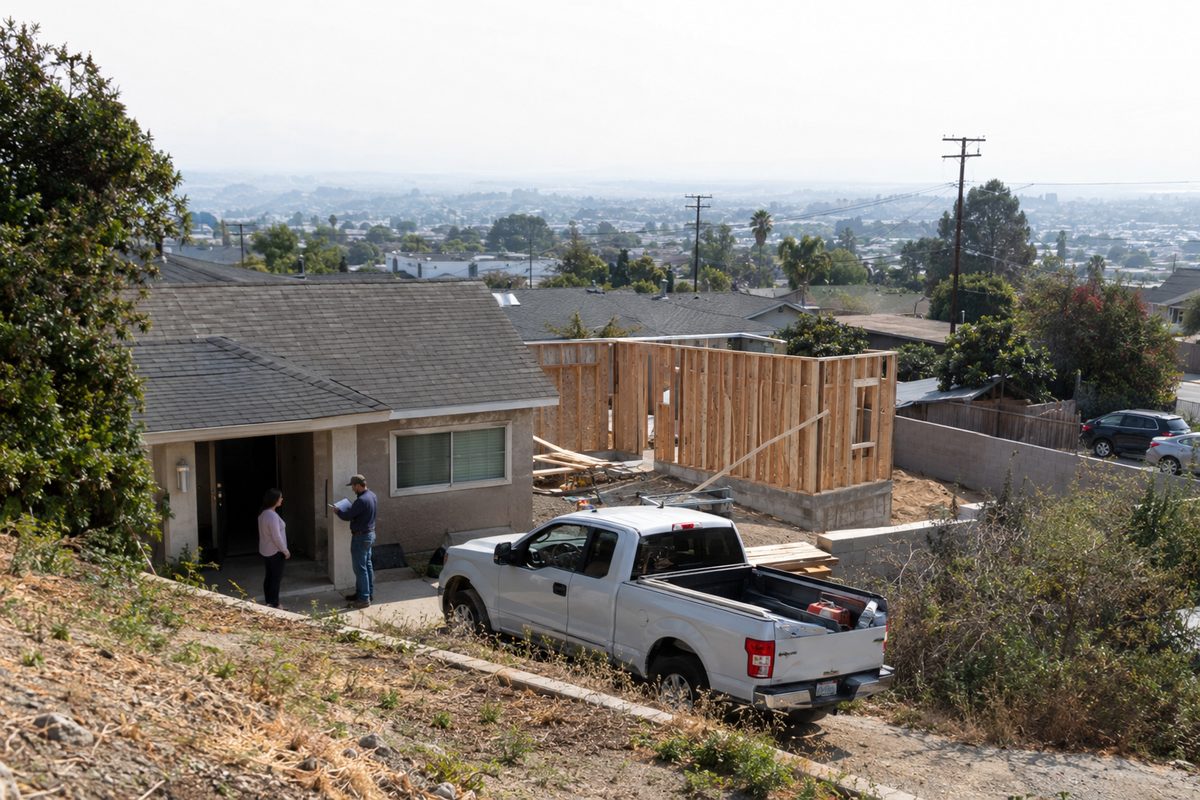
You're wondering whether you really have to check the license number on the card before the work starts. It's the one item on this list you can't do later. Los Angeles's own owner-builder notice says it in a sentence the city makes property owners initial: if you contract with someone who doesn't have a license, the Contractors State License Board "may be unable to assist you" over money you lose, and your only remedy "may be in civil court."
Hire someone licensed instead and seven sections of the state's contractor law start working for you — a $25,000 bond, a cap on what anyone can ask you for up front, a written contract you can hold them to, and a window to change your mind. We read those seven sections in the code itself, rather than the agency summaries of them, because two of the most useful numbers in here are buried in subdivisions nobody links to.
Start with the line that decides whether a license is even required. Section 7048 of the Business and Professions Code exempts a job only when the whole contract — "labor, materials, and all other items" — comes to less than $1,000 and "the work or operation does not require a building permit." That second clause is the one people miss. A $900 job that needs a permit is not exempt, and most real repairs need a permit. The exemption also evaporates if the person advertises as a contractor, or hires anyone to help, or if one job gets chopped into sub-$1,000 contracts — the statute names that last one as evasion, in those words.
In a fire zone, the stakes are criminal
Unlicensed work on disaster damage is its own crime, and L.A. County has been charging it. Section 7028.16 covers anyone acting as a contractor without a license on repairs to a structure damaged by a natural disaster for which the Governor or the President declared an emergency. The penalty runs up to a $10,000 fine, or 16 months, two years or three years in state prison, or both. The same sentence adds something worth knowing: a person who used the unlicensed contractor "is a victim of crime regardless of whether that person had knowledge that the contractor was unlicensed."
The Los Angeles County District Attorney's office charged five people in December 2025 over unlicensed contracting in Altadena, inside the Eaton Fire zone, after an operation the license board ran. The office's Consumer Protection Division is prosecuting them. Six more were charged on June 26 of this year after investigators from the District Attorney's Bureau of Investigation and the license board set appointments at a Pacific Palisades address to take bids on an accessory dwelling unit and a demolition; none of the six held a license or had an application pending, and together they bid as much as $1.27 million, Fox 11 reported.
One caveat the code can't settle for you: both the felony and the seven-day cancellation window below attach to damage from a declared emergency, and no statute tells you whether a declaration still reaches your address today. That's a question for the license board or the county, not for a reading of the code.
1. The license number, before the estimate
The board's license lookup takes five different things, so a missing license number isn't a dead end: the license number itself, the business name, a person's name, a home improvement salesperson registration number, or that salesperson's name. What comes back includes complaint disclosure, which is the part worth reading twice. The board's phone line is (800) 321-CSLB, or 2752.
If the person pitching you isn't the contractor, there's a second check. A home improvement salesperson has to be registered with the board, and section 7152 requires them to identify the business name and license number of the contractor they're representing before they do any soliciting, selling or negotiating. Not after the pitch. Failing to do it is grounds for discipline, which means a door-knocker who won't name a license number has already given you your answer.
2. What the $25,000 bond is actually worth
Every licensed contractor files a bond, and section 7071.6 sets it at $25,000. It isn't $25,000 per job. It's one bond for everything the contractor takes on while it's in force, and the money is split among whoever files against it.
Then read subdivision (b), which almost nobody does. The surety's total liability on claims is capped at $7,500 — except for the beneficiaries named in section 7071.5(a) and (b), whose claims get the rest reserved exclusively for them. Subdivision (a) is "a homeowner contracting for home improvement upon the homeowner's personal family residence." So a homeowner remodeling the house they live in can reach the full $25,000, and an unpaid supplier or a neighbor shares a $7,500 pool. The gray zone: the statute doesn't define "homeowner" or "personal family residence," and a rental, a flip or a property held by a trust or an LLC is not obviously inside subdivision (a). If that's your situation, the bond is not the protection you think you bought.
Even inside subdivision (a) the ceiling is low against real L.A. prices. NBC Los Angeles reported in September 2024 on two county homeowners left by the same company: one in Whittier had paid $84,000 of a $104,000 garage-to-ADU conversion, one in East Los Angeles had paid $200,000, and both projects were abandoned, with the claims landing on a single $25,000 bond. A board representative told the station it recognizes $25,000 may not be enough, but that it's what the law currently requires.
3. The contract, signed before anybody starts
Section 7159 applies once the aggregate price of one or more improvement contracts passes $500, and it's blunt about the timing: the contract and every change to it has to be written and signed by both sides "prior to the commencement of work." Not after the demolition. The document has to carry the contractor's name, business address and license number, the contract price in dollars and cents, and a description of the project including the materials and equipment.
Change orders follow the same rule. L.A. County's own rebuilding presentation, given on July 24 with the license board and the county's consumer agency on the panel, puts the requirement as a checklist: a change order is in writing, signed by both the homeowner and the contractor, and states the work added or changed, the cost increase or decrease, and the effect on the schedule. The county's consumer affairs department reduces the whole section to four words on its slide: no contract, no protection.
4. The deposit: $1,000 or 10 percent, whichever is less
This is the number to memorize. Under section 7159.5, "the downpayment shall not exceed one thousand dollars ($1,000) or 10 percent of the contract amount, whichever amount is less." On a $90,000 rebuild the legal deposit is $1,000, not $9,000 and certainly not half.
Everything after the deposit is governed too. The contract needs a payment schedule in dollars and cents that points at specific work or specific materials, and, the deposit aside, the contractor may neither request nor accept a payment that "exceeds the value of the work performed or material delivered." There's one real exception, and it's the one a serious outfit offers rather than argues about: a contractor furnishing a performance and payment bond, a lien and completion bond, or a bond equivalent or joint control the registrar has approved "may accept payment prior to completion." If nobody has mentioned one of those and the ask is still 40 percent up front, the ask isn't legal.
Paragraph (6) of the same subdivision is the one almost nobody uses, and it's the strongest tool a homeowner has. After any payment and before the next one, the contractor has to get you a full and unconditional release from anyone who could file a mechanics lien for the work you just paid for — if you ask. And the statute says plainly what you can do while you wait: you "may withhold all further payments until these releases are furnished." That's how a homeowner stops paying twice for the same lumber when a general contractor isn't paying the subs.
5. The cancellation clock, which is longer than you think
Three different windows exist, and the county's consumer agency lays them out in one place. Seven business days if you're in a declared disaster area. Five days for a door-to-door sale at your home or temporary residence. Three days for a contract signed away from the seller's usual place of business — a fair, a trade show, a pop-up office.
The seven-day version is written into section 7159 for a contract to repair or restore residential premises damaged by a sudden or catastrophic event under a declared state of emergency. The clock runs to "midnight of the seventh business day" after you got your signed and dated copy, the notice has to be in writing, and once you send it the contractor has ten days to return anything you've paid. You don't owe anyone a reason.
6. Whose name goes on the permit
Section 7048 already told you most of this work needs a permit. The question is whose name is on it, and the city of Los Angeles cares enough to make you initial the answer. Its owner-builder declaration — the form the Department of Building and Safety won't issue a permit without — opens on the practice it exists to stop: "a frequent practice of unlicensed persons is to have the property owner obtain an 'Owner-Builder' building permit" that makes it look as though the owner is doing the work themselves.
Sign it and you're the responsible party of record. The form spells out what that costs: you may be liable for injuries to an unlicensed worker on your property, and your homeowner's insurance may not cover them. Engage anyone other than licensed contractors on construction worth $500 or more and you may count as an employer under state and federal law, which means payroll withholding, workers' compensation and unemployment contributions. Item three of the same form names the alternative in the city's own words — that you may protect yourself by hiring a licensed contractor and having the permit filed in that contractor's name instead of your own.
You can check whether the permit was ever pulled. The department's online building records return permits and their inspections by address, with building permits available back to 1905 and certificates of occupancy to 1940. The records are informational rather than official, so for a certified copy you're going to a branch office.
7. Where the complaint goes
Start with the contractor, in writing, which is both the sensible first move and the one the board expects: it publishes a sample demand letter for exactly this. The complaints it actually receives are narrower than people assume, and the categories are statutory — abandoning a job without legal excuse, work that departs from accepted trade standards, failing to complete the work for the agreed price, and unreasonable delay. If what's gone wrong fits one of those, it fits a complaint.
For unlicensed work, there's a separate route and a reason to use it fast. The board's "Fraudulent or Unlicensed Activity" form feeds its Statewide Investigative Fraud Team, and the board says a timely report is what lets it dispatch them. The county's presentation asks for the details that make that possible: the name, vehicle information, location, dates and type of work, with photos or video if it's safe to take them. The board's disaster help center carries the same instructions.
L.A. County also has a free local office, which is the part most people don't know exists. The Department of Consumer and Business Affairs answers questions and takes complaints one at a time, at (800) 593-8222. And if the money is gone and the contractor was never licensed, the city's own form has already told you where this ends: civil court — and for a loss small enough to fit its ceiling, small claims is the cheap end of it.
One last clock, because it's the one people start late. The seven days run from the moment you take your signed copy, not from the day the first truck shows up — and after you cancel, the contractor has ten more to give the money back.
Every figure above was checked on October 4, 2026 against the text of Business and Professions Code sections 7028.16, 7048, 7071.5, 7071.6, 7152, 7159 and 7159.5 on the Legislature's own site, the Contractors State License Board's disaster help center and license-lookup pages, Los Angeles County's July 24, 2026 rebuilding presentation, the city's owner-builder notice and its online building-records page. This page is not legal advice; where a linked source and this page disagree, the source wins. It is re-verified and updated in place at this address.
Comments 0