 ™
Google Says AI Agents Built Its Dancing Jack-O'-Lantern Robot From Scratch
A DeepMind builder says AI agents produced the 12-degree-of-freedom robot from a single plain-English prompt.
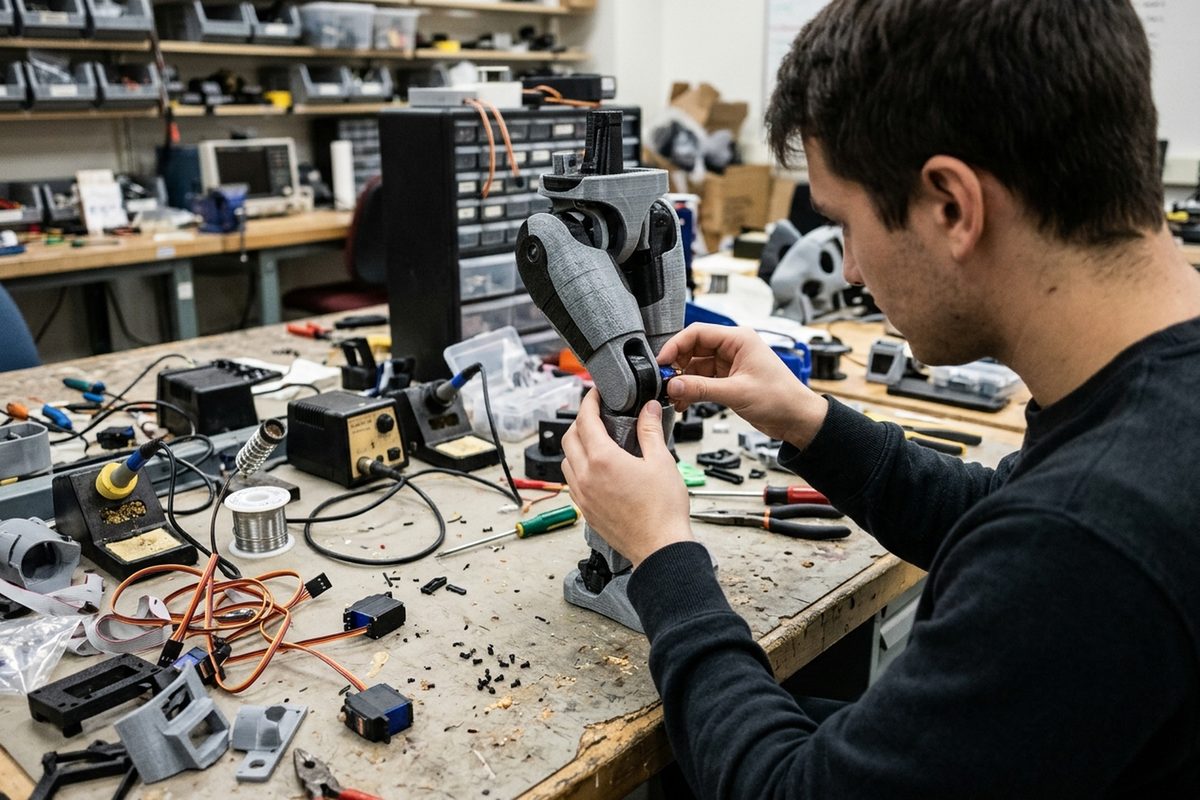
A jack-o'-lantern that dances was Google's Halloween treat, and the company says AI agents built the robot from scratch. The moves are in the video, below. The bolder part is who Google gives the credit to.
"No trick," Google wrote on X on Saturday. The post credits its Google DeepMind team and AI agents running on Gemini 4 Argon, the company's flagship reasoning model. It also credits Antigravity, Google's platform for coding agents. Under the costume sits a serious pitch: agents that don't just write an app but make a physical machine.
The bigger claim came from Aaron Saunders, who posted on X as part of the DeepMind team. In that post, which Google shared and Digg collected, he wrote that they "built a physical, dancing 12 degrees of freedom robot directly from a single plain-English prompt, with no manual CAD required!" He said the agents designed and simulated the pumpkin before it came to life.
Twelve isn't a toy number. It's the same count Google's own Oct. 13 developer blog post gives for the legs of Boston Dynamics' four-legged Spot robot.
The posts skip the middle, though. As Digg noted, Saunders never says how the team got from one typed request to a dancing pumpkin. That leaves the one-prompt robot as the team's claim, with the workshop part off camera.
It does fit a case Google has been making for weeks. In that Oct. 13 post, the company said Argon scored 87% on ERQA, a test of physical and spatial reasoning, beating every other frontier model. It also showed Argon turning a photo of a pen-and-paper sketch into a physics simulation of a humanoid robot throwing a ball. The post framed the model as progress toward physical AGI.
Getting your hands on the same tools isn't free. Google's blog says Argon inside Antigravity is for Google AI Ultra subscribers. Google's API pricing page says the model isn't on the free tier at all, and every token gets billed, thinking tokens included.
Right now, according to that Google price list, developers pay $2 per million input tokens and $10 per million output tokens. Those rates hold through Nov. 30.
Google promised no trick. The pricier part lands Dec. 1, when Google's pricing page doubles the model's rates. Input goes to $4 per million tokens, and output goes to $20 per million.
Source: X, retrieved November 1, 2026. Other sources: ai.google.dev, digg.com, developers.googleblog.com, ai.google.dev (2).
Comments 0