 ™
™Frank Lloyd Wright Built Six Houses in Los Angeles. Ranked by Whether You Can Actually Get Inside.
One is a ticketed World Heritage Site. One legally owes you 12 days a year and is closed anyway. The other four are private homes you will only ever see from the sidewalk — if you can see them at all. We ranked the access, not the architecture.
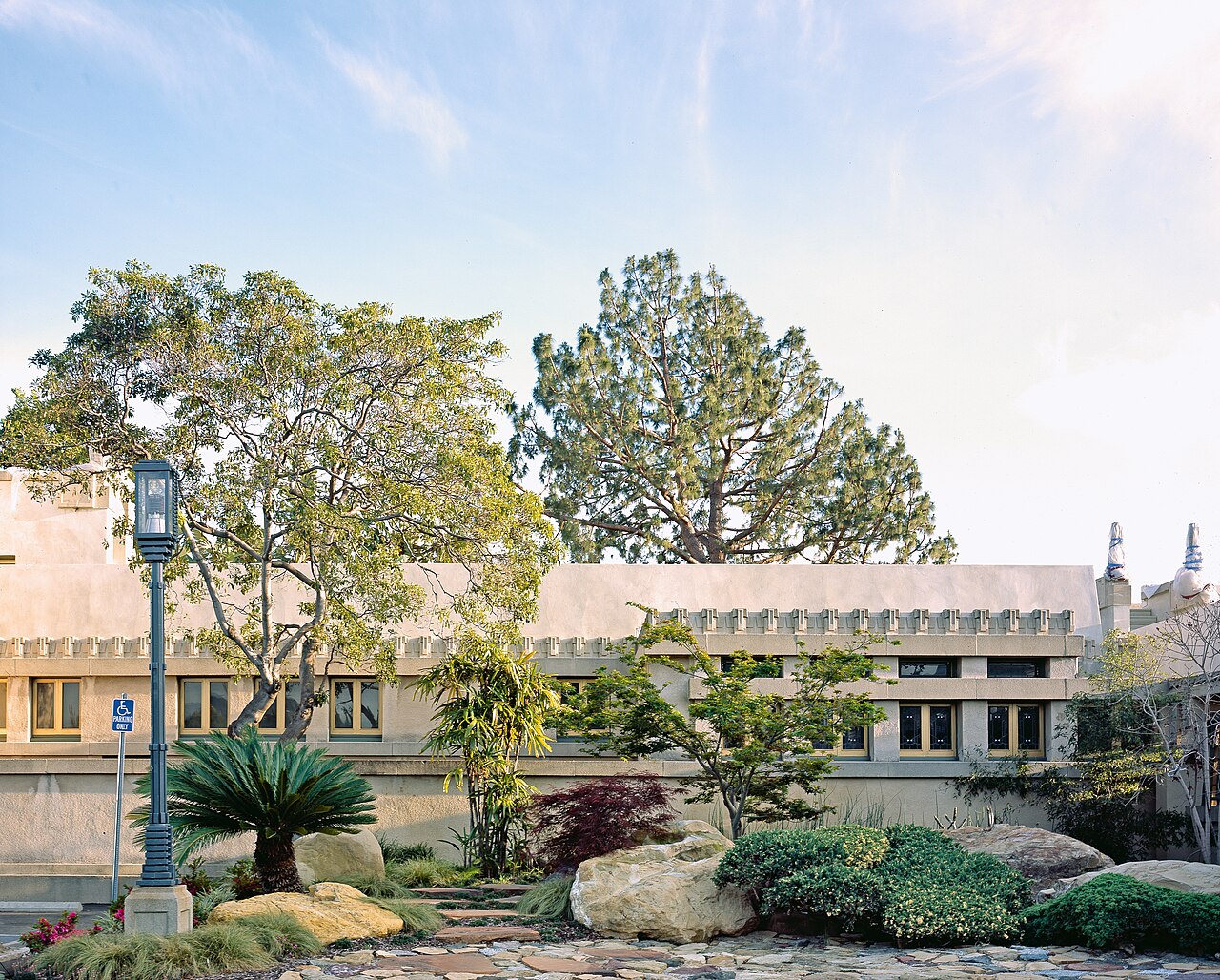
Every guidebook prints the same six names — Hollyhock, Ennis, Storer, Freeman, Millard, Sturges — and every guidebook implies you can go look at them. You cannot, mostly. Frank Lloyd Wright designed six houses in and around Los Angeles between 1919 and 1939, and in 2026 exactly one of them will let a member of the public buy a ticket and walk through the front door. The rest are private homes, closed restorations, or — in one celebrated case — a masterpiece sunk so deep into its own ravine that you can stand on the street and see essentially nothing. So we set the architecture aside, because the architecture isn't the argument. The argument is access, and we ranked all six on it. Number one is not close.
1. Hollyhock House — the only door that opens
This is the entire top of the list and it deserves to be. Hollyhock House was Wright's first Los Angeles commission, built between 1919 and 1921 for the oil heiress and theater producer Aline Barnsdall, who handed it and the surrounding parkland to the city in 1927, per the Los Angeles Department of Cultural Affairs. It is city-owned, it is a museum, and in 2019 it became the first work of modern architecture in the United States inscribed on the UNESCO World Heritage List, honored as part of a group of Wright buildings designated together, again per the city.
The practical part, which is the only part that separates it from the other five: it is open Thursday through Saturday, 11 a.m. to 4 p.m., last entry 3:30, and a self-guided ticket runs $12 for adults, $6 for seniors and students, and free for anyone under 18 with a paying adult, per the house's own visitor page. Guided tours run Fridays and Saturdays. That is a World Heritage Site for the price of two coffees, on Hollywood Boulevard, with parking in the same park. If you have been meaning to see a Frank Lloyd Wright building in this city, this is not the best one you can see — it is the only one.
2. Ennis House — the icon that legally owes you, and stiffs you anyway
Ennis is the one on the postcards and in the movies: the last and largest of Wright's four Los Angeles textile-block houses, its hillside in Los Feliz stacked out of more than 27,000 hand-cast concrete blocks in a Mayan-Revival key pattern, and it has turned up in more than 80 productions, from Blade Runner to Mulholland Drive, per the Frank Lloyd Wright Foundation. It is a designated Los Angeles Historic-Cultural Monument on the National Register. It ranks second here for a reason none of that explains.
When billionaire Ron Burkle bought the house in 2011 for roughly $4.5 million — down from a $15 million ask — the purchase came with a string attached. "As part of his purchase agreement, Burkle is obliged to offer some form of public access to the building a minimum of 12 days per year," CBS Los Angeles reported, adding that "the requirement applies to future owners of the home as well," per CBS Los Angeles. Twelve days a year is a covenant no other private house on this list carries. It is also, as of September 7, 2026, an IOU: the Frank Lloyd Wright Foundation lists Ennis as privately owned and "currently closed to the public" for restoration. We rank it second not because you can get in — you can't — but because it is the only closed house that is legally supposed to let you.
3. Freeman House — held in trust, and holding still
The Samuel and Harriet Freeman House, a textile-block house completed in 1925, spent 36 years as close to a public institution as a private residence gets. Harriet Freeman left it to USC's School of Architecture in 1986, per the Los Angeles Conservancy, which is why it ranks above two houses that are architecturally its equal: for three and a half decades it belonged to a university that held it for study and preservation rather than to an owner who held it to live in.
That tenure ended badly and then hopefully. The 1994 Northridge earthquake did serious damage; by 2000 the house was deemed uninhabitable, and USC eventually sold it into private hands in February 2022, per the Conservancy, which now holds a conservation easement on the property. The new owner brought a rehabilitation plan to the city's Cultural Heritage Commission in September 2022. So the door is shut, but it is shut for repairs, with a preservation easement written into the deed and a conservancy watching the work — which is more of a future than most of what's below.
4. Storer House — the one with the famous afterlife
The Storer House, a 1923 textile-block house in the Hollywood Hills built for the homeopathic physician John Storer, is a private residence you cannot tour. It ranks fourth on a technicality that is really a compliment: of the houses you can't get into, it is the one whose care is best documented. The film producer Joel Silver bought it in 1984 and ran an award-winning restoration supervised by Wright's grandson, Eric Lloyd Wright, before selling in 2002 — and Silver liked the textile block so much he adapted one of its motifs into the logo for Silver Pictures, per the house's National Register history. It was placed on the National Register in 1971 and named a Los Angeles Historic-Cultural Monument in 1972. None of that gets you inside. It does mean the house has spent its private life being conspicuously well kept, which counts for something when the alternative is a ravine.
5. Millard House (La Miniatura) — the beloved one you literally cannot see
Here is the pick we expect the mail on. La Miniatura is, for a lot of people, the most cherished house on this list: Wright's first textile-block house, built in 1923 for the rare-book dealer Alice Millard, the one Wright himself nicknamed and doted on and later said "belonged to the ground on which it stood," per its National Register listing. Ranking it fifth will read as heresy to anyone who has spent time with the drawings. We're doing it anyway, and on a checkable ground: importance is not access, and La Miniatura offers the public less to see than anything else here.
Wright built it into the side of an existing ravine in Pasadena, a siting decision that produced one of his most poetic houses and, incidentally, one of his most invisible ones — screened by its own trees, set below the grade of a quiet residential crescent, on a lot that has recently traded privately in the $4.5 million range. There is no museum, no covenant, no docent, no vantage. The Storer House at least advertises its own maintenance; La Miniatura, for the person standing on the public street, is mostly a rumor of a roofline through the foliage. It is a better building than its rank and a worse visit than its reputation, and both of those can be true.
6. Sturges House — the outlier, cantilevered out of reach
The George Sturges House is the odd one out twice over: it is the only house on this list that isn't from the 1920s, and the only one Wright built here in the style he called Usonian. Completed in 1939 in the Brentwood Heights hills, its board-and-brick box cantilevers off the slope on a roughly 21-foot deck — "the only structure in Southern California built in the modern style Wright called Usonian," per its Wikipedia entry, and a Los Angeles Historic-Cultural Monument since 1993. For years it belonged to the actor Jack Larson, television's original Jimmy Olsen.
It lands last because it offers the public the least and promises the least. When it went to auction in February 2016 with a $2.5-to-$3 million estimate, no qualified bidder even registered and the lot was withdrawn, per artnet News; it has changed hands privately since and remains a single-family home on a tucked-away Brentwood street. No ticket, no tour, no covenant, no institutional guardian, and a cantilever pointed at a canyon rather than a sidewalk. It is a wonderful house. It is also, for you, a photograph in a book.
What the ranking is really measuring
Six houses, one open door. Put plainly: Wright's Los Angeles is a public collection with a single public room. The good news is that the single room is a World Heritage Site you can enter on a Thursday, Friday or Saturday for twelve dollars. The rest are a lesson in how a masterpiece disappears into private life — sold, shuttered, restored, or swallowed by its own landscaping — and a reminder that the fastest way to see five of the six is to keep a very good architecture book on the shelf. If you want the real thing, the ranking collapses to one instruction: go to Barnsdall Art Park on a Thursday, Friday or Saturday, before the last entry at 3:30.
Ownership status, hours, ticket prices and public-access terms were checked on August 17, 2026, against each house's own pages and the sources linked above. The four private residences are homes, not attractions; we've named neighborhoods, not doorsteps, on purpose.
Comments 0