 ™
Five Landmark L.A. Murals, Ranked. The Most Famous One Comes Last.
Ranked by each wall's public record and whether you can stand in front of it at any hour, for free.
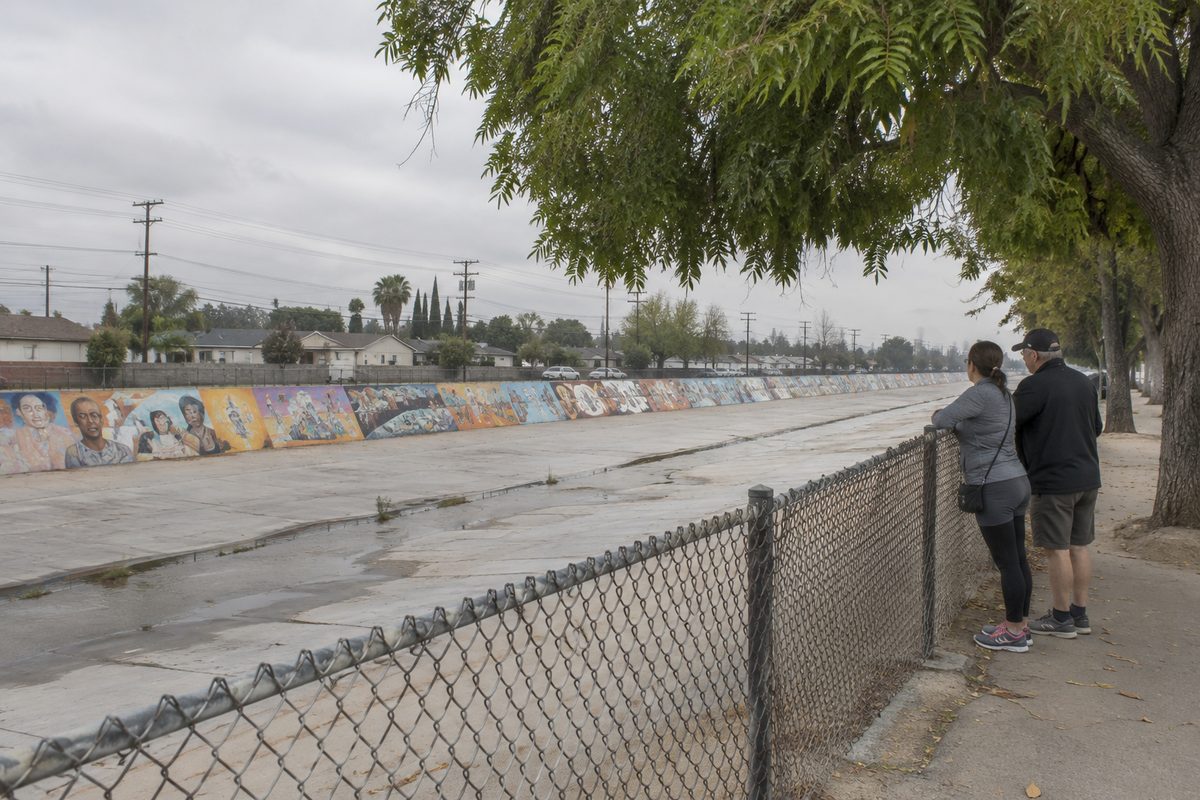
The most important mural in Los Angeles comes in last here, and I'd put it there again tomorrow. David Alfaro Siqueiros's "América Tropical" is the one landmark on this list whose city page posts hours.
The order comes from the record: each wall's entry in the Mural Conservancy of Los Angeles database or on a city page, its artist and year, and how much stands between you and the paint. All five are free to see. The four outdoor walls have no posted hours on the pages that describe them, and that's the edge each one holds over Olvera Street.
Two famous walls didn't make the cut. In 2013, PBS SoCal's list of monumental L.A. murals called the L.A. Fine Arts Squad's "Isle of California" "lost to the sun." Paul Botello's wall at Ruben F. Salazar Park in East L.A. stays off until there's a conservancy record to rank it on.
1. The Great Wall of Los Angeles, Valley Glen
Judy Baca's mural stretches 2,754 feet down the Tujunga Wash, painted on the channel's western concrete face from Oxnard Street up to Burbank Boulevard, L.A. City Planning says. The Army Corps of Engineers controlled the channel and hired Baca to paint it in 1974.
Young people ages 14 to 21 painted the first 1,000 feet in nine weeks in the summer of 1976. When the work wrapped up in 1984, some 400 young painters had joined 35 artists on the wall, the city says, and its historic resources office got it onto the National Register of Historic Places in 2017.
Getting there is a walk. PBS SoCal's walking route starts on the wash's east bank: get on the Tujunga Wash Greenway off Coldwater Canyon, just above Burbank Boulevard, walk upstream and look down into the channel on your left.
2. Pope of Broadway, downtown
Anthony Quinn dances across a 70-by-60-foot wall of the Victor Clothing Company building at 240 S. Broadway, in a pose the conservancy compares to his Zorba the Greek. Eloy Torrez painted it in 1985, with Bob Grigas assisting.
Behind Quinn, Torrez painted the Bradbury Building, which stands directly across the street, so it's the only mural here that comes with its own answer key. It's on a public sidewalk with no hours or gate on its record. It loses to the Great Wall on ambition, and that's all.
3. Gintong Kasaysayan, Gintong Pamana, Historic Filipinotown
Eliseo Art Silva's 1995 mural backs Unidad Park at 1660 Beverly Blvd. The conservancy says it covers four thousand years of Filipino and Filipino American history, with a huge bird carrying Filipino Americans on its wings and farmworkers along the bottom.
SPARC, the arts nonprofit that commissioned it, calls it the largest Filipino American mural in the country and the first memorial to Filipino American farmworkers. SPARC also says the wall kept coming up in the campaign that got the district named Historic Filipinotown in August 2002.
This is the placement I'm least sure about. SPARC's fundraising page said the mural had faded and was delaminating, and it doesn't say whether the restoration got finished. The two records don't agree on its size either: 140 by 20 feet for the conservancy, 145 by 30 for SPARC. Neither lists park hours. If it's been restored, it belongs at No. 2.
4. We Are Not a Minority, Estrada Courts
Che Guevara points out of a 32-by-24-foot wall at Estrada Courts on Olympic Boulevard. The conservancy dates it to 1978 and credits Mario Torero with a San Diego collective it lists as "El Congresso de Artistas Cósmicos de Las Américas de San Diego," artists who came out of the Chicano Park fight.
The title once said "you." Torero, as PBS SoCal quoted him, switched it to "we" to show the civil rights movement "is all encompassing."
It's fourth because what's up there now is a repaint. The conservancy paid Torero and Carmen Kalo to redo it in 1995, Ernesto de la Loza helped, and the work was finished in 1996. PBS SoCal reported in 2013 that Torero hoped to bring back the original composition.
5. América Tropical, Olvera Street
In 1932, Siqueiros got a commission for a picture-perfect tropical scene, up on a second-story outside wall. What he delivered, El Pueblo de Los Angeles says, was a jungle with an Indian peasant on a cross, an American eagle perched above him and revolutionary soldiers taking aim. PBS SoCal reported it was fully whitewashed by 1938 and rededicated in October 2012.
Here's the defended hot take: the city's founding street holds the most important mural in Los Angeles, and it's the hardest one on this list to see. Yes, it matters most. That's exactly why a schedule hurts here more than it would anywhere else.
El Pueblo's page lists the America Tropical Interpretive Center as open 10 a.m. to 3 p.m. Tuesday through Sunday, with free admission. Monday isn't on the schedule.
Source: themcla.org, retrieved November 25, 2026. Other sources: pbssocal.org, City of Los Angeles, pbssocal.org (2), themcla.org (2), sparcinla.org, themcla.org (3), City of Los Angeles (2).
Comments 0