 ™
™The AI Wedding Toast Has Arrived, and It Is Freaking People Out
A family member played a machine-made song about the bride instead of giving a speech. Twelve seconds of it were enough to show where AI is going next — into the rituals people thought were safe from it.
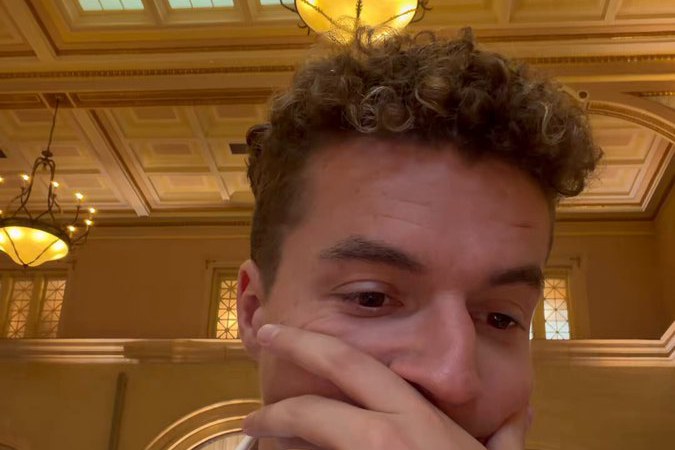
On Saturday night, an X user posting as coleman reis wrote that he was at a wedding where a member of the bride's family, rather than standing up and giving a speech, played a song about her generated with AI. The post carries a 12-second video and a two-line caption: "at a wedding right now and one of the family members made an AI song about the bride and played it instead of making a speech / the future is very very dark."
at a wedding right now and one of the family members made an AI song about the bride and played it instead of making a speech the future is very very dark
— coleman reis (@DJCassiusKing) August 9, 2026
The video opens on the poster himself: hand over his mouth, dress shirt, the coffered ceiling and chandeliers of a formal reception hall behind him — the look of a guest watching something he does not quite believe. That reaction, more than anything the camera shows of the room, is what carried the clip: 12 seconds of a face doing the arithmetic between what a toast is for and what was playing instead.
That is the whole of the reporting. The clip runs 12 seconds, it was posted early on 9 August 2026, and by the time the desk read it the post had drawn more than 15,000 likes. Who the family member was, what the song said, how the room reacted, whether the bride laughed or winced — none of that is in the post, and none of it is claimed here. The audio in the video cannot be reviewed server-side, so what follows rests on the caption and on the account's own account of what happened, credited to @DJCassiusKing.
A new place to put the machine
AI drafting work emails stopped being a story two years ago. What is still a story — what keeps producing clips like this one — is placement. People keep carrying the machine into rooms nobody expected it to enter: wedding vows, eulogies, graduation speeches, condolence notes, prayers at the family table, and now the toast. Each one is a small unannounced experiment in how much of a ritual can be outsourced before the ritual stops working. The technology in this video is not novel. The venue is. Someone walked a text-to-song model into the one room in American life still reserved for saying a hard thing out loud to someone you love, and handed it the microphone.
And the room flinched — that is the other half of the phenomenon, and it is the half that travels. The reaction to the clip is not confusion about what AI can do; everyone knows it can write a song. It is the jolt of recognition from people who have, in the last year or two, received something they suspect was machine-written: a birthday message with suspiciously even rhythm, a condolence note that used the word "journey," a toast-shaped paragraph with no toast inside it. The wedding clip gives that suspicion a shape, a soundtrack and a room to stand in — which is why the caption's five words about the future landed harder than the song did.
The desk's view, offered as commentary and not as reporting: the objection is not that the song was bad. It may well have been catchy. The objection is that a toast is not an output. Its value is almost entirely in the cost of making it — the hours of remembering, the drafts, the visible nerves, the fact that a person who is not a writer sat down and tried to be one for four minutes because someone they love was getting married. Strip the labor out and you have kept the artifact and thrown away the gift.
This is the specific thing AI does to social ritual, and it is different from what it does to work. At a job, effort is a cost to be minimized; that is what tools are for. At a wedding, effort is the message. The speech says: you are worth the discomfort of public speaking. A generated song says something else, and everyone in the room can hear which one it is, even when nobody says so.
The part worth watching
What makes the post land is the last line — "the future is very very dark" — which is doing more work than a joke usually does. It reads less like a prediction about technology than a prediction about permission. Once one relative does this at one reception and it goes fine, the bar for the next one moves. Speeches get shorter. Then optional. Then generated, because that is what everyone is doing now and nobody wanted to be the person who read a machine's words aloud first.
None of that has happened. One person did one thing at one wedding, and the internet watched 12 seconds of it. But the flinch that followed was not about that reception — it was thousands of people simultaneously checking where else the machine had quietly been seated, and realizing the answer is: closer than last year. The story is not that the future arrived at a wedding. It is that everyone recognized it immediately.
Comments 0